Is Composite Material for Decking Worth the Investment? Complete Guide
Discover if composite material for decking is right for your home. Compare costs, top brands, joist requirements, and long-term ROI in this complete guide.

The Evolution of Composite Decking
Composite material for decking has transitioned from a niche, low-maintenance alternative to the dominant choice for premium residential outdoor spaces. Early generation composites (pre-2010) were prone to fading, staining, and structural sagging due to their uniform wood-plastic mixture. Today, the industry standard relies on advanced co-extrusion technology, wrapping a recycled high-density polyethylene (HDPE) or wood-fiber core in a highly durable polymer capstock. This complete guide breaks down the structural requirements, material science, and real-world costs of specifying composite decking for your next build.
Quick Cost Snapshot (Material Only)
- Entry-Level Scalloped Composite: $6.50 – $8.50 per sq. ft.
- Mid-Tier Solid Composite: $9.00 – $11.50 per sq. ft.
- Premium Heat-Mitigating Composite: $12.00 – $15.00 per sq. ft.
- Hidden Fastener Systems: $1.10 – $1.60 per sq. ft.
Note: Framing, labor, and substructure add an additional $15 to $25 per sq. ft. to the total project cost.
Capstock Chemistry: The Critical Distinction
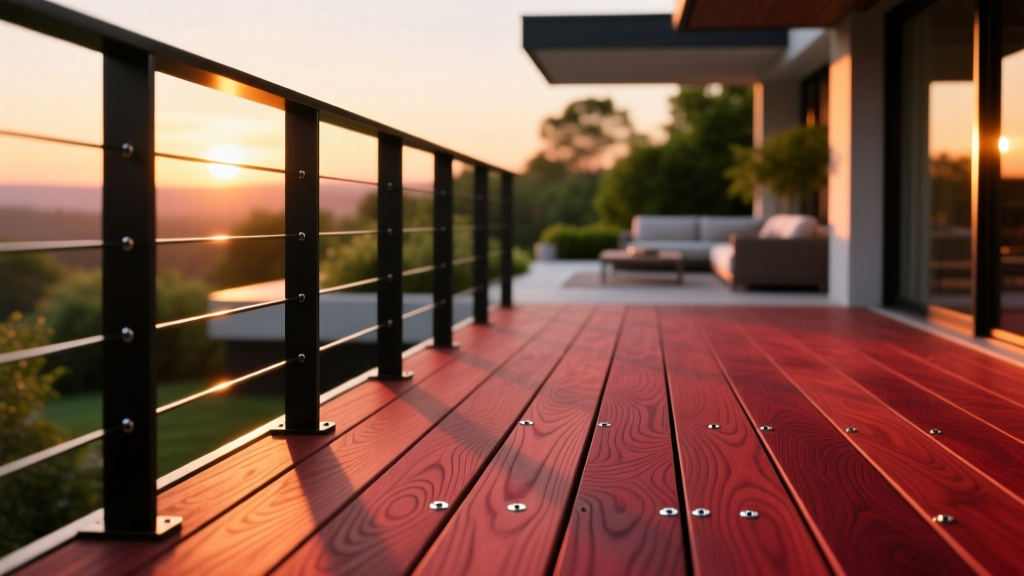
When evaluating composite material for decking, the core provides the structural rigidity, but the capstock dictates the board's lifespan and aesthetic retention. You must specify fully capped boards (wrapped on all four sides or three sides with a protective polymer shell).
Capped Composite vs. Advanced PVC
Standard capped composites utilize a wood-plastic core wrapped in an Acrylonitrile Styrene Acrylate (ASA) or Polyethylene (PE) shell. This offers excellent UV resistance and a natural wood-grain feel. Advanced PVC decking (such as TimberTech's PVC lines) uses a 100% synthetic cellular core. While PVC is technically not "composite" in the traditional wood-blend sense, it is frequently cross-shopped. PVC offers superior scratch resistance and is lighter, making it ideal for curved deck applications, but it lacks the acoustic dampening and heavy, premium underfoot feel of a dense HDPE composite core.
Structural Requirements: Joist Spacing and Framing
Composite boards are heavier and more flexible than pressure-treated pine. Relying on standard 16-inch on-center (OC) framing for all composite profiles is a common failure point that leads to noticeable sagging over time. Always consult the American Wood Council's DCA 6 guide for baseline structural requirements, but adhere strictly to the composite manufacturer's span tables.
| Board Profile | Max Span (Perpendicular) | Max Span (45° Diagonal) | Avg. Weight / Linear Ft. |
|---|---|---|---|
| Solid Bottom (Premium) | 16" OC | 12" OC | ~2.8 lbs |
| Scalloped Bottom (Mid-Tier) | 16" OC | 12" OC | ~1.9 lbs |
| Solid PVC (Lightweight) | 16" OC | 12" OC | ~1.5 lbs |
Top Composite Material for Decking Brands Compared
The market is dominated by three primary manufacturers, each with distinct product tiers. Selecting the right line depends on your budget, climate, and performance priorities.
Trex: Transcend Lineage vs. Enhance Naturals
Trex remains the market leader. Their premium Transcend Lineage features advanced heat-mitigating technology that reflects solar energy, keeping the deck surface up to 20°F cooler than standard dark composites—a critical feature for south-facing decks in high-sun climates. The entry-level Enhance Naturals line utilizes a scalloped bottom to reduce material costs and weight, making it easier to install, though it lacks the stiffness and acoustic solidity of the premium tiers.
TimberTech: Pro vs. Advanced PVC
TimberTech (by AZEK) excels in realistic wood-grain texturing and scratch resistance. Their Pro line is a capped composite known for exceptional impact resistance, ideal for homes with large dogs or heavy patio furniture. For maximum moisture resistance (e.g., docks or heavily shaded, damp environments), their Advanced PVC lines are impervious to water absorption and mold.
Fiberon: Concordia vs. Promenade
Fiberon offers highly competitive pricing and excellent color consistency. The Concordia line provides a four-sided cap with a rich, multi-tonal aesthetic at a mid-tier price point. Their Promenade PVC line is one of the lightest on the market, significantly reducing shipping costs and installer fatigue on large commercial or multi-level residential projects.
Hidden Failure Modes: Thermal Expansion and Static
Composite materials behave differently than natural wood. Ignoring these physical properties during installation will void your warranty and ruin the deck.
- Longitudinal Thermal Expansion: Composites expand and contract primarily along their length. A 20-foot composite board can expand up to 1/4 inch in extreme temperature swings. According to Trex official installation guidelines, you must leave a 3/16-inch gap between board ends when installing at 50°F. Failing to do so will cause the boards to buckle or push against the house ledger.
- Static Electricity Buildup: In dry, arid climates, the polymer capstock can generate significant static charge, resulting in painful shocks when touching metal railings. Mitigate this by applying commercial anti-static sprays during the first season, or by grounding the metal railing system directly to the earth.
- Heat Retention on Dark Colors: Deep browns and charcoals absorb heat. Barefoot traffic on dark composite in direct 90°F+ sunlight can cause burns. Specify "cool" color technology or lighter shades like coastal grey or sea salt for unshaded, south-facing applications.
Fastening Systems: Hidden Clips vs. Face Screws
The method you use to secure composite material for decking drastically impacts both the final aesthetic and labor costs.
Hidden Fasteners (Grooved Edges): Most modern composite boards come with pre-routed grooves. Stainless steel or polymer clips (like TigerClaw or Trex Hideaway) lock into the grooves and screw into the joists. This provides a clean, screw-free surface. Cost impact: Adds ~$1.25/sq. ft. in hardware but reduces labor time by 20%.
Face-Screwing (Square Edges): If using square-edge boards for picture-framing or fascia, you cannot use standard wood screws; they will cause the composite to "mushroom" and crater. You must pre-drill every hole, drive a specialized composite screw, and hammer in a color-matched composite plug. Cost impact: Adds ~$1.80/sq. ft. in plugs/screws and increases face-fastening labor time by up to 40%.
ROI and Long-Term Maintenance Realities
While the upfront material cost for composite is 2.5x to 3x higher than pressure-treated lumber, the lifecycle cost tells a different story. Pressure-treated pine requires annual cleaning, bi-annual sanding, and staining every 2-3 years, costing roughly $400 to $800 annually in materials and weekend labor. Composite requires only occasional sweeping and an annual wash with a mild, non-abrasive soap.
"According to Remodeling Magazine's Cost vs. Value Report, adding a composite deck recoups approximately 50% to 60% of its cost at resale. However, the true financial benefit lies in the elimination of 15+ years of wood staining and the strong buyer appeal of a guaranteed zero-maintenance outdoor space."
Frequently Asked Questions
Can I install composite decking over an existing wood frame?
Yes, but only if the existing frame is structurally sound, properly flashed, and meets the 12-inch or 16-inch on-center joist spacing requirements for the specific composite profile you choose. You must replace any rotted joists and apply fresh butyl joist tape before laying the new composite boards.
Does composite decking fade over time?
Modern capped composites are manufactured with UV-inhibitors integrated directly into the polymer shell. While you may see a very slight, uniform lightening (less than 5%) during the first 6 months of UV exposure as the outer manufacturing residue wears off, high-quality capped boards will not chalk, streak, or fade significantly over their 25-year warranted lifespan.
Is composite material for decking slippery when wet?
Early generations were notoriously slick. Today, manufacturers use deep, multi-directional micro-texturing in the capstock to provide slip resistance that meets or exceeds the ADA (Americans with Disabilities Act) coefficient of friction requirements for flat surfaces, even when wet. Look for boards with a pronounced wire-brushed or embossed wood-grain texture for poolside applications.
Written by
Sarah WhitfieldSarah Whitfield is a chartered quantity surveyor (MRICS) and construction cost analyst with 15 years of experience in material pricing, procurement strategy, and project budgeting. She earned her degree in Construction Management from the University of Reading (UK) and has worked on projects ranging from $2M custom homes to $180M mixed-use developments across North America and Europe. Sarah currently leads cost estimating for BuildMat Insight, maintaining a proprietary database of 4,000+ material price points updated quarterly. She is a frequent contributor to RSMeans cost data panels and has presented at the International Cost Engineering Council (ICEC) congress. Based in Denver, CO, Sarah is an avid trail runner and volunteer mentor for Women in Construction.
More from Sarah Whitfield
View all
Wood & Lumber
What Are the Different Types of Wood? A Builder's Guide
Compare structural softwoods, finish hardwoods, and engineered lumber. Analyze Janka ratings, MOE values, and 2026 pricing for construction.
Aug 4, 2026

Walls & Panels
Steel Framing vs Wood Framing: Corrosion and Moisture Defense
Compare steel framing vs wood framing for moisture resistance. Learn about galvanized coatings, condensation risks, and corrosion protection strategies.
Jul 21, 2026

Stone & Masonry
How to Cut Stone Veneer: Wet Saw vs Grinder Comparison
Compare the best tools for cutting stone veneer. We review wet saws, angle grinders, and chop saws to help you achieve clean, chip-free cuts.
Jul 21, 2026