Trex Decking Colors: Heat & Fade Performance Specs (2026)
Analyze Trex decking colors by thermal retention, UV fade resistance, and slip ratings. Technical specs for Transcend, Select, and Enhance lines.
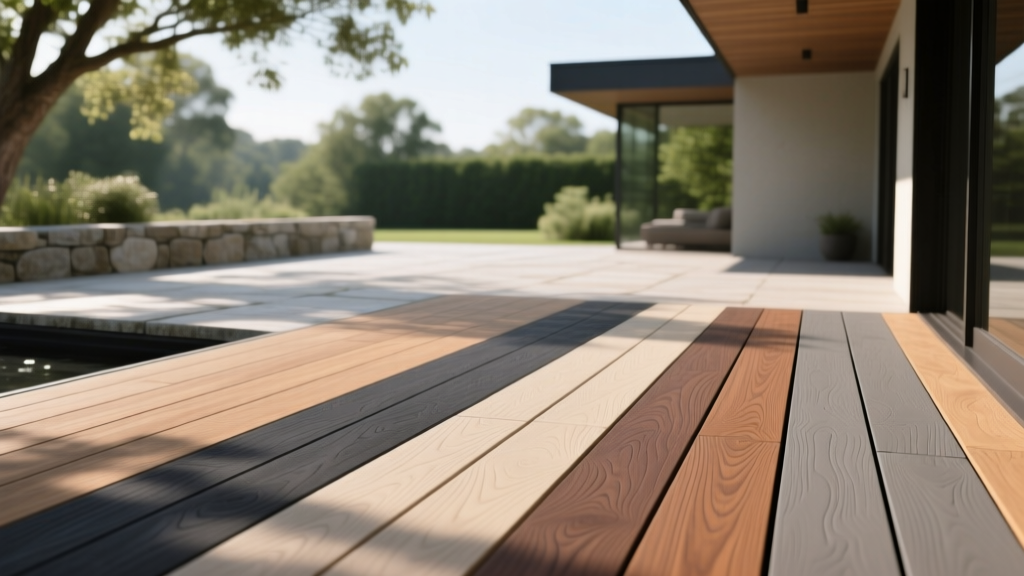
The Physics of Composite Color: Thermal Absorption vs. Reflectance
When selecting trex decking colors, homeowners typically focus on aesthetic harmony with their home's exterior. However, from a building science perspective, color dictates the thermal mass, solar reflectance, and long-term ultraviolet (UV) degradation rate of the capped polymer composite. Trex manufactures its boards using a proprietary blend of reclaimed polyethylene film and wood fibers, encased in a co-extruded polymer shell. The specific pigments used in this shell—ranging from high-reflectance titanium dioxide in lighter shades to high-absorption iron oxides in darker shades—directly influence the board's surface temperature under direct solar radiation.
The EPA's Solar Reflectance Index (SRI) guidelines demonstrate that darker surfaces can reach temperatures significantly higher than ambient air. In composite decking, this thermal delta is critical for barefoot comfort and material expansion. A darker Trex board will absorb more infrared radiation, leading to higher surface temperatures and slightly greater thermal expansion coefficients compared to lighter shades, which must be accounted for during the framing and gapping phase of installation.
Trex composite decking expands and contracts at a rate of approximately 1/32 inch per 12-foot board for every 40°F temperature change. Because darker colors like Lava Rock absorb more heat, they experience a wider operational temperature swing than lighter colors like Island Mist. Installers must strictly adhere to the 1/4-inch end-gap specification for dark-colored boards installed in high-sun, high-temperature environments to prevent buckling.
Trex Color Thermal Performance Matrix
The following matrix categorizes current Trex decking colors by their thermal retention profiles. Surface temperature deltas are estimated based on direct midday sun exposure at 85°F ambient temperature. These metrics are vital for specifying materials in high-heat climates or around pool decks where barefoot contact is expected.
| Trex Color | Product Line | Relative SRI Proxy | Est. Temp Delta (+°F over Ambient) | Barefoot Comfort Rating |
|---|---|---|---|---|
| Island Mist | Transcend | High | +20°F to +25°F | Excellent |
| Winchester Grey | Select | Medium-High | +28°F to +33°F | Good |
| Gravel Path | Transcend | Medium | +35°F to +40°F | Moderate |
| Toasted Sand | Enhance Naturals | Medium-Low | +42°F to +48°F | Poor (Midday) |
| Tiki Torch | Transcend | Low | +50°F to +55°F | Poor |
| Spiced Rum | Transcend | Very Low | +55°F to +62°F | Unusable Barefoot |
| Lava Rock | Transcend | Very Low | +58°F to +65°F | Unusable Barefoot |
UV Fade Resistance and Capped Polymer Specifications
Fade resistance in composite decking is not determined by the core material, but by the thickness and chemical composition of the protective polymer cap. Trex utilizes advanced UV-inhibitor packages within the capstock to prevent the breakdown of color pigments. According to Trex Limited Warranty Documentation, the performance thresholds vary significantly across their three primary product tiers.
Trex Transcend: The 50-Year Polymer Shell
Trex Transcend features the thickest co-extruded polymer shell in the lineup, backed by a 50-year limited fade and stain warranty. In accelerated weathering tests utilizing ASTM G154 (fluorescent UV exposure) and ASTM G155 (xenon arc exposure) standards, Transcend boards demonstrate a Delta E (ΔE) color shift of less than 2.5 over the equivalent of 25 years of solar exposure. A ΔE below 3.0 is generally imperceptible to the human eye, meaning colors like Spiced Rum and Island Mist retain their original hue profile without the chalky oxidation seen in first-generation uncapped composites.
Trex Enhance & Select: 25-Year UV Thresholds
Trex Enhance (Basics and Naturals) and Trex Select utilize a slightly thinner polymer cap and a scalloped bottom profile (Enhance) to reduce material weight and cost. These lines carry a 25-year fade warranty. While they utilize the same base UV inhibitors as Transcend, the reduced cap thickness means that in extreme high-UV environments (such as high-altitude installations above 6,000 feet or unshaded southern exposures in the Sunbelt), a measurable ΔE shift of 3.0 to 4.5 may occur between years 20 and 25. For these specific microclimates, specifying the Transcend line is structurally recommended.
Slip Resistance and Surface Embossing Variables
Color itself does not alter the coefficient of friction; however, the manufacturing embossing rollers used for different color runs can result in microscopic variations in surface texture depth. Trex boards are tested to meet or exceed the Americans with Disabilities Act (ADA) guidelines for slip resistance. The North American Deck and Railing Association (NADRA) emphasizes that wet composite decking requires specific surface topography to maintain safe traction.
- Dry Dynamic Coefficient of Friction (DCOF): Across all Trex colors, the dry DCOF typically measures between 0.55 and 0.65, well above the ANSI A326.3 safety threshold of 0.42.
- Wet DCOF Variance: When wet, the DCOF drops. Lighter colors like Island Mist and Winchester Grey, which feature a more pronounced, high-contrast woodgrain embossing to mimic painted or weathered wood, often yield a slightly higher wet DCOF (approx. 0.48) compared to the smoother, dense-grain embossing used on Lava Rock (approx. 0.44).
- Micro-Texturing: All Transcend colors feature a multi-dimensional wire-brushed surface texture that creates micro-channels for water displacement, reducing hydroplaning under bare feet.
Climate-Specific Color Selection Framework
Selecting the right Trex color requires balancing aesthetic intent with environmental physics. Use this decision framework to finalize your material specification:
If Installing in High-Heat / Sunbelt Climates (AZ, TX, FL):
Recommendation: Restrict selection to Island Mist, Winchester Grey, or Gravel Path. Darker colors will exceed 140°F on the surface during summer peaks, risking thermal expansion issues and making the deck unusable without footwear. Ensure framing joists are spaced at 12 inches on-center (OC) rather than 16 inches OC to minimize deflection under high thermal loads.
If Installing in High-Altitude / High-UV Zones (CO, UT, MT):
Recommendation: You must specify Trex Transcend. The intense UV radiation at altitudes above 5,000 feet will degrade the thinner caps of the Enhance and Select lines prematurely. Color choice can be darker (e.g., Tiki Torch) as ambient temperatures remain lower, mitigating the heat absorption risk.
If Installing Around Pool Decks (Constant Moisture & Bare Feet):
Recommendation: Choose Island Mist or Gravel Path. These colors offer the optimal intersection of high solar reflectance (keeping the surface cool for bare feet) and deep embossing textures that maintain a safe wet DCOF when splashed with pool water.
Technical Specifications FAQ
Does the color of Trex decking affect its structural load capacity?
No. The pigments are isolated to the outer polymer cap. The structural core—composed of a high-density polyethylene (HDPE) and wood fiber matrix—remains identical across all colors within the same product line (e.g., all Transcend boards share the same moment of inertia and span ratings, regardless of whether they are Lava Rock or Island Mist).
Can I mix different Trex colors on the same deck without causing uneven expansion?
Yes, provided you are mixing colors within the same product line (e.g., using Transcend Island Mist for the main field and Transcend Lava Rock for the picture-frame border). Because the core material and board dimensions are identical, the structural expansion rates are uniform. However, the dark border will feel significantly hotter to the touch than the lighter field boards under direct sunlight.
How does Trex color performance compare to PVC decking?
Trex (a capped wood-plastic composite) inherently absorbs slightly more heat than pure cellular PVC decking of the exact same color due to the wood flour content in the core, which has a higher specific heat capacity than PVC foam. If absolute minimum heat retention is the primary engineering requirement over all other factors, a light-colored cellular PVC board will outperform light-colored Trex by a surface temperature margin of approximately 5°F to 8°F.