Agricultural Fencing Specs: Tensile Strength & Gauge Guide 2026
Compare agricultural fencing performance ratings, wire gauge specs, and ASTM coating standards to build high-tensile perimeters that last decades.
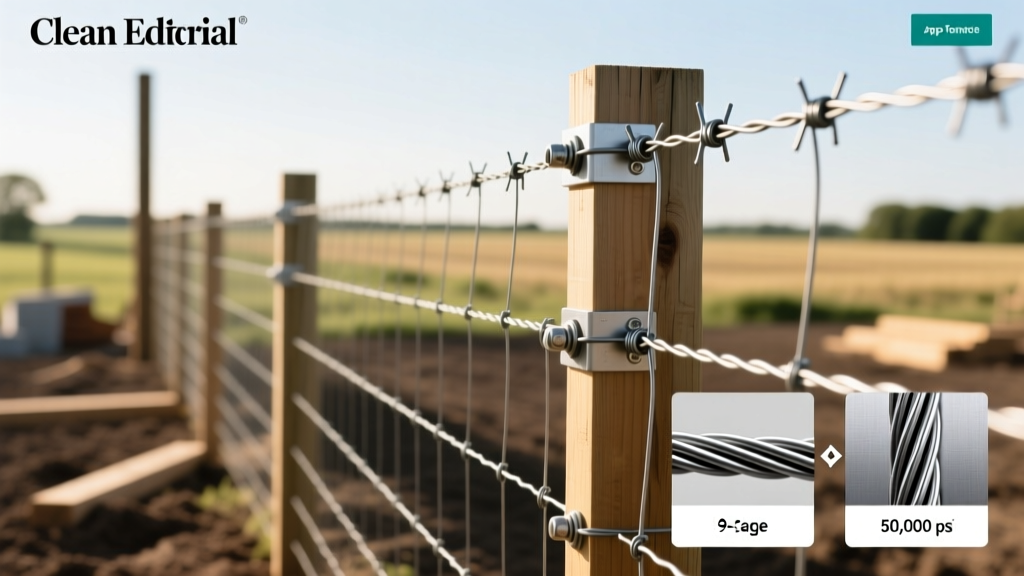
The Physics of Perimeter Containment: Wire Metallurgy
The structural integrity of any agricultural perimeter relies entirely on the metallurgical properties of the line wire. Modern agricultural fencing is bifurcated into two primary metallurgical categories: low-carbon (mild) steel and high-tensile steel. Understanding the carbon content and cold-drawing process is critical for predicting fence behavior under livestock impact and environmental loading.
Low-carbon wire typically contains between 0.08% and 0.12% carbon. This low carbon matrix yields a highly ductile wire that can absorb blunt impacts (such as a cow leaning against it) by stretching and deforming. However, this ductility is also its primary failure mode; low-carbon wire suffers from permanent "creep" and will not return to its original tension, requiring frequent re-stretching.
Conversely, high-tensile agricultural fencing utilizes steel with a carbon content ranging from 0.28% to 0.80%. During manufacturing, the wire is cold-drawn through tungsten carbide dies, which aligns the steel's grain structure and drastically increases its yield strength. According to technical specifications from Bekaert Fencing, high-tensile wire can withstand a minimum tensile strength of 170,000 PSI, compared to just 65,000 PSI for standard low-carbon wire. This allows high-tensile wire to act like a heavy-duty rubber band, absorbing impact and snapping back to its original tension without permanent deformation.
Decoding Wire Gauge and Breaking Strength Matrices
Wire gauge in agricultural fencing follows the American Wire Gauge (AWG) standard, where a lower number indicates a thicker wire. However, gauge alone is an incomplete metric; a 12.5-gauge high-tensile wire is exponentially stronger than a 12.5-gauge low-carbon wire. Below is the performance matrix for the most common agricultural line wires used in 2026.
| AWG Gauge | Diameter (Inches) | Metallurgical Class | Minimum Tensile Strength (PSI) | Approx. Breaking Strength (lbs) |
|---|---|---|---|---|
| 12.5 | 0.099" | High-Tensile | 170,000 - 200,000 | 1,550 |
| 14.0 | 0.080" | High-Tensile | 170,000 - 200,000 | 1,000 |
| 15.5 | 0.067" | High-Tensile | 170,000 - 200,000 | 700 |
| 12.5 | 0.099" | Low-Carbon (Mild) | 60,000 - 70,000 | 750 |
| 14.0 | 0.080" | Low-Carbon (Mild) | 60,000 - 70,000 | 480 |
For large livestock (cattle, horses), 12.5-gauge high-tensile is the industry baseline. For sheep, goats, or predator exclusion, 14-gauge or 15.5-gauge high-tensile is often utilized in woven wire configurations to reduce overall weight and material cost while maintaining sufficient tensile memory.
Coating Specifications and Corrosion Resistance (ASTM Standards)
The lifespan of agricultural fencing is dictated not by the steel core, but by the sacrificial coating. The Food and Agriculture Organization (FAO) notes that uncoated steel wire will fail in high-moisture environments within 3 to 5 years. To ensure longevity, specify coatings that adhere to strict ASTM manufacturing standards.
Galvanization Classes (ASTM A641)
Zinc galvanization protects the steel core via cathodic protection; the zinc corrodes preferentially to the steel. Under ASTM A641, zinc coatings for agricultural wire are categorized into three classes based on the weight of the zinc applied:
- Class 1: Minimum 0.28 oz/ft² (85 g/m²). Suitable for dry, arid climates. Expected lifespan: 10-15 years.
- Class 2: Minimum 0.47 oz/ft² (140 g/m²). The standard commercial grade. Expected lifespan: 15-20 years.
- Class 3: Minimum 0.80 oz/ft² (240 g/m²). Required for coastal, high-humidity, or high-acid soil environments. Expected lifespan: 25-40 years.
Zinc-Aluminum Alloys (ASTM A854)
For maximum performance, specify Zinc-Aluminum (often branded as Zinal or Bezinal) coatings per ASTM A854. This alloy consists of 95% zinc and 5% aluminum. The aluminum provides a dense physical barrier against moisture, while the zinc provides the necessary sacrificial anode protection at cut ends and scratches. Zinc-Aluminum coated wires demonstrate up to 300% greater corrosion resistance than standard Class 3 galvanized wire in salt-spray testing.
Structural Load Ratings: Post Spacing and H-Brace Engineering
High-tensile wire exerts massive continuous lateral loads on corner and end posts. A standard 5-wire high-tensile fence tensioned to 150 lbs per wire generates 750 lbs of continuous horizontal pull on the corner assembly. Standard driven T-posts cannot withstand this load; engineered wooden H-brace assemblies are mandatory.
The 2/3 Geometry Rule: The horizontal brace post must be installed at exactly 2/3 the height of the top wire. The diagonal brace must push from the bottom of the corner post (ground level) up to the intersection of the horizontal brace and the corner post. This transfers the horizontal tension vector directly into the soil as downward compressive force, preventing the corner post from leaning.
Thermal Contraction and Tension Springs
Steel expands and contracts with temperature fluctuations. The coefficient of thermal expansion for steel wire dictates that a 1,320-foot (1/4 mile) run of high-tensile wire will change in length by approximately 6 to 8 inches between winter and summer extremes. For any continuous run exceeding 1,320 feet, inline tension springs (rated for 150-200 lbs) must be installed in every wire to absorb thermal contraction and prevent the wire from snapping or pulling corner posts out of plumb during sub-zero temperatures.
2026 Cost vs. Lifecycle Performance Matrix
When budgeting agricultural fencing, evaluating the initial material cost per linear foot without factoring in the expected lifecycle and maintenance requirements leads to severe capital misallocation. The table below outlines 2026 material-only costs (excluding labor and heavy equipment rentals) for standard agricultural configurations.
| Fencing Type | Material Spec | Cost per Linear Foot (2026) | Expected Lifecycle | Maintenance Frequency |
|---|---|---|---|---|
| 5-Wire High-Tensile (Barbed) | 12.5 ga, Class 3 Galv. | $1.85 - $2.20 | 30 - 40 Years | Low (Annual tension check) |
| Woven Wire (Field Fence) | 12.5/14 ga, Class 2 Galv. | $3.10 - $3.80 | 15 - 20 Years | High (Frequent re-stretching) |
| High-Tensile Woven (Fixed Knot) | 12.5 ga, Zinc-Aluminum | $4.50 - $5.20 | 40 - 50 Years | Minimal |
| 3-Wire Low-Carbon (Barbed) | 12.5 ga, Class 1 Galv. | $1.40 - $1.70 | 10 - 15 Years | Very High (Bi-annual stretching) |
While low-carbon barbed wire presents the lowest initial capital expenditure, the labor cost associated with bi-annual re-stretching and premature replacement makes it the most expensive option over a 30-year amortization period. High-tensile fixed-knot woven wire, while carrying a premium upfront cost, offers the highest information gain for commercial livestock operations by virtually eliminating maintenance downtime and providing absolute predator and calf exclusion.