Barbed Wire Fence Selection Guide: Gauges, Types & Costs
Master barbed wire fence selection with our taxonomy guide. Compare gauges, twist types, and coatings to choose the right agricultural or security barrier.
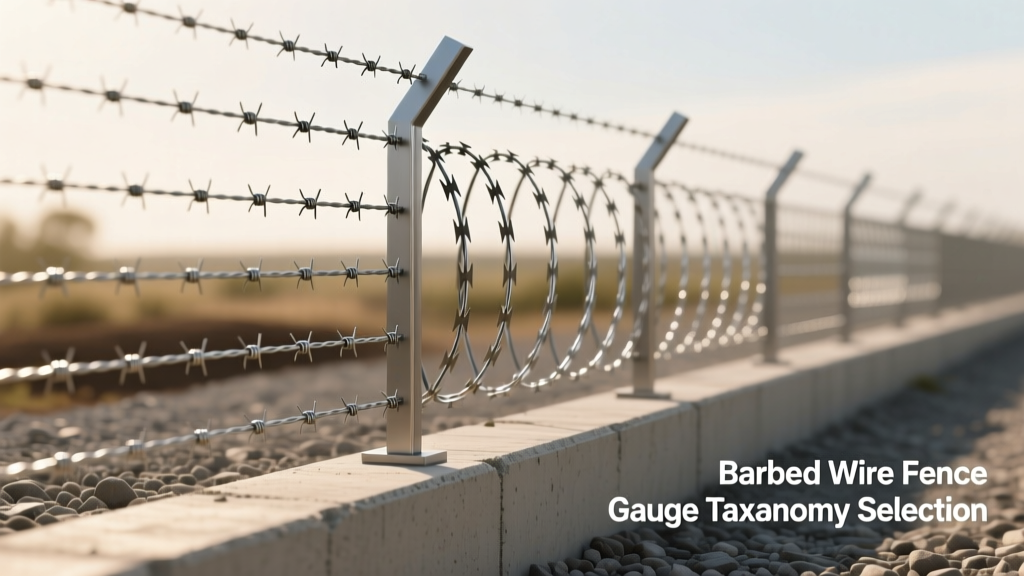
The Anatomy of a Barbed Wire Fence
Selecting the correct barbed wire fence requires moving beyond generic hardware store rolls and understanding the metallurgical and structural taxonomy of the wire itself. A standard barbed wire strand consists of two primary components: the line wires (the longitudinal strands that bear the tensile load) and the barbs (the deterrent elements locked into the line wires). The performance, lifespan, and containment efficacy of the fence are dictated by the gauge of the line wire, the mechanics of the twist, the geometry of the barb, and the chemical composition of the protective coating.
According to ASTM A121 standards, which govern metallic-coated carbon steel barbed wire, manufacturers must adhere to strict tolerances for wire diameter, barb spacing, and coating weight. Ignoring these specifications often results in premature structural failure, particularly in high-wind environments or when containing high-pressure livestock.
Wire Gauge Taxonomy: Decoding Thickness and Strength
The gauge system for fencing wire is inverse: a lower gauge number indicates a thicker, heavier wire. However, thickness does not universally equate to strength. The introduction of high-tensile steel has fundamentally altered the selection matrix, allowing thinner wires to outperform thicker, softer wires.
| Gauge | Approx. Diameter | Tensile Grade | Breaking Strength | Primary Application |
|---|---|---|---|---|
| 12.5 ga | 0.099 in (2.51 mm) | Standard (Low Carbon) | ~950 lbs | Heavy livestock (bulls, horses), high-impact security perimeters |
| 14 ga | 0.080 in (2.03 mm) | Standard / Medium | ~700 lbs | General cattle containment, property line demarcation |
| 15.5 ga | 0.058 in (1.47 mm) | High-Tensile | ~1,200+ lbs | Long-distance agricultural runs, wildlife exclusion, modern high-tension systems |
Barb Configuration and Twist Mechanics
The method used to integrate the barb into the line wire dictates the fence's structural integrity. If the twist fails, the barb slides down the wire, rendering the fence useless as a psychological barrier.
Twist Types
- Single Twist: The barb is wrapped around both line wires, but the line wires themselves are not twisted together. This is an older, largely obsolete design prone to barb slippage under tension.
- Double Twist (Standard): The two line wires are twisted together continuously, and the barb is locked between the twists. This is the standard for low-carbon 12.5 and 14-gauge wires.
- Reverse Twist: The line wires are twisted in alternating directions (left, then right). This locks the barb securely in place and prevents the wire from unspooling if cut. Reverse twist is mandatory for high-tensile 15.5-gauge wire to manage the immense stored kinetic energy.
Barb Point Geometry
Barbs are classified by the number of points (prongs). 2-point barbs are standard for cattle and general perimeter security. 4-point barbs provide a denser psychological deterrent and are specified for high-security perimeters or containing aggressive animals like bulls. Standard barb spacing is 4, 5, or 6 inches; 4-inch spacing increases the roll weight and cost by approximately 15% but significantly reduces the likelihood of an animal pushing through the strands without contact.
Coating Classifications: Rust Resistance
The lifespan of a barbed wire fence is entirely dependent on its coating. The University of Missouri Extension emphasizes that selecting the correct coating class is more critical than wire thickness for long-term ROI.
- Class 1 Galvanized (Zinc): Features a thin zinc coating (approx. 0.28 oz/sq ft). Suitable for dry, arid climates. Expected lifespan: 5 to 10 years before red rust compromises the wire's tensile strength.
- Class 3 Galvanized (Zinc): Contains nearly three times the zinc of Class 1 (approx. 0.80 oz/sq ft). The minimum recommended standard for humid, coastal, or high-rainfall environments. Expected lifespan: 15 to 20 years.
- Zinc-Aluminum Alloy (e.g., Bezinal): A modern metallurgical advancement consisting of 95% zinc and 5% aluminum. According to data from Bekaert Fencing, this alloy provides up to four times the corrosion resistance of standard Class 1 galvanization while maintaining superior flexibility during installation. This is the premium choice for 2026 installations in harsh environments.
Decision Matrix: Matching Wire to Application
Use the following framework to specify the exact material requirements for your project.
| Application Scenario | Recommended Gauge | Twist & Barb Spec | Minimum Coating |
|---|---|---|---|
| High-Security Commercial Perimeter | 12.5 ga (Low Carbon) | Double Twist, 4-point, 4' spacing | Class 3 or Zinc-Aluminum |
| Long-Distance Cattle Ranching (1+ miles) | 15.5 ga (High-Tensile) | Reverse Twist, 2-point, 5' spacing | Class 3 or Zinc-Aluminum |
| Temporary Grazing / Rotational Paddocks | 14 ga (Standard) | Double Twist, 2-point, 6' spacing | Class 1 Galvanized |
| Predator / Wildlife Exclusion Overlay | 15.5 ga (High-Tensile) | Reverse Twist, 4-point, 4' spacing | Class 3 Galvanized |
Cost Breakdown and Material Sourcing
Pricing for barbed wire is standardized by the 1,320-foot roll (exactly 1/4 mile). When budgeting for 2026 projects, factor in the premium for high-tensile and advanced coatings.
- 12.5 ga, 2-point, Class 1: $65 - $80 per 1,320 ft roll.
- 12.5 ga, 4-point, Class 3: $95 - $115 per 1,320 ft roll.
- 15.5 ga High-Tensile, 2-point, Zinc-Aluminum: $110 - $135 per 1,320 ft roll.
While high-tensile 15.5-gauge wire carries a 30% to 40% higher upfront material cost, it requires fewer intermediate posts (spaced at 16 to 20 feet compared to 10 to 12 feet for standard wire) and fewer tensioning adjustments over its lifespan, resulting in a lower total installed cost per linear foot.
The most common cause of barbed wire fence failure is over-tensioning low-carbon wire. Standard 12.5-gauge wire should only be tensioned to 200-300 lbs. Applying the 1,500+ lbs of tension intended for high-tensile wire to a standard 12.5-gauge strand will cause the wire to neck down, permanently weaken, and eventually snap at the barb twists during temperature drops. Always use a calibrated inline tension gauge (ratchet strainer) during installation.
Post Spacing and Suspension
For high-tensile 15.5-gauge barbed wire, utilize treated wood or driven steel posts spaced 16 to 20 feet apart on straight runs. For standard 12.5-gauge wire, reduce spacing to 10 to 12 feet. In areas subject to heavy snow loads or high winds, install vertical stays (droppers) between posts to prevent the wire strands from tangling and to maintain the psychological barrier profile.