Cedar Privacy Fence Specifications, Grades & Durability Data
Analyze western red cedar privacy fence performance ratings, wood grading specs, Janka hardness, and decay resistance for long-lasting installations.
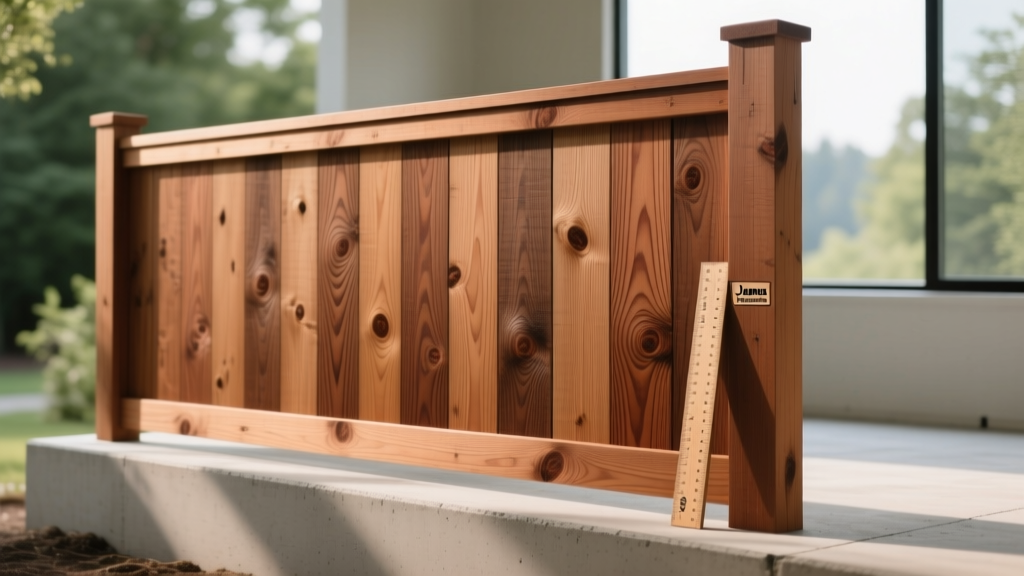
Botanical and Material Specifications
When specifying a cedar privacy fence for residential or commercial perimeters, understanding the botanical and physical distinctions between cedar species is critical for predicting long-term performance. The two primary species utilized in North American fencing are Western Red Cedar (Thuja plicata) and Eastern White Cedar (Thuja occidentalis). While both belong to the cypress family and share natural decay resistance, their structural densities and extractive profiles differ significantly.
Western Red Cedar is the industry standard for premium privacy fencing due to its larger dimensional profiles, straight grain, and high concentration of thujaplicins—water-soluble organic compounds that act as natural fungicides. According to data published by the USDA Forest Products Laboratory, the heartwood of Western Red Cedar exhibits exceptional resistance to decay fungi and termite attack without the need for chemical pressure treatment, classifying it naturally for AWPA Use Category UC3B (above ground, uncoated, exposed to weather).
Eastern White Cedar, while highly rot-resistant, typically yields narrower, shorter boards with a higher frequency of structural defects. It is more frequently milled into stockade or picket styles rather than large-format horizontal or vertical privacy panels. For full-height (6-foot to 8-foot) privacy applications, Western Red Cedar remains the superior specification due to its superior modulus of elasticity and lower tendency to warp over long spans.
Lumber Grading Standards for Privacy Applications
The visual and structural integrity of a cedar privacy fence is dictated by the lumber grading rules established by the Western Red Cedar Lumber Association (WRCLA) and the National Lumber Grades Authority (NLGA). Privacy fencing requires a balance between aesthetic uniformity and structural soundness. Selecting the incorrect grade often leads to premature board failure, excessive light penetration through knot holes, or severe warping.
| Grade Designation | Visual Characteristics | Privacy Suitability | Relative Cost Index |
|---|---|---|---|
| Clear A (Select) | 100% clear heartwood on one face; minor pin knots on reverse. | Exceptional for high-end modern horizontal privacy screens. | $$$$$ |
| Clear B | Mostly clear face; allows minor, easily repaired defects. | High suitability for premium vertical board-on-board privacy. | $$$$ |
| Select Tight Knot (STK) | Tight, sound knots under 2.5 inches; no open holes. | Industry standard for traditional privacy; blocks 95% of light. | $$$ |
| No. 1 (Quality Knotty) | Larger sound knots; occasional minor splits at edges. | Moderate privacy; light may penetrate through loose knots. | $$ |
| No. 2 (Standard) | Large knots, knot holes, and edge wane permitted. | Poor for strict privacy; requires secondary screening or patching. | $ |
For strict privacy requirements where light penetration and visibility must be minimized, Select Tight Knot (STK) is the minimum acceptable specification. Clear grades (A and B) are typically reserved for architectural screening where budget is secondary to visual perfection. No. 2 grade lumber should be rejected for primary privacy enclosures, as the permitted knot holes compromise the visual barrier and create entry points for moisture-driven rot.
Mechanical Properties and Decay Resistance Metrics
Cedar is fundamentally a softwood, meaning its mechanical strength metrics are lower than those of pressure-treated Southern Yellow Pine or tropical hardwoods like Ipe. However, its performance in fencing applications relies more on dimensional stability and chemical resistance than sheer compressive strength.
Janka Hardness and Impact Resistance
The Janka hardness test measures the force required to embed a 0.444-inch steel ball halfway into the wood. Western Red Cedar registers at approximately 350 lbf (1,560 N), while Eastern White Cedar is slightly softer at 320 lbf. For context, pressure-treated Pine averages 690 lbf. This lower hardness makes cedar privacy panels susceptible to denting from high-impact objects (e.g., commercial landscaping equipment, stray projectiles). Specifying thicker panel profiles (5/8-inch nominal rather than 1/2-inch) mitigates impact deflection and fastener pull-through.
Modulus of Rupture (MOR) and Elasticity (MOE)
When engineering cantilevered privacy screens or gates, the Modulus of Rupture (bending strength) and Modulus of Elasticity (stiffness) are critical. Western Red Cedar boasts an MOR of 7,500 psi and an MOE of 1.11 million psi. These metrics indicate that while cedar will flex under heavy wind loads, it possesses adequate stiffness to span 8-foot horizontal rails without permanent deformation, provided the fastening schedule adheres to structural engineering guidelines.
Data Highlight: Extractive Bleeding
The same thujaplicins that provide decay resistance are highly water-soluble. In the first 6 to 12 months post-installation, unsealed cedar privacy fences will leach reddish-brown tannins and extractives. This bleeding can stain adjacent concrete, stucco, or light-colored masonry. Specifications for cedar installations near sensitive hardscaping must include a 12-inch minimum clearance gap at the base or the application of a penetrating alkyd-oxide sealer prior to installation.
Dimensional Stability and Shrinkage Rates
Wood movement is the primary cause of privacy fence failure, manifesting as twisted pickets, popped fasteners, and misaligned gates. Cedar's cellular structure makes it one of the most dimensionally stable softwoods available, exhibiting significantly lower shrinkage rates than pine or fir.
- Radial Shrinkage (Green to Oven-Dry): 2.4%
- Tangential Shrinkage (Green to Oven-Dry): 4.6%
- Volumetric Shrinkage: 6.8%
The ratio of tangential to radial shrinkage (T/R ratio) for Western Red Cedar is approximately 1.9. A T/R ratio close to 1.0 is ideal for preventing cupping and checking. Because cedar's ratio is relatively low, flat-sawn cedar privacy boards are far less likely to cup severely compared to flat-sawn pine boards. However, to ensure maximum stability in exterior privacy applications, specify Kiln-Dried After Treatment (KDAT) or Kiln-Dried (KD) lumber with a moisture content (MC) between 12% and 15% at the time of installation. Installing green (S-GRN) cedar with an MC above 19% will result in up to 3/16-inch of shrinkage per 6-inch board width as it acclimates to local ambient humidity, potentially opening gaps in board-on-board privacy configurations.
Fastener Chemistry and Galvanic Corrosion
The chemical composition of cedar dictates strict fastener specifications. The natural acids and moisture content in cedar react aggressively with standard zinc electroplated fasteners, leading to rapid galvanic corrosion, black streaking (iron tannate staining), and catastrophic fastener failure within 3 to 5 years.
Warning: Prohibited Fastener Types
Never use standard bright zinc, electro-galvanized, or aluminum fasteners with cedar privacy fencing. Aluminum will pit and degrade rapidly due to the alkaline nature of the wood extractives, while electro-galvanized zinc will strip within months, causing severe black bleeding down the face of the privacy panels.
For permanent cedar privacy fence installations, fastener specifications must meet one of the following standards:
- Type 304 Stainless Steel (ASTM F593): The minimum standard for most inland environments. Provides excellent resistance to tannin corrosion and eliminates black streaking entirely.
- Type 316 Stainless Steel: Mandatory for privacy fences installed within 5 miles of a saltwater coastline or in areas subjected to heavy de-icing salts.
- Hot-Dipped Galvanized (ASTM A153 Class D): An acceptable, cost-effective alternative to stainless steel. The thick zinc coating (minimum 1.0 oz/ft²) sacrificially protects the steel core. Note: HDG fasteners may still cause minor gray staining on cedar, though structural integrity is maintained.
Wind Load Ratings and Structural Engineering
A solid cedar privacy fence acts as a massive sail, subjecting posts and footings to extreme lateral sheer forces. Unlike chain-link or spaced picket fences that allow wind permeability, a 6-foot solid cedar privacy board fence generates approximately 1.5 to 2.0 pounds per square foot (psf) of wind pressure at 70 mph, scaling exponentially with wind velocity.
According to the American Wood Protection Association and standard structural engineering practices for wind-borne debris regions, privacy fence posts must be engineered to withstand local Ultimate Design Wind Speeds (Vult), which frequently exceed 115 mph in coastal and southern jurisdictions.
Post Embedment and Footing Specifications
To prevent overturning moments in high-wind events, the 1/3 embedment rule is the absolute minimum baseline. For a 6-foot above-grade privacy fence, posts must be embedded a minimum of 30 inches into undisturbed soil or concrete. In regions with frost lines, embedment must extend 6 inches below the local frost depth to prevent frost heave from compromising the fence's plumb alignment.
For commercial or high-wind residential applications, specify 4x4 minimum post dimensions (actual 3.5" x 3.5") with a concrete footing diameter of 10 to 12 inches. The concrete should achieve a minimum compressive strength of 3,000 PSI at 28 days. Bell-shaped footings (wider at the base than the top) are highly recommended in expansive clay soils to provide mechanical resistance against uplift forces generated by negative wind pressure on the leeward side of the privacy panels.