Chain Link Fence Cost Estimator: 2026 Pricing & Materials
Calculate your exact chain link fence cost with our 2026 estimator. Break down material, labor, gauge, and gate pricing for accurate budgeting.
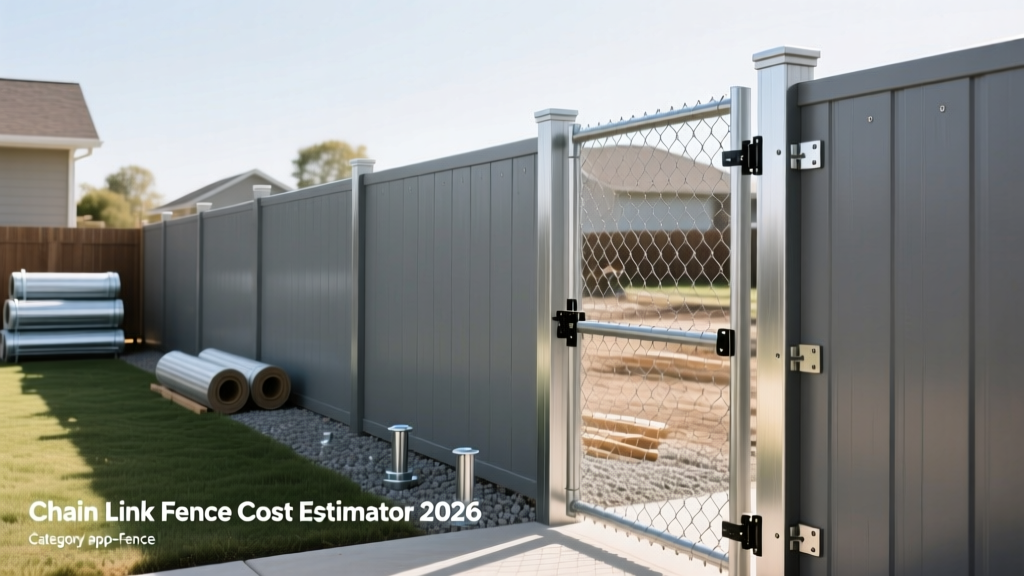
The True Chain Link Fence Cost: Beyond the Linear Foot
Estimating the total chain link fence cost requires moving past simple per-foot averages and analyzing the specific metallurgical and structural variables of your project. In 2026, the national average for a professionally installed chain link fence ranges from $15 to $32 per linear foot. However, a 4-foot residential boundary fence and an 8-foot commercial security perimeter utilize entirely different material grades, post diameters, and concrete footing requirements.
This guide provides a granular cost estimation framework, breaking down wire gauges, coating types, structural hardware, and labor multipliers so you can calculate exact material quantities and anticipate final contractor invoices.
Quick 2026 Cost Snapshot (National Averages)
- Materials Only: $5.00 – $12.00 per linear foot
- Labor & Installation: $10.00 – $20.00 per linear foot
- Total Installed (4ft - 6ft height): $15.00 – $32.00 per linear foot
- Standard Gate (4ft wide): $250 – $450 installed
Data synthesized from HomeGuide's 2026 fencing cost report and regional contractor aggregates.
Material Variables: Gauge, Coating, and Mesh Size
The primary driver of your material cost is the wire gauge and the protective coating. Counterintuitively, in wire gauges, a lower number indicates a thicker, stronger, and more expensive wire. Standard residential fencing typically uses 11.5-gauge wire, while commercial and high-security applications require 9-gauge or 6-gauge wire.
| Wire Gauge | Wire Thickness | Primary Application | Material Cost (per LF) |
|---|---|---|---|
| 11.5 Gauge | 0.120 inches | Residential boundaries, dog runs | $5.00 - $7.50 |
| 9 Gauge | 0.148 inches | Commercial, tennis courts, parks | $8.00 - $11.00 |
| 6 Gauge | 0.192 inches | High security, correctional, industrial | $12.00 - $16.00+ |
Coating Technology: GBW vs. GAW
When budgeting for chain link, you must specify the galvanization process. According to the Chain Link Fence Manufacturers Institute (CLFMI), there are two distinct methods:
- Galvanized Before Weaving (GBW): The wire is coated in zinc before being woven into the diamond mesh. This leaves the cut ends and knuckles exposed to moisture, leading to premature rust points. This is the cheaper, big-box store standard.
- Galvanized After Weaving (GAW): The mesh is woven first, then entirely submerged in molten zinc. This seals the cut ends and knuckles completely. GAW costs roughly 15% to 20% more than GBW but effectively doubles the fence's lifespan in humid or coastal environments.
Vinyl-Coated Options: Adding a black or green PVC coating over a GAW core adds $2.50 to $4.00 per linear foot. Black vinyl is currently the highest-demand residential option as it visually recedes into landscaping, offering a premium look without the maintenance of wood.
Framework: Calculating Exact Quantities for Your Project
To prevent material shortages or costly over-ordering, use this mathematical framework to calculate your exact bill of materials. Standard chain link fabric is sold in 50-foot rolls.
- Calculate Total Linear Footage (LF): Measure the exact perimeter of the fence line. Do not subtract gate widths yet; calculate them separately in step 5.
- Fabric Rolls Needed: Divide Total LF by 50. Round up to the nearest whole number. (e.g., 180 LF / 50 = 3.6 → Order 4 rolls).
- Line Posts: Standard spacing is 10 feet on center. Divide Total LF by 10, then add 1. (180 / 10 = 18 + 1 = 19 line posts).
- Terminal Posts (End, Corner, and Gate Posts): Count every corner (1 per corner), every end of a continuous run (2 per run), and add 2 for every gate opening.
- Top Rail and Hardware: Top rail is sold in 21-foot lengths. Divide Total LF by 21 and round up. You will need one tension bar per continuous run (usually 2 per roll) and one tension band per terminal post.
- Concrete Volume: Rule of thumb for footings: the hole diameter must be 3x the post diameter, and the depth must be 1/3 the above-ground height plus 6 inches for a gravel drainage base. For a 6-foot fence, dig 2.5 feet deep. A standard 12-inch diameter hole at this depth requires roughly 0.15 cubic yards of concrete per hole.
Labor Rates and Terrain Multipliers
Labor accounts for 50% to 65% of the total chain link fence cost. While flat, clear terrain allows crews to use mechanized augers and install 150 to 200 linear feet per day, site-specific challenges trigger specific upcharges.
Before any post-hole digging begins, you must call 811 to have underground utilities marked. Striking a gas or fiber-optic line due to skipping this free service can result in tens of thousands of dollars in damages and severe liability. Most professional contractors include this in their workflow, but DIYers must initiate it at least 72 hours before breaking ground.
Specific Labor Upcharges
- Rocky or Clay-Heavy Soil: If hand-digging or auger extensions are required, expect an additional $4.00 to $8.00 per LF.
- Steep Slopes (Biasing): Chain link cannot be "stepped" like wood or vinyl. It must be "biased," meaning the fabric is stretched at a parallelogram angle to follow the ground contour. Biasing requires specialized cutting, extra waste fabric, and tighter post spacing (reduced to 8 feet). Add 15% to 25% to total labor costs for slopes exceeding a 10-degree grade.
- Tree Root Avoidance: Shifting post layouts to avoid major root systems adds $50 to $100 per relocated terminal post due to custom fabric cutting.
Gates, Hardware, and Hidden Upgrades
Gates are the most mechanically complex and expensive components of a chain link system. The structural posts supporting a gate must be heavier and set in deeper concrete than standard line posts to withstand the dynamic cantilever weight of the swinging gate.
| Gate Type | Standard Width | Required Post Size (Schedule 40) | Installed Cost Range |
|---|---|---|---|
| Single Swing (Walk) | 36" - 48" | 2-3/8" O.D. | $250 - $450 |
| Double Drive (Swing) | 10' - 16' | 3-1/2" O.D. | $800 - $1,400 |
| Single Slide (Rolling) | 10' - 20' | 4" O.D. (Heavy Duty) | $1,500 - $2,800 |
| Cantilever Slide | 12' - 30' | 4"+ O.D. (Commercial) | $3,500 - $6,000+ |
For sliding gates, you must also budget for the "tail" or counterbalance section. A cantilever gate requires the total fabric and frame length to be 50% wider than the actual opening to provide the necessary counterweight. For example, a 12-foot driveway opening requires an 18-foot gate structure.
Chain Link vs. Solid Fencing: Long-Term ROI and Wind Load
When evaluating the chain link fence cost against wood or solid vinyl alternatives, consider the structural physics of wind load. Solid fences act as sails during high-wind events. The American Fence Association notes that solid fences must be engineered to withstand massive lateral sheer force, requiring deeper footings, heavier rails, and more frequent structural repairs.
"Chain link fabric possesses an open-area ratio of approximately 75%. This aerodynamic permeability means wind passes directly through the mesh, transferring almost zero lateral sheer force to the posts and footings. In hurricane-prone or high-wind corridors, chain link virtually eliminates the risk of catastrophic blow-downs, making its 20-year lifecycle cost significantly lower than wood or vinyl, despite similar initial installation prices."
Maintenance and Depreciation
A pressure-treated pine fence requires staining or sealing every 2 to 3 years ($3 to $5 per LF per treatment) to prevent rot and warping. Vinyl fences, while low maintenance, become brittle in extreme cold and can shatter upon impact from landscaping equipment or vehicles. A properly installed GAW galvanized or vinyl-coated chain link fence requires zero scheduled maintenance. Occasional rinsing with a hose to remove pollen and dirt is the only upkeep required, solidifying its position as the highest-ROI perimeter solution for both residential and commercial applications in 2026.