Chain Link Gates: ASTM Specifications and Performance Ratings Guide
Compare chain link gates performance ratings, ASTM framework specs, zinc coating classes, and wind load metrics for commercial and residential use.
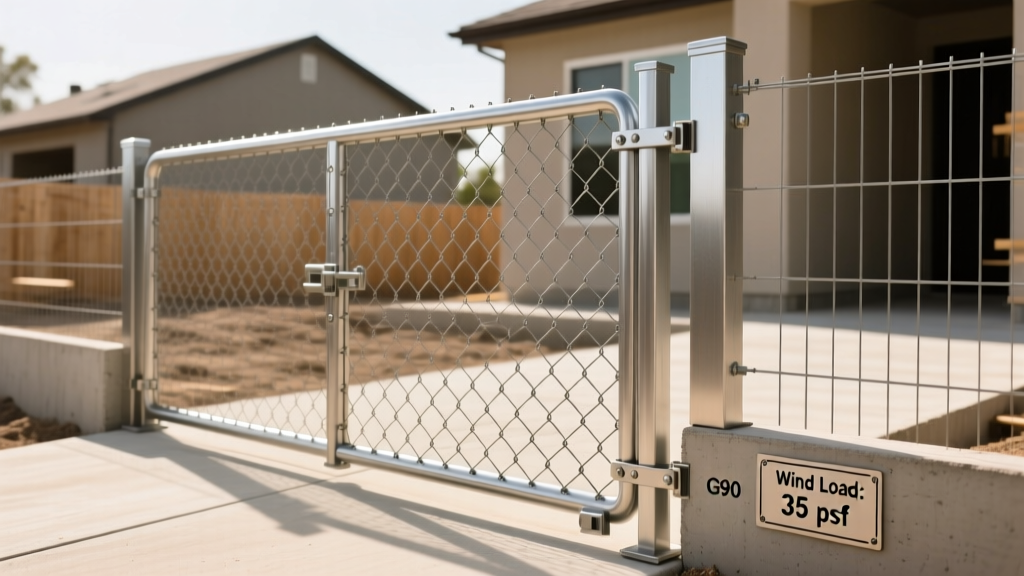
Decoding ASTM Standards for Chain Link Gates
Chain link gates are the most mechanically stressed components of any perimeter security system. Unlike static fence panels, gates endure dynamic wind loads, kinetic impact from vehicles or pedestrians, and repetitive torsional stress at the hinge points. Evaluating chain link gates requires moving beyond basic dimensions and analyzing performance ratings governed by the American Society for Testing and Materials (ASTM). The Chain Link Fence Manufacturers Association (CLFMA) aligns all commercial and industrial gate specifications with three primary ASTM standards to ensure structural integrity and longevity.
- ASTM F669: Standard Practice for Installation of Chain Link Fence. This dictates the foundational performance requirements, including post-hole depths, concrete footing specifications, and gate post bracing protocols.
- ASTM F1083: Standard Specification for Pipe, Steel, Hot-Dipped Zinc-Coated (Galvanized) Welded, for Fence Structures. This defines the exact outside diameter (OD) and wall thickness tolerances for gate framework.
- ASTM A392: Standard Specification for Zinc-Coated Chain-Link Fence Fabric. This establishes the minimum zinc coating weights required to prevent red rust on the gate mesh.
Framework Gauge and Pipe Schedule Matrix
The most common point of failure in gate procurement is mismatching the framework schedule to the operational duty cycle. Residential gates often utilize formed steel or light-wall tubing, which will sag under commercial wind loads. For performance-critical applications, framework must be specified by Schedule (wall thickness) rather than just nominal gauge.
| Duty Classification | Typical Application | Gate Framework OD | Wall Thickness (Min) | Pipe Schedule / Gauge |
|---|---|---|---|---|
| Residential (Light) | Single-family backyards | 1-5/8 in. | 0.065 in. | 16 Ga (Standard Tube) |
| Commercial (Medium) | Schools, parks, retail | 2 in. to 2-1/2 in. | 0.095 in. to 0.120 in. | 12 Ga / Sch 40 |
| Industrial (Heavy) | Logistics, utilities, prisons | 2-1/2 in. to 3-1/2 in. | 0.203 in. to 0.216 in. | Schedule 40 Steel Pipe |
Zinc Coating Classes and Corrosion Performance
The corrosion resistance of chain link gates is dictated by the zinc coating weight applied to both the fabric and the framework. According to ASTM International, galvanized coatings are divided into distinct classes that directly correlate to the gate's expected lifespan before the onset of red rust.
Class 1 vs. Class 2 Galvanization
Class 1 galvanizing requires a minimum of 1.2 ounces of zinc per square foot. While acceptable for temporary or low-security residential gates, Class 1 coatings typically degrade in 7 to 10 years in moderate climates. Class 2 galvanizing mandates a minimum of 2.0 ounces of zinc per square foot. For commercial and industrial chain link gates, Class 2 is the absolute minimum performance baseline, extending the functional lifespan to 20+ years. For highly corrosive environments (coastal zones, chemical storage perimeters), specifying a Class 2A coating or a fused PVC/ColorCore coating over a Class 2 zinc base is mandatory.
Never mix aluminum gate fabric with steel gate framework, or vice versa, without dielectric isolation hardware. When dissimilar metals contact in the presence of an electrolyte (rainwater), galvanic corrosion will rapidly destroy the anodic metal (aluminum), leading to catastrophic mesh failure at the tension bands within 24 months.
Wind Load Ratings and Deflection Limits
A 12-foot by 6-foot double-drive chain link gate acts as a massive sail under wind pressure. Performance ratings for deflection are critical; a gate that bows excessively will bind at the latch and fail to close securely. Gate framework must be engineered to meet ASCE 7 wind load standards based on the local geographic wind speed map.
To mitigate deflection, industrial chain link gates require internal or external truss systems:
- Steel Cable Truss Rods: Standard for gates up to 10 feet in width. The turnbuckle tensioning system transfers the vertical weight of the free-hanging gate leaf back to the hinge post.
- Welded Steel Tubular Trusses: Mandatory for double-drive gates exceeding 12 feet in total width. These rigid mid-rail trusses prevent the parallelogram distortion that causes latch misalignment.
- Center Stops: For double-drive gates, a ground-mounted center stop or overhead header bar is required to prevent the gate leaves from overlapping and bending the drop rods during high-wind events.
Hardware Performance: Hinges, Latches, and Automation
The hardware attached to chain link gates represents the highest concentration of kinetic stress. Standard stamped-steel hinges will deform under the weight of Schedule 40 framework. Performance specifications must dictate heavy-duty hardware.
Hinge Specifications
For commercial and industrial gates, specify malleable iron or forged steel ball-bearing hinges. The hinge pin diameter must be a minimum of 3/4-inch for single gates and 1-inch for double drive gates. Cantilever slide gates require sealed, heavy-duty roller assemblies rated for a minimum of 100,000 operational cycles.
UL 325 Compliance for Automated Gates
If the chain link gate will be equipped with an automated operator, the entire assembly must comply with UL 325 (Underwriters Laboratories Standard for Safety for Door, Drapery, Gate, Louver, and Window Operators and Systems). This requires the integration of monitored photoelectric sensors or edge sensors capable of reversing the gate motor within a fraction of a second upon detecting an obstruction. The American Fence Association strictly advises against automating chain link gates without first upgrading the framework to Schedule 40 to handle the sudden kinetic shock of motor reversal.
Specification Checklist for Procurement
When drafting an RFQ (Request for Quote) or bid specification for chain link gates, copy and paste this exact performance matrix to eliminate substandard contractor substitutions:
- Framework: ASTM F1083 Schedule 40 hot-dipped galvanized steel pipe.
- Fabric: ASTM A392, 9-gauge wire, 2-inch mesh, Class 2 zinc coating (2.0 oz/ft²).
- Top/Bottom Rails: Continuous Schedule 40 pipe, sleeved and bolted at splices.
- Truss System: Adjustable 3/8-inch galvanized steel cable with forged turnbuckle (single leaf) or welded tubular truss (double leaf).
- Hinges: 1-inch forged steel ball-bearing industrial hinges with 1-inch pins.
- Latching: Heavy-duty gravity latch with provisions for padlock, paired with a minimum 1-inch solid steel drop rod anchored into a concrete pad.