Goat Fence Cost Calculator: 2026 Material & Post Guide
Calculate exact goat fence costs for 2026. Get material quantities, post spacing formulas, and woven wire pricing to budget your livestock enclosure.
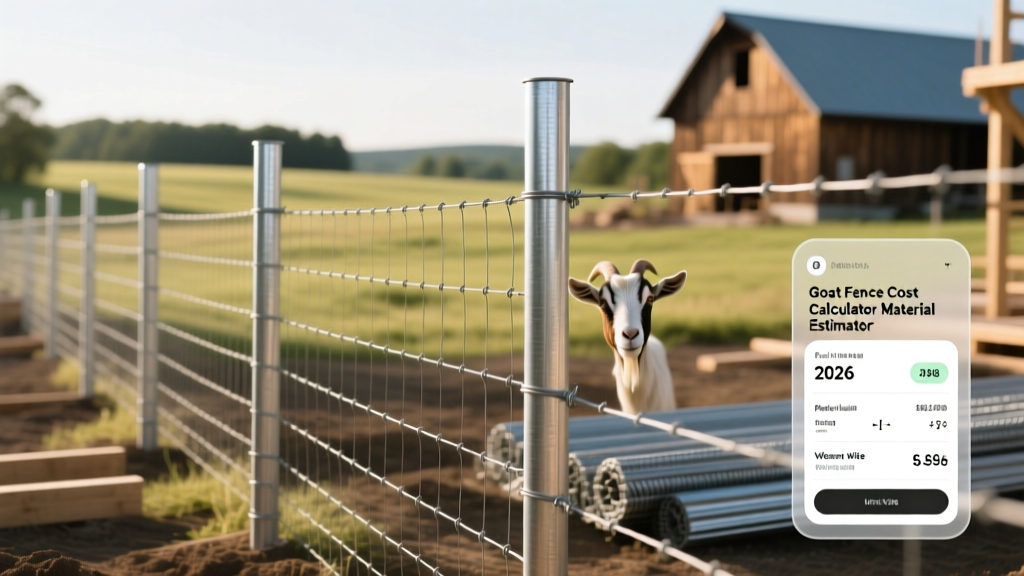
The Anatomy of a Predator-Proof Goat Enclosure
Estimating the cost of a goat fence requires understanding why standard agricultural fencing fails for this specific livestock. Goats are notorious escape artists that exploit structural weaknesses, squeeze through wide gaps, and aggressively rub against wire, causing standard field fences to bow and snap. According to livestock management guidelines from Penn State Extension, a proper goat enclosure must utilize tightly spaced woven wire combined with rigid post spacing to prevent the mesh from stretching under animal pressure.
Wire Specifications: Why Cattle Fence Fails
Standard cattle fencing features a 12-inch vertical stay spacing. Goats will easily push their heads through these gaps, becoming trapped or escaping entirely. A true goat fence requires a 4-inch by 4-inch mesh pattern. Furthermore, the wire must be a minimum of 12.5-gauge high-tensile steel with a Class 3 galvanized zinc coating (meeting ASTM A641 standards). Class 1 coatings will rust through within three to five years in humid climates, while Class 3 provides up to 0.80 ounces of zinc per square foot, extending the fence lifespan to 20+ years. Manufacturer specifications from Red Brand confirm that 48-inch tall, 12.5-gauge woven wire with 4-inch vertical stays is the industry baseline for caprine containment.
To prevent goats from standing on their hind legs and leaning over the 48-inch fence, install a single strand of 12.5-gauge smooth high-tensile wire offset 6 inches outward and 6 inches above the top of the woven wire. Energize this strand with a minimum 5-joule charger to deter climbing and predator entry.
Goat Fence Material Calculator: Formulas & Quantities
Use the following formulas to calculate the exact material quantities required for your perimeter. Do not rely on rough estimates; over-ordering wire leads to wasted capital, while under-ordering T-posts compromises structural integrity.
- Total Perimeter (Linear Feet): Measure all boundary lines. (Length + Width + Length + Width).
- Woven Wire Rolls (330 ft each): (Total Perimeter ÷ 330) + 1 extra roll for overlap, gates, and mistakes. Always round up.
- Line Posts (T-Posts): Total Perimeter ÷ Post Spacing. For goats, line posts must be spaced no more than 10 feet apart (8 feet is preferred for high-traffic rubbing areas). Subtract the number of corners and gate posts from this total.
- Brace Posts (Wood): Calculate 3 wood posts per corner (1 corner post, 2 brace posts) and 3 wood posts per gate opening.
- Horizontal Brace Rails: 1 per corner/gate assembly (4-foot length).
- Diagonal Brace Wire: 1 length of 9-gauge high-tensile wire per corner/gate assembly.
2026 Material Cost Breakdown & Pricing Table
Material costs for agricultural fencing have stabilized following the supply chain fluctuations of the early 2020s, but steel and treated lumber remain sensitive to regional freight surcharges. The table below reflects national average retail pricing for Q1 2026.
| Material Component | Specification / Dimensions | 2026 Est. Unit Cost | Notes / Sourcing Advice |
|---|---|---|---|
| Woven Wire Roll | 48" tall, 12.5ga, 4x4" spacing, Class 3 | $225.00 - $260.00 | Do not substitute with 14ga field fence. |
| Steel T-Post (Line) | 7 ft length, 1.33 lb/ft, painted green | $9.50 - $12.00 | Must include 6-inch steel anchor plate. |
| Treated Wood Post (Brace) | 8 ft length, 4-5" diameter, AWPA U1 treated | $28.00 - $42.00 | Southern Yellow Pine or Douglas Fir. |
| Tubular Steel Gate | 12 ft wide, 50" tall, 1.5" OD round tube | $165.00 - $210.00 | Ensure 4x4" mesh weld pattern to match fence. |
| Heavy-Duty Hinge/Latch Kit | Drop-pin hinges, gravity latch, chain stop | $35.00 - $55.00 | Weldable or bolt-on; avoid cheap stamped steel. |
| High-Tensile Brace Wire | 9-gauge, galvanized (for H-brace diagonals) | $0.15 per ft | Sold in 100ft+ coils. |
Step-by-Step Estimation Example: 1-Acre Square Paddock
To demonstrate the calculator in action, let us estimate the materials and costs for a perfectly square 1-acre goat paddock. One acre equals 43,560 square feet. The square root of 43,560 is roughly 208.7 feet per side.
- Calculate Perimeter: 208.7 ft x 4 sides = 835 linear feet.
- Wire Rolls Needed: 835 ÷ 330 = 2.53. Order 3 rolls. (3 x $240 = $720).
- Line Posts Needed: 835 ÷ 10 ft spacing = 83.5. Order 84 T-posts. (84 x $10.50 = $882).
- Brace Posts Needed: 4 corners x 3 posts = 12 wood posts. Add 1 gate opening (3 posts) = 15 total wood posts. (15 x $35 = $525).
- Gate & Hardware: One 12-foot gate ($185) + Hardware kit ($45) = $230.
- Consumables (Staples, Brace Wire, Clips): Estimate 15% of wire cost = $108.
Cost Per Linear Foot: ~$2.95 / LF (Materials Only)
Note: Professional installation labor typically adds $3.50 to $5.50 per linear foot, bringing the total installed cost to roughly $5,400 - $7,000 for this 1-acre footprint.
Hidden Costs: Terrain, Gates, and Predator Aprons
Basic calculators often fail to account for site-specific variables that drastically inflate the final invoice. When budgeting your goat fence, apply the following multipliers based on your terrain and local predator pressure.
1. Sloped Terrain and Stepping
Woven wire cannot be bent to follow the contour of a hill without buckling and creating escape gaps. On slopes exceeding a 15% grade, the fence must be "stepped." This requires cutting the wire at each T-post and overlapping the sections, which increases wire waste by up to 20% and requires additional T-posts to secure the overlapping cuts. Add a 15% contingency to your wire budget for hilly terrain.
2. The Predator Apron (Anti-Dig Barrier)
Coyotes, feral dogs, and foxes will dig under a woven wire fence to access goats. In high-predator areas, you must install a predator apron. This involves trenching 12 inches outward from the fence base and burying an 18-inch wide strip of 14-gauge welded wire mesh, or bending the bottom 12 inches of the woven wire outward at a 90-degree angle and pinning it to the soil with landscape stakes. This adds approximately $1.20 to $1.80 per linear foot to the project.
Never use barbed wire as a top strand or within the main body of a goat fence. Goats lack the thick hide of cattle and will suffer severe lacerations to their udders, eyes, and necks when attempting to reach forage on the other side of the fence. Always use smooth high-tensile wire for offset deterrents.
Expert Sourcing & Final Considerations
When purchasing materials, avoid big-box home improvement stores for the primary woven wire and T-posts. Their agricultural fencing inventory is frequently limited to 14-gauge field fence with inadequate zinc coatings. Source your materials from dedicated agricultural cooperatives, local farm supply distributors, or direct from manufacturers. Ensure all treated wood posts meet AWPA U1 standards for ground contact (UC4A or UC4B categories), as untreated or poorly treated pine will rot at the soil line within 36 months, compromising your expensive H-brace corners.
"A fence is only as strong as its corners. If your H-brace assemblies are not built to the 8-4-9 rule (8-foot vertical posts, 4-foot horizontal rail, 9-foot diagonal tension wire), the tension of 12.5-gauge woven wire will pull the corner posts inward, causing the entire fence line to sag within the first winter freeze-thaw cycle."