Galvanized Chain Link Fence Cost Calculator & 2026 Pricing
Calculate exact material quantities and 2026 costs for your galvanized chain link fence. Includes formulas, gauge comparisons, and hidden hardware pricing.
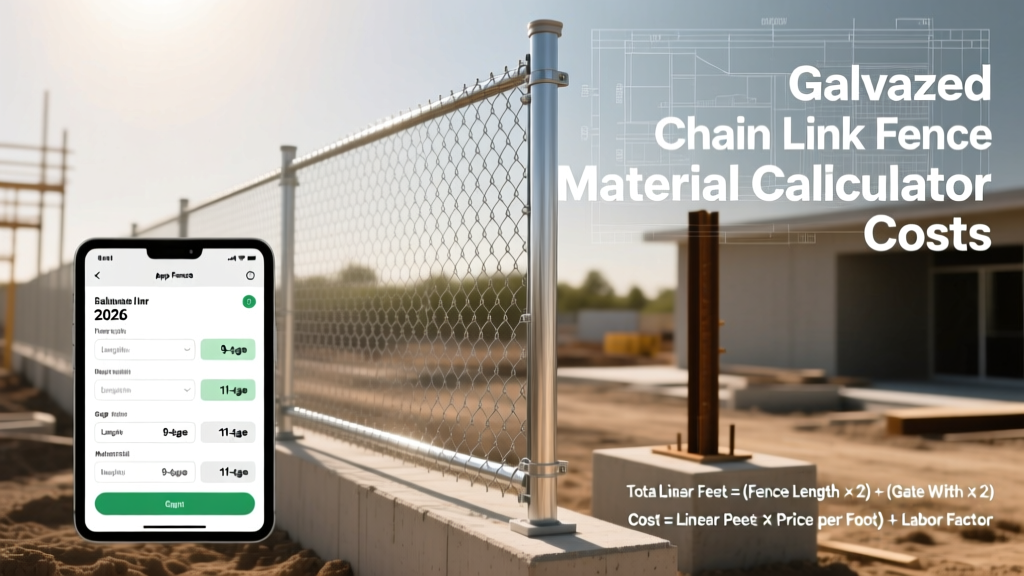
Estimating a galvanized chain link fence requires more than multiplying linear footage by a generic square-foot price. Accurate budgeting demands calculating specific post counts, tensioning hardware, concrete volumes, and fabric waste factors based on ASTM standards. This guide provides the exact mathematical formulas, 2026 unit pricing, and material matrices required to build a precise bill of materials for residential and commercial chain link installations.
The 2026 Galvanized Chain Link Fence Cost Matrix
Pricing for galvanized steel fluctuates with global zinc and raw steel markets. As of 2026, the cost of standard Class 1 galvanized fabric (per ASTM A392) has stabilized, but labor and concrete delivery costs remain elevated. The table below outlines current material and installed costs per linear foot (LF) based on fence height and wire gauge.
| Fence Height | Wire Gauge | DIY Material Cost (Per LF) | Pro Installed Cost (Per LF) | Primary Application |
|---|---|---|---|---|
| 4 Feet | 11.5-Gauge | $11.50 - $14.00 | $28.00 - $34.00 | Small dog runs, property line markers |
| 5 Feet | 11.5-Gauge | $13.00 - $16.50 | $32.00 - $39.00 | Standard residential backyards |
| 6 Feet | 11.5-Gauge | $15.50 - $19.00 | $38.00 - $46.00 | Privacy, security, large pet containment |
| 6 Feet | 9-Gauge | $19.00 - $24.00 | $48.00 - $58.00 | Commercial security, high-wind zones |
| 8 Feet | 9-Gauge | $26.00 - $32.00 | $65.00 - $80.00 | Industrial, athletic courts, municipal |
Material Quantity Calculator: Formulas & Multipliers
To generate an accurate shopping list, apply these specific multipliers to your total measured linear footage. Never estimate by eye; chain link hardware requires exact counts to avoid mid-project supply runs.
Fabric and Top Rail Calculations
- Chain Link Fabric: Multiply total linear feet by 1.05. This 5% waste factor accounts for overlaps at terminal posts and cutting around uneven terrain. Formula: (Total LF × 1.05) / 50 = Number of 50-foot rolls.
- Top Rail: Standard top rail is sold in 21-foot lengths (1-3/8" OD for residential). Formula: Total LF / 21 = Number of top rail sections (always round up).
- Tension Wire: Required at the bottom to prevent animals from lifting the fabric. Formula: Total LF × 1.10 = Linear feet of 7-gauge coil spring wire.
Post Counting Rules (10-Foot Spacing Standard)
The American Fence Association mandates a maximum line post spacing of 10 feet on-center for standard wind load resistance. Do not space line posts at 12 feet; this causes top rail sagging and fabric billowing in 40+ MPH winds.
Line Post Formula: (Total LF / 10) - 1 = Number of Line Posts.
Example: For a 100-foot straight run, (100 / 10) - 1 = 9 line posts.Terminal Post Formula: Count 2 end posts per continuous run, plus 1 for every corner, plus 2 for every gate opening. Terminal posts are typically 2-3/8" OD for 6-foot fences and require heavy-duty concrete footings.
Hidden Costs: Hardware, Tensioning, and Concrete
Contractors often lose margin, and DIYers blow budgets, by failing to account for the "nickel-and-dime" hardware. Below is the 2026 unit pricing and quantity logic for the essential tensioning and structural components.
- Tension Bars: You need exactly one 5/16" steel tension bar per terminal post, plus two for every gate. (Cost: $6.50 each).
- Tension Bands: These secure the tension bar to the terminal post. Rule of thumb: 1 band per foot of fence height. A 6-foot fence requires 6 tension bands per terminal post. (Cost: $0.85 each).
- Rail End Caps & Loop Caps: 1 per line post (loop cap) and 3 per terminal post (rail end caps for the top rail and brace rail connections). (Cost: $1.20 each).
- Carriage Bolts & Nuts: 1.25" galvanized carriage bolts for tension bands and rail ends. Budget $0.40 per bolt/nut assembly.
Concrete Volume Calculator
Setting posts in dry-pack or wet-mix concrete is non-negotiable for longevity. Post holes must be dug to the local frost line (typically 24" to 36" in northern climates) with a diameter three times the post width.
| Post Type | Hole Dimensions (Depth × Width) | 60lb Bags of Concrete Required | Estimated Cost Per Hole (2026) |
|---|---|---|---|
| Line Post (1-5/8" OD) | 24" Deep × 8" Wide | 1.5 Bags | $9.75 |
| Terminal Post (2-3/8" OD) | 30" Deep × 10" Wide | 2.5 Bags | $16.25 |
| Gate Hinge Post (2-3/8" OD) | 36" Deep × 12" Wide | 3.5 Bags | $22.75 |
Decision Framework: 9-Gauge vs. 11.5-Gauge Fabric
Choosing the wrong gauge is the most common material estimation error. Gauge measures wire thickness; the lower the number, the thicker the wire. Use this framework to finalize your fabric order.
11.5-Gauge (0.120" Wire)
- Best For: Standard residential yards, garden borders, light pet containment.
- Pros: 20% lighter, easier to unroll and tension manually, lower upfront cost.
- Cons: Susceptible to denting from heavy impacts (e.g., falling branches, riding mowers).
- Verdict: Choose if budget is the primary constraint and security is secondary.
9-Gauge (0.148" Wire)
- Best For: Commercial properties, athletic fields, high-wind zones, large aggressive dogs.
- Pros: Highly rigid, resists impact deformation, longer lifespan before zinc oxidation.
- Cons: Heavy (requires two people or a mechanical unroller to install), higher cost.
- Verdict: Mandatory for any fence over 6 feet tall or subject to commercial liability.
Real-World Example: Quoting a 150-Foot Residential Run
To demonstrate the calculator in action, let us estimate a 150-foot straight run of 6-foot tall, 11.5-gauge galvanized chain link with one 4-foot walk gate. No corners.
- Fabric: 150 LF × 1.05 = 157.5 LF. Order three 50-foot rolls. (3 × $145 = $435)
- Top Rail: 150 LF / 21 = 7.14. Order 8 sections of 21' rail. (8 × $28 = $224)
- Line Posts: (150 / 10) - 1 = 14 posts. (14 × $18 = $252)
- Terminal Posts: 2 end posts + 2 gate posts = 4 posts. (4 × $32 = $128)
- Concrete: (14 line × 1.5 bags) + (4 terminal × 2.5 bags) = 31 bags. (31 × $6.50 = $201.50)
- Hardware Kit: Tension bars, bands, caps, gate hinges, and latch. (Approx. $110)
- Walk Gate: Pre-assembled 4' × 6' galvanized gate. ($165)
Total Estimated Material Cost: $1,515.50 (Approx. $10.10 per linear foot). If hiring a professional fencing contractor, expect a multiplier of 2.2x to 2.5x for labor, equipment, and overhead, bringing the installed total to roughly $3,300 - $3,700.
Pro-Tips for Minimizing Material Waste and Failure
- Always Buy Class 2 Galvanizing for Coastal Zones: If your property is within 15 miles of saltwater, standard Class 1 galvanizing will show rust streaks within 36 months. Specify Class 2 (ASTM A392) which features a minimum 2.00 oz/sq ft zinc coating.
- Use a Come-Along for Tensioning: Do not rely on manual pulling or a standard ratchet strap to tension 6-foot fabric. Rent or buy a 1-ton come-alwinch and a pulling bar. Proper tension requires 400-600 lbs of lateral force to eliminate vertical sagging.
- Slope Step-Down Method: If your terrain slopes more than 5 degrees, do not rack the fabric. Step the fence down in 10-foot panels. This requires adding 1 extra terminal post and 1 extra tension bar per step-down point to your material list.