Fence Wood Taxonomy: Species, Lumber Grades & Selection Framework
Master fence wood selection with our taxonomy guide. Compare species, lumber grades, pressure treatments, and 2026 costs for durable residential fencing.
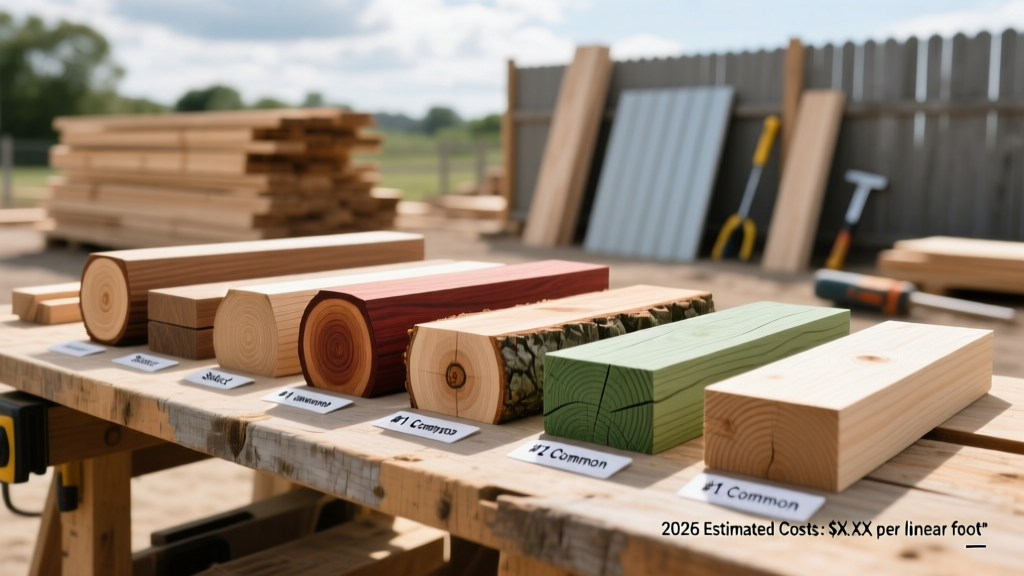
The Core Taxonomy of Fence Wood: Softwoods vs. Hardwoods
Selecting the right fence wood requires moving beyond the generic "pine or cedar" dichotomy. The structural integrity, decay resistance, and lifespan of a wood fence are dictated by its botanical taxonomy and subsequent milling treatment. In residential and commercial fencing, softwoods dominate due to their workability and cost-efficiency, but specific species offer vastly different performance profiles.
Western Red Cedar (Thuja plicata)
Western Red Cedar (WRC) is the premium standard for natural, untreated fencing. It contains high levels of thujaplicins, natural fungicides that provide inherent resistance to decay and insect attack. According to the Western Red Cedar Lumber Association (WRCLA), WRC has a low shrinkage factor, meaning it is significantly less prone to warping, twisting, or checking compared to pressure-treated alternatives. However, it lacks the structural bending strength of dense pines, requiring closer post spacing (typically 6 feet on center rather than 8 feet).
Southern Yellow Pine (Pinus taeda / Pinus echinata)
Southern Yellow Pine (SYP) is the workhorse of the fencing industry. In its raw state, SYP has virtually no natural decay resistance. However, its high permeability makes it the ideal candidate for pressure treatment. SYP boasts a Janka hardness of roughly 870 lbf, making it highly resistant to impact damage from landscaping equipment or severe weather.
Coastal Redwood (Sequoia sempervirens)
Redwood offers superior dimensional stability and a rich aesthetic, but its availability is strictly regional (primarily the West Coast). It is graded similarly to cedar but commands a 30% to 45% price premium, restricting its use to high-end custom architectural fencing.
- Choose WRC if: You want a natural, untreated finish, prioritize low warping, and have a budget of $35-$50 per linear foot.
- Choose Treated SYP if: You need high structural impact resistance, require ground-contact durability on a budget ($18-$25 per linear foot), and plan to paint or stain after curing.
- Choose Redwood if: You are in the Pacific Northwest or California, require premium architectural aesthetics, and budget is secondary.
Lumber Grades and Dimensional Standards for Fencing
A common mistake in fence wood procurement is ignoring lumber grading rules. Grading dictates the allowable size and frequency of knots, wane (bark edges), and slope of grain, which directly impact the board's structural weakness and visual appeal.
| Grade Designation | Characteristics & Allowable Defects | Best Application |
|---|---|---|
| Clear Heart / Select | 100% heartwood, no knots larger than 1 inch, minimal wane. Extremely stable. | High-end horizontal privacy fences, estate gates. |
| #1 Common (WRC) | Tight knots up to 1.5 inches, minor wane allowed. Good structural integrity. | Premium stockade fences, visible architectural screens. |
| #2 Common (WRC/SYP) | Sound knots up to 2.5 inches, some bark edges permitted. The industry standard. | Standard 6-foot privacy fences, dog-ear pickets, ranch rails. |
| #3 Common / Utility | Large loose knots, significant wane, high risk of splitting and warping. | Temporary construction fencing, agricultural corrals. |
For standard residential privacy fences, #2 Common is the optimal balance of cost and durability. Ensure your supplier specifies "kiln-dried" (KD) or "kiln-dried after treatment" (KDAT) for SYP, as green (wet) lumber will shrink up to 1/4 inch per 6-inch board width as it acclimates, opening massive gaps in a privacy fence.
Pressure Treatment Chemistry: MCA, ACQ, and Micronized Copper
If you select SYP or another non-durable species, the pressure treatment chemistry is critical. The outdated CCA (Chromated Copper Arsenate) was phased out for residential use decades ago. Today, the market relies on copper-based organic systems.
Micronized Copper Azole (MCA-C)
MCA-C is the current 2026 industry standard for residential fence wood. Instead of dissolving copper in an amine solvent (like older MCQ treatments), MCA-C suspends sub-micron copper particles in water. This results in a lighter, more natural wood color that weathers to a silver-gray rather than a harsh green. The co-biocide (typically tebuconazole) protects against termite and fungal attack.
Understanding AWPA Use Categories
The American Wood Protection Association (AWPA) classifies treated wood by its intended exposure. For fencing, you must verify the AWPA tag on the end of the lumber:
- UC2 (Interior / Above Ground): Never use for fencing.
- UC3B (Above Ground, Exposed): Acceptable for pickets, rails, and stringers that do not touch the soil.
- UC4A (Ground Contact): Mandatory for fence posts set in concrete or soil. Retains a higher concentration of copper (typically 0.15 to 0.31 pcf depending on the specific formulation).
- UC4B (Heavy Duty Ground Contact): Required for posts in areas with high termite pressure or constant moisture (e.g., Florida, Gulf Coast).
Real-World Cost Breakdown (2026 Pricing)
Material costs fluctuate based on regional mill output and transportation. The following table reflects national averages for Q1 2026, encompassing material costs per linear foot (LF) for a standard 6-foot tall privacy fence, excluding complex gate hardware or demolition.
| Material / Species | Treatment / Finish | Material Cost (per LF) | Installed Cost (per LF) | Expected Lifespan |
|---|---|---|---|---|
| Southern Yellow Pine | MCA-C (UC4A Posts / UC3B Pickets) | $9.00 - $13.00 | $22.00 - $28.00 | 15 - 20 Years |
| Western Red Cedar | Untreated (#2 Common) | $18.00 - $26.00 | $38.00 - $48.00 | 20 - 25 Years |
| Western Red Cedar | Clear Heart (Select Grade) | $35.00 - $50.00 | $60.00 - $85.00 | 25 - 30+ Years |
| Coastal Redwood | Untreated (Construction Grade) | $28.00 - $38.00 | $55.00 - $70.00 | 25 - 30 Years |
Common Failure Modes and How to Prevent Them
Even premium fence wood will fail prematurely if the installation methodology ignores wood's hygroscopic nature. The USDA Forest Products Laboratory notes that moisture entrapment is the primary catalyst for fungal decay in exterior wood structures.
The Concrete Collar Trap
The most frequent cause of fence failure is post rot at the grade line. Traditional installation involves dropping a 4x4 post into a hole and filling it entirely with concrete. This creates a "concrete collar" that traps moisture against the wood while preventing drainage. As the wood expands and contracts, it pulls away from the concrete, creating a gap where water pools.
The Fix: Use a 6-inch base of crushed gravel at the bottom of the post hole for drainage. Pour concrete only up to 2 inches below grade level, and slope the top of the concrete away from the post to shed water. Alternatively, use galvanized steel post anchors (like the Simpson E-Z Base) embedded in concrete, keeping the wood entirely above grade and out of the moisture zone.
Board Warping and the "Bark Side" Rule
Flat-sawn boards (the most common and economical cut) will inevitably cup as they dry. The direction of the cup is determined by the growth rings. When installing pickets, always orient the boards so the bark side (the side with the wider, flatter growth rings) faces outward. If the board cups, it will cup away from the rails, allowing water to shed off the convex surface rather than pooling in a concave bowl against the fence structure.
Critical Fastener Warning: Never use standard electroplated zinc screws with MCA-C treated pine or cedar. The copper and tannins in these woods will rapidly corrode standard zinc, leading to black streaks and structural failure within 3 years. You must use hot-dipped galvanized (HDG) fasteners meeting ASTM A153 standards, or polymer-coated structural screws specifically rated for ACQ/MCA treated lumber.
Final Selection Checklist
Before signing a contract or placing a lumber yard order, verify these four parameters:
- Species & Grade: Confirm if you are receiving #2 Common or Utility grade, and identify the exact species (SYP vs. WRC).
- AWPA Tag: Physically inspect the end tags on the posts to ensure they read UC4A (Ground Contact) or higher.
- Moisture Content: If buying treated pine, ask for KDAT (Kiln-Dried After Treatment) to minimize post-installation shrinkage gaps.
- Fastener Compatibility: Ensure your hardware spec calls for hot-dipped galvanized or specialized polymer-coated exterior screws.