Cost to Build a Privacy Fence: 2026 Maintenance & TCO Guide
Analyze the true cost to build a privacy fence with our 2026 TCO guide. Compare wood, vinyl, and composite upkeep, repair costs, and lifespans.

The Hidden Math: Initial Cost vs. Total Cost of Ownership
When calculating the initial cost to build a privacy fence, most homeowners only factor in the price of materials and the contractor's labor quote. However, the upfront invoice represents only 40% to 60% of the fence's true 15-year Total Cost of Ownership (TCO). A pressure-treated pine fence might save you $4,000 on day one compared to a composite alternative, but if it requires $400 in annual staining and premature post replacements due to soil moisture, that initial savings evaporates within five years.
This maintenance guide bridges the gap between installation pricing and long-term upkeep. By understanding the specific failure modes, required chemical treatments, and structural vulnerabilities of each material, you can accurately forecast your decade-long financial commitment and choose a privacy fence that aligns with both your current budget and your future maintenance tolerance.
2026 Baseline: Cost to Build a Privacy Fence by Material
The following matrix outlines current national averages for a standard 6-foot-tall privacy fence. Labor rates in 2026 reflect sustained demand and updated minimum wage adjustments in the construction sector. Maintenance costs assume professional application for staining and DIY for basic cleaning.
| Material Type | Initial Cost (Per Linear Ft.) | 10-Year Maintenance Cost | 15-Year TCO (Per Linear Ft.) | Expected Lifespan |
|---|---|---|---|---|
| Pressure-Treated Pine | $18 - $28 | $12 - $18 / yr | $320 - $480 | 12 - 15 Years |
| Western Red Cedar | $30 - $45 | $8 - $12 / yr | $420 - $600 | 15 - 20 Years |
| Vinyl (PVC) | $25 - $40 | $1 - $3 / yr | $290 - $460 | 20 - 30 Years |
| Composite (e.g., Trex) | $55 - $80 | $2 - $4 / yr | $870 - $1,240 | 25 - 30+ Years |
| Corrugated Metal/Wood | $35 - $55 | $5 - $8 / yr | $450 - $700 | 20 - 25 Years |
Sources: Pricing aggregates reflect Q1 2026 contractor estimates and material supplier data, cross-referenced with Angi's fencing cost guides.
Wood Privacy Fences: High Upkeep, Specific Failure Modes
Wood remains the most popular choice for privacy fences due to its natural aesthetic and lower upfront cost. However, wood is a hygroscopic material; it constantly absorbs and releases moisture, leading to dimensional changes, warping, and biological decay if not meticulously managed.
Moisture Wicking and Post Rot
The most common catastrophic failure in wood privacy fences is not the pickets, but the structural posts. When a pressure-treated post is set directly into concrete, moisture becomes trapped at the concrete-to-wood interface. Over 5 to 7 years, this causes the post to rot below grade, leading to severe leaning.
If you are using wood posts in the ground, ensure the lumber is stamped for UC4A (Ground Contact) by the American Wood Protection Association. Standard UC3B (Above Ground) lumber will rot within 36 months when buried. For maximum longevity, bypass concrete altogether and use galvanized steel post anchors, such as the OZCO OWT Wood Post Base, which elevates the wood 1 inch above the concrete footing to allow airflow and prevent capillary wicking.
UV and Water Sealing Protocols
Unsealed cedar or pine will turn a silvery-gray within 12 months due to UV lignin degradation. To maintain the original color and prevent water intrusion, you must apply a penetrating oil-based sealer every 2 to 3 years. Avoid film-forming finishes like polyurethane or solid latex paints, which peel and require costly, labor-intensive scraping.
- Top Product Recommendation: Ready Seal Natural Cedar Exterior Wood Stain and Sealer. This paraffin-oil blend penetrates deeply and does not require back-brushing, reducing professional application labor costs by up to 30%.
- Application Timing: Apply only when the wood moisture content is below 15% (use a pinless moisture meter) and when temperatures are between 50°F and 85°F.
Vinyl (PVC) Fences: Low Maintenance, Hidden Brittleness
Vinyl fencing eliminates the need for staining and sealing, drastically reducing the recurring cost to build a privacy fence over time. However, vinyl introduces a different set of structural and cosmetic maintenance requirements that homeowners often overlook until a failure occurs.
Thermal Expansion and Rail Sag
PVC expands and contracts significantly with temperature fluctuations (up to 1/2 inch per 10-foot rail in extreme climates). If your contractor did not leave the manufacturer-specified 1/4-inch expansion gaps inside the routed posts, the rails will buckle and warp during summer heatwaves. Furthermore, on wide 8-foot privacy panels, the bottom vinyl rail will sag over time under the weight of the pickets unless an aluminum reinforcement insert was installed inside the hollow rail during construction.
Cleaning Without Damaging the Cap Layer
Premium vinyl fences feature a co-extruded cap layer containing titanium dioxide (TiO2) to prevent UV yellowing. Using high-pressure power washers (above 2,000 PSI) or abrasive chemical cleaners will strip this cap layer, exposing the brittle substrate beneath and accelerating degradation.
- Safe Cleaning Protocol: Use a garden hose and a soft-bristle brush with a diluted solution of Simple Green Oxy Solve House and Siding Cleaner. For mildew in shaded areas, a 30% white vinegar and 70% water solution effectively kills spores without damaging the PVC surface.
Composite Fences: The Premium Upkeep Reality
Composite privacy fences, such as Trex Seclusions or Fiberon, represent the highest initial cost to build a privacy fence, but they offer unparalleled resistance to rot and insects. The primary maintenance challenge with composite materials is organic staining and mold growth.
Early-generation composites (pre-2018) were highly porous and susceptible to deep tannin stains from falling leaves and persistent black mold. Modern capped composites are far more resistant, but pollen and organic debris will still accumulate in the embossed wood-grain texture. According to Bob Vila's exterior maintenance guidelines, composite materials require gentle, non-abrasive cleaning to prevent scratching the protective polymer shell. Use products like Wet & Forget Hose End to gently dissolve organic growth over several weeks rather than scrubbing aggressively with stiff bristles, which will permanently scuff the matte finish.
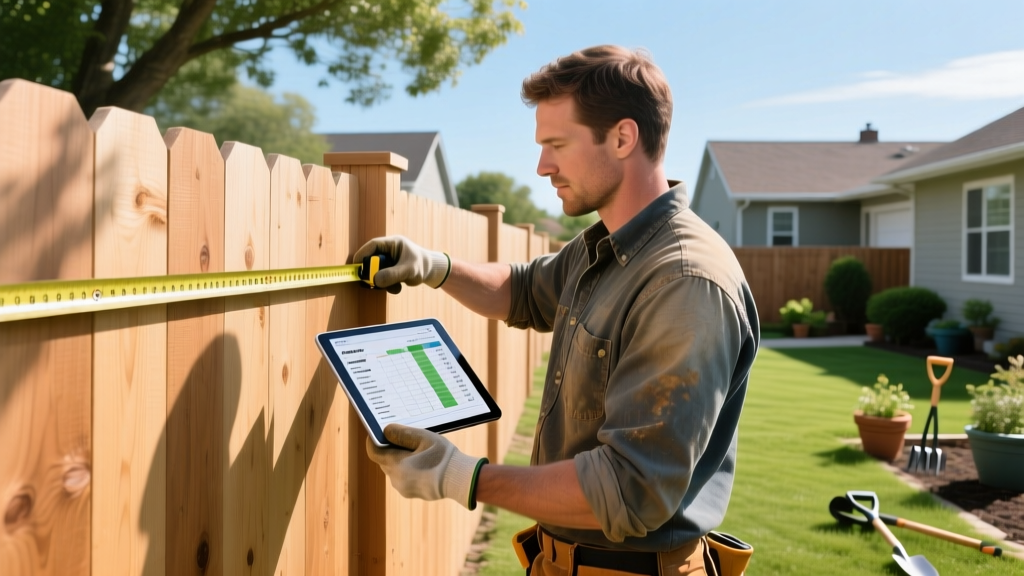
Annual Maintenance & Inspection Checklist
To protect your investment and minimize long-term repair costs, execute this targeted inspection and maintenance schedule every spring.
- Clear the Grade (March): Remove soil, mulch, and vegetation within 2 inches of the bottom rail or pickets. Soil contact traps moisture and invites termite foraging (for wood) or accelerates metal corrosion (for steel components).
- Hardware Torque Check (April): Check all structural brackets, tension bands, and hinge screws. Temperature cycling loosens standard wood screws over time. Replace any stripped or rusted fasteners with 18-8 stainless steel or polymer-coated structural screws (e.g., GRK Fasteners RSS).
- Plumb and Alignment Test (May): Use a 4-foot level on every third post. If a post is more than 1/4 inch out of plumb, excavate 6 inches of soil around the base and install a steel mending plate or concrete wedge anchor to stabilize it before the lean worsens.
- Surface Treatment (September): For wood fences, apply water-repellent sealers in early autumn. This allows the wood to dry out fully during the late summer months, ensuring maximum penetration before winter freeze-thaw cycles begin.
Repair vs. Replace Decision Matrix
Knowing when to patch a failing section versus tearing down the entire run is crucial for managing your long-term fencing budget. Use these thresholds to make financially sound decisions:
- Repair (Pickets): If less than 10% of the pickets are warped, cracked, or rotted, individual replacement is cost-effective. Ensure you keep a stash of spare pickets from the original build, as new lumber will not match the weathered color of the existing fence.
- Repair (Posts): If a post is rotting strictly at the concrete grade-line but is solid below, you can use a steel post repair spike (like the OZCO Steel Post Repair Kit) driven into the ground alongside the post to bypass the rot and restore structural integrity for roughly $45 per post.
- Replace (Structural Failure): If more than 20% of your structural posts show signs of below-grade rot, or if the fence is experiencing 'domino leaning' (where one leaning post pulls the entire connected section out of alignment), the structural integrity is compromised. At this stage, the labor cost to individually reset posts exceeds the cost of a full tear-down and rebuild.
- Replace (Vinyl Brittleness): If your vinyl fence shatters or cracks upon minor impact (e.g., a stray baseball or weed whacker), the PVC has lost its plasticizers due to severe UV degradation. The entire run must be replaced, as the material is no longer structurally viable.
Ultimately, the true cost to build a privacy fence is not just the check you write the contractor on installation day. By selecting materials that match your willingness to perform annual upkeep, and by enforcing strict installation standards like ground-contact lumber ratings and steel post anchors, you can extend your fence's lifespan by decades and dramatically lower your 15-year total cost of ownership.
Written by
Elena RodriguezElena Rodriguez is a civil engineer and technical writer specializing in concrete technology, masonry systems, and ASTM/ACI compliance. She earned her B.S. in Civil Engineering from Texas A&M University and spent a decade at a materials testing laboratory, performing over 2,000 concrete compressive strength tests and masonry prism evaluations. Elena is an ACI-certified Field Testing Technician (Grade I) and a member of ASTM Committee C12 on Natural Building Stone. She currently consults on forensic engineering cases involving concrete failures and moisture intrusion. Based in San Antonio, TX, Elena is a proud member of the Society of Women Engineers (SWE) and coaches her daughter's FIRST Robotics team.
More from Elena Rodriguez
View all
Walls & Panels
Cost Analysis: Light Gauge Steel Framing Advantages and Disadvantages
Evaluate light gauge steel framing advantages and disadvantages through a strict cost analysis lens, comparing material, labor, and lifecycle expenses.
Aug 4, 2026

Walls & Panels
Gypsum Board Types: Exact Specifications, Thickness & Dimensions
Compare standard, Type X, and moisture-resistant gypsum board types. Get exact specifications, thicknesses, dimensions, and ASTM standards for your project.
Aug 4, 2026

Fire Resistance
Best Fire-Resistant Outdoor Decking Materials: 2026 Buyer Guide
Discover the best fire-resistant outdoor decking materials for 2026. Compare Class A PVC, aluminum, and hardwood options for WUI compliance and safety.
Aug 4, 2026