Best Basement Floor Paint Brands & Epoxies for 2026
Compare top basement floor paint brands for 2026. Deep dives into Rust-Oleum, Kilz, and Drylok epoxies, including moisture prep, costs, and failure modes.
The Chemistry of Below-Grade Coatings: Why Standard Paint Fails
Concrete is essentially a hard sponge. In below-grade environments, the surrounding soil constantly pushes moisture vapor through the slab via capillary action. When homeowners apply standard acrylic latex basement floor paint, they create a non-permeable film. As moisture vapor transmission (MVT) rates exceed the coating's tolerance, osmotic pressure builds beneath the paint. Osmotic blistering occurs when water vapor passes through the concrete but cannot pass through the coating. The vapor condenses into liquid water beneath the film, drawing more moisture through the concrete via osmosis, creating immense localized pressure that results in bubbling, peeling, and catastrophic adhesion failure.
2026 Brand Deep-Dive: The Big Three Basement Floor Coatings
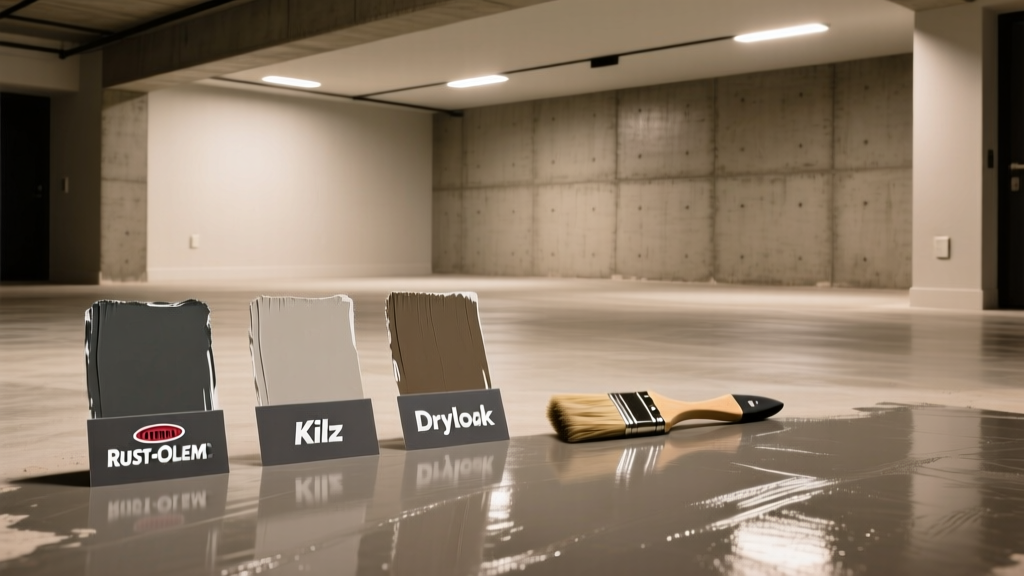
When evaluating the current market, three distinct product lines dominate the residential below-grade space. Each utilizes entirely different chemistry, dictating where and how they should be applied.
1. Rust-Oleum RockSolid Polycuramine
Traditional epoxies are rigid and prone to yellowing under UV exposure (less relevant in basements, but still a factor in walk-out basements). Rust-Oleum’s RockSolid line utilizes polycuramine chemistry, a proprietary hybrid that the manufacturer claims is 20 times stronger than standard epoxy. It is highly resistant to hot tire pickup, chemicals, and impact.
- Coverage: The 2.5-car garage kit (burst-pouch system) covers approximately 250 square feet at a mil thickness of 3-4 mils.
- Cost: $160–$185 per kit, translating to roughly $0.64–$0.74 per square foot.
- Prep Requirement: Mandatory mechanical diamond grinding or aggressive acid etching. The concrete must have a CSP (Concrete Surface Profile) of 2 or 3.
- Best For: Finished basement gyms, workshops, and high-traffic utility spaces requiring a seamless, high-gloss, chemical-resistant finish.
2. KILZ Over Armor Textured Concrete Paint
KILZ Over Armor is a 100% acrylic, high-build textured coating. Unlike thin epoxies, this product is designed to bridge hairline cracks (up to 1/4 inch) and hide surface imperfections like spalling or minor pitting. However, its acrylic nature means it has a much lower tolerance for subsurface moisture.
- Coverage: Because of its thick viscosity, one gallon covers only 75–100 square feet. Two coats are strictly required.
- Cost: ~$48 per gallon, equating to $1.20–$1.30 per square foot (factoring in two coats).
- Prep Requirement: Power washing and TSP (Trisodium Phosphate) cleaning. Acid etching is recommended for smooth troweled concrete.
- Best For: Older, slightly damaged basement floors where aesthetic concealment is prioritized over heavy chemical resistance, provided the slab is verified dry.
3. DRYLOK Extreme Concrete and Masonry Waterproofer
DRYLOK Extreme is not a decorative floor paint; it is a penetrating and film-forming masonry waterproofer. It utilizes a blend of Portland cement, silica sand, and proprietary active chemicals that react with free lime in the concrete to form insoluble crystalline structures. It is rated to withstand up to 15 psi of hydrostatic pressure.
- Coverage: 75–100 square feet per gallon.
- Cost: ~$42 per gallon, yielding $0.85–$1.10 per square foot (requires 2-3 coats for warranty compliance).
- Prep Requirement: Surface must be bare, unpainted, and etched. It cannot be applied over existing sealers or paints.
- Best For: Unfinished utility basements, root cellars, and crawlspaces where stopping active moisture intrusion is the sole objective, and aesthetics are secondary.
Product Comparison & Cost Matrix
| Product Line | Chemistry | Moisture Tolerance | Est. Cost / Sq Ft | Recoat Time |
|---|---|---|---|---|
| Rust-Oleum RockSolid | Polycuramine | Low (Requires dry slab) | $0.64 - $0.74 | 8-12 Hours |
| KILZ Over Armor | 100% Acrylic | Very Low (Vapor permeable but blisters) | $1.20 - $1.30 | 4-6 Hours |
| DRYLOK Extreme | Cementitious / Crystalline | High (Withstands 15 psi) | $0.85 - $1.10 | 2-4 Hours |
The Mandatory Pre-Application Protocol: ASTM D4263 Moisture Testing
Skipping moisture testing is the leading cause of basement floor paint failure. Before purchasing any product, you must quantify the Moisture Vapor Transmission (MVT) rate. While professional installers use calcium chloride test kits (ASTM F1869), homeowners can reliably perform the plastic sheet test, which aligns with the principles of ASTM D4263. For a deeper understanding of below-grade moisture dynamics, refer to the Building Science Corporation's guide on basement moisture.
- Cut the Plastic: Cut a 16x16 inch square of 4-mil clear polyethylene sheeting.
- Seal the Edges: Tape all four edges to the concrete floor using duct tape, creating an airtight seal.
- Wait 16 Hours: Leave the patch undisturbed for a minimum of 16 hours. Ensure the basement HVAC is running at normal operating temperatures.
- Evaluate: If the concrete under the plastic is darker than the surrounding floor, or if water droplets have formed on the underside of the plastic, your MVT is too high for standard epoxies or acrylics. You must use a moisture-mitigating primer or a crystalline waterproofer like DRYLOK.
Troubleshooting Common Failure Modes
Even with premium products, specific environmental factors can cause coating failure. Here is how to diagnose and prevent the most common issues:
Hot Tire Pickup
The Symptom: The paint peels off in sheets where car tires or heavy rubber equipment rest.
The Cause: Plasticizers in rubber tires migrate into the coating, softening it. When the tire cools and contracts, it grips the softened paint and pulls it from the concrete. This is common with cheap, water-based acrylic epoxies.
The Fix: Only use high-solids polycuramine (like RockSolid) or 100% solids epoxy. Ensure the ambient temperature is above 60°F during the entire 7-day cure cycle, not just the dry-to-touch phase.
Efflorescence Blistering
The Symptom: White, crusty blisters form under the paint film, eventually popping and leaving craters.
The Cause: Water moving through the concrete dissolves alkaline salts. When the water evaporates at the surface, the salts crystallize and expand, pushing the paint off the slab.
The Fix: Acid etching with muriatic or phosphoric acid prior to painting neutralizes surface alkalinity. For severe cases, apply a silicate-based concrete densifier before the topcoat to lock the capillaries.
Peeling at Control Joints
The Symptom: The coating cracks and delaminates precisely along the saw-cut control joints in the concrete.
The Cause: Concrete slabs expand and contract with seasonal temperature shifts. Control joints are designed to crack in a straight line to relieve this tensile stress. If you bridge a control joint with a rigid epoxy, the coating will bear the brunt of the slab's movement and snap.
The Fix: Never coat over active control joints. Use a chalk line to mark the joints, tape them off before rolling the paint, and fill them post-cure with a flexible, paintable polyurethane joint sealant like Sikaflex Self-Leveling Sealant.
Final Verdict: Matching the Product to Your Basement's Reality
There is no single "best" basement floor paint. The correct choice is dictated entirely by your slab's moisture profile and your functional requirements. If your slab passes the 16-hour plastic sheet test and you need a durable, attractive finish for a home gym or living space, Rust-Oleum RockSolid Polycuramine offers the highest ROI and chemical resistance. If you are dealing with an older, pitted floor in a dry basement, KILZ Over Armor provides excellent aesthetic concealment. However, if your basement suffers from active moisture intrusion or high hydrostatic pressure, bypass decorative paints entirely and seal the slab with DRYLOK Extreme to protect your home's structural integrity.
Always prioritize surface preparation over product cost. A $500 professional diamond grinding job will guarantee the adhesion of a $160 polycuramine kit, whereas skipping prep will guarantee a $160 failure. For safe indoor application, always verify the product's VOC levels align with EPA guidelines for indoor air quality, ensuring adequate cross-ventilation during the curing process.