Diagnosing a Floor Crack: Lifespan Impact and Durability Analysis by Material
Analyze the durability impact of a floor crack across concrete, tile, and wood. Learn diagnostic frameworks, repair thresholds, and lifespan extensions.
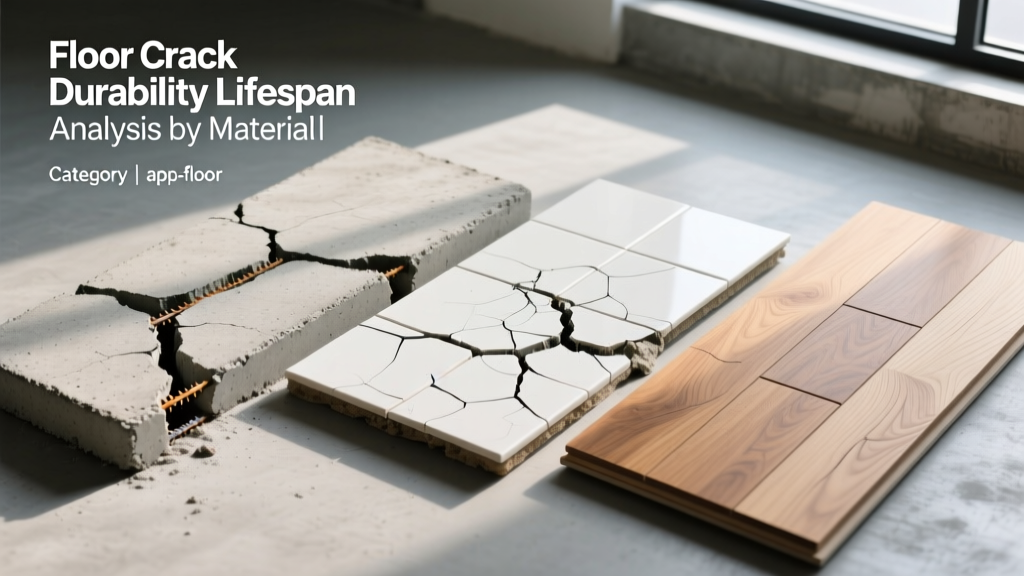
The Anatomy of a Floor Crack: Structural vs. Cosmetic
A floor crack is rarely just a visual defect; it is a physical manifestation of stress, moisture imbalance, or structural deflection. When analyzing the durability and remaining lifespan of a flooring system, the first step is classifying the fracture. Cosmetic cracks—typically limited to the wear layer or grout joints—do not compromise the structural integrity of the substrate. Structural cracks, however, penetrate the subfloor or slab, transferring kinetic energy to the finished floor and accelerating material fatigue.
The 3-Millimeter Rule of Thumb
In forensic flooring analysis, the 3-millimeter (approx. 1/8 inch) width threshold is the critical dividing line. Cracks narrower than 3mm are generally the result of plastic shrinkage or thermal cycling and can be managed with surface-level routing and sealing. Cracks exceeding 3mm often indicate differential settlement, heavy dynamic loading, or severe moisture-induced expansion. Once a floor crack breaches this width, the expected lifespan of rigid surface materials (like tile or stone) drops by an estimated 40% to 60% unless a decoupling membrane is introduced.
Material-Specific Crack Tolerance and Lifespan Degradation
Different flooring materials react to substrate fracturing in vastly different ways. Understanding these material-specific failure modes is essential for accurate lifespan forecasting.
Concrete and Cementitious Overlays
Concrete floors are designed to crack; control joints are intentionally placed to dictate where these fractures occur. However, random map cracking or structural floor cracks outside of joint lines signal a failure in the curing process or subgrade preparation. According to guidelines from the American Concrete Institute (ACI), active cracks in concrete slabs will continue to widen and narrow with seasonal temperature shifts. If a decorative concrete overlay is applied without addressing active substrate cracks, the overlay will reflect the crack within 6 to 12 months, effectively reducing its 20-year expected lifespan to less than 2 years.
Ceramic and Porcelain Tile
Tile possesses high compressive strength but virtually zero tensile flexibility. When a floor crack propagates through a concrete subfloor and reaches the tile assembly, the tile will snap rather than bend. The Tile Council of North America (TCNA) mandates the use of crack isolation membranes (meeting ANSI A118.12 standards) over known substrate fractures. Without a membrane like Schlüter-DITRA or a liquid-applied elastomeric coating like RedGard, a single active floor crack can cause a cascading failure across a 50-square-foot area, necessitating a complete tear-out long before the tile's inherent 50-year lifespan is reached.
Engineered and Solid Hardwood
Wood flooring rarely 'cracks' in the same way masonry does; instead, it checks, splits, or gaps. A literal split through the face of a hardwood plank is almost always a symptom of severe moisture differential. The National Wood Flooring Association (NWFA) specifies that the moisture content (MC) differential between the subfloor and the hardwood should not exceed 2% for strip flooring and 4% for wide plank flooring. When a floor crack appears in hardwood, it usually means the bottom of the board is absorbing moisture from an unsealed subfloor while the top is exposed to dry ambient air, causing the wood fibers to tear apart. Lifespan impact: Severe splitting compromises the structural tongue-and-groove lock, leading to localized deflection and requiring board replacement within 1 to 3 years.
Never patch a floor crack in a ground-level concrete slab without first performing an ASTM F2170 Relative Humidity (RH) test. Trapping hydrostatic moisture beneath an epoxy repair will cause the patch to delaminate and blister within months, accelerating the degradation of any subsequent floor covering.
Crack Progression Matrix: When to Repair vs. Replace
Use the following decision matrix to determine the viability of repairing a floor crack versus replacing the affected flooring section. This framework is based on 2026 industry standard restoration protocols.
| Material | Crack Type & Width | Substrate Condition | Lifespan Impact | Required Action |
|---|---|---|---|---|
| Polished Concrete | Hairline (<1mm) | Stable, dry | Negligible | Apply low-viscosity polyurea crack filler. |
| Polished Concrete | Structural (>3mm) | Active movement | Severe (Spalling risk) | V-cut, route, and install flexible polyurethane sealant. |
| Porcelain Tile | Single tile fracture | Stable subfloor | Moderate (Aesthetic) | Replace single tile; monitor adjacent grout lines. |
| Porcelain Tile | Continuous line crack | Slab deflection | Critical (Cascading failure) | Tear out 3ft perimeter, install ANSI A118.12 membrane, reinstall. |
| Solid Hardwood | Face checking | Humidity fluctuation | Low (Surface only) | Stabilize indoor RH to 35-55%; apply wood filler. |
| Solid Hardwood | Through-board split | High subfloor moisture | Critical (Structural failure) | Identify moisture source, dry subfloor, replace split boards. |
Root Cause Diagnostics: Why Your Floor is Failing
Repairing a floor crack without addressing the root cause is a temporary fix that will fail under continued stress. Execute this diagnostic sequence to identify the underlying catalyst.
- Deflection Testing: For suspended wood-framed floors, measure the deflection under load. The International Residential Code (IRC) mandates a maximum deflection of L/360 for live loads. If the floor bounces or deflects beyond this ratio, the floor crack is a result of joist undersizing or span overreach.
- Thermal Imaging: Use an infrared camera to scan the floor crack. Cold spots along the fracture line often indicate missing subfloor insulation or, more critically, a leaking hydronic radiant heating tube embedded in the slab, which washes out the subgrade and causes settlement.
- Moisture Mapping: Utilize a pinless moisture meter to map the area surrounding the crack. If moisture levels spike within 12 inches of the fracture, you are likely dealing with a capillary action issue drawing groundwater through a compromised vapor barrier.
To determine if a concrete floor crack is still active, snap a tight chalk line directly across the fracture. Check the line weekly for a month. If the chalk line snaps or fractures, the crack is actively moving and requires a flexible, elastomeric repair rather than a rigid epoxy injection.
Advanced Repair Technologies for Extended Lifespan
Modern flooring restoration has moved beyond simple cement patching. To restore the original design lifespan of a floor after a major fracture, specialized chemical and mechanical interventions are required.
Epoxy Injection for Structural Welding
For dormant structural cracks in concrete slabs, gravity-fed or pressure-injected epoxy (such as Simpson Strong-Tie SET-XP or SikaDur-35) effectively 'welds' the slab back together. The epoxy possesses a higher tensile strength than the concrete itself, restoring up to 90% of the slab's original load-bearing capacity and preventing the crack from transferring to an overlayment.
Stitch Drilling and Cross-Stapling
When a floor crack threatens to widen under heavy rolling loads (such as in commercial warehouses), stitch drilling is employed. This involves cutting transverse slots across the crack at 12-inch intervals, inserting deformed steel staples, and anchoring them with high-modulus epoxy. This mechanical lock prevents vertical shear and horizontal separation, extending the functional lifespan of the industrial floor by 15 to 20 years.
Frequently Asked Questions
Can I install luxury vinyl plank (LVP) over a cracked concrete subfloor?
Yes, but with strict conditions. LVP is a floating floor and will bridge minor hairline cracks. However, any floor crack wider than 1/8 inch or exhibiting vertical displacement (one side higher than the other) must be ground flat and filled with a Portland cement-based self-leveling underlayment. If left unaddressed, the continuous point-load will cause the LVP's click-lock mechanism to fatigue and snap within 12 to 18 months.
Does homeowners insurance cover floor crack repairs?
Generally, no. Insurance policies classify floor cracks resulting from normal settling, concrete shrinkage, and long-term moisture exposure as 'maintenance and wear' issues. Coverage is typically only triggered if the floor crack is the direct, sudden result of a covered peril, such as a burst pipe washing out the subgrade or a localized sinkhole event.
How often should I inspect control joints for new cracking?
For newly poured concrete floors, inspect control joints and surrounding areas at 7 days, 28 days, and 6 months. The vast majority of plastic shrinkage cracks appear within the first 48 hours, while drying shrinkage cracks develop over the first 28 days. Catching and sealing these early prevents moisture ingress that leads to freeze-thaw spalling in colder climates.