Floor Repair Cost Calculator: 2026 Material & Labor Guide
Calculate exact floor repair costs with our 2026 estimator. Includes material formulas, labor rates, and hidden subfloor prep expenses for wood and tile.
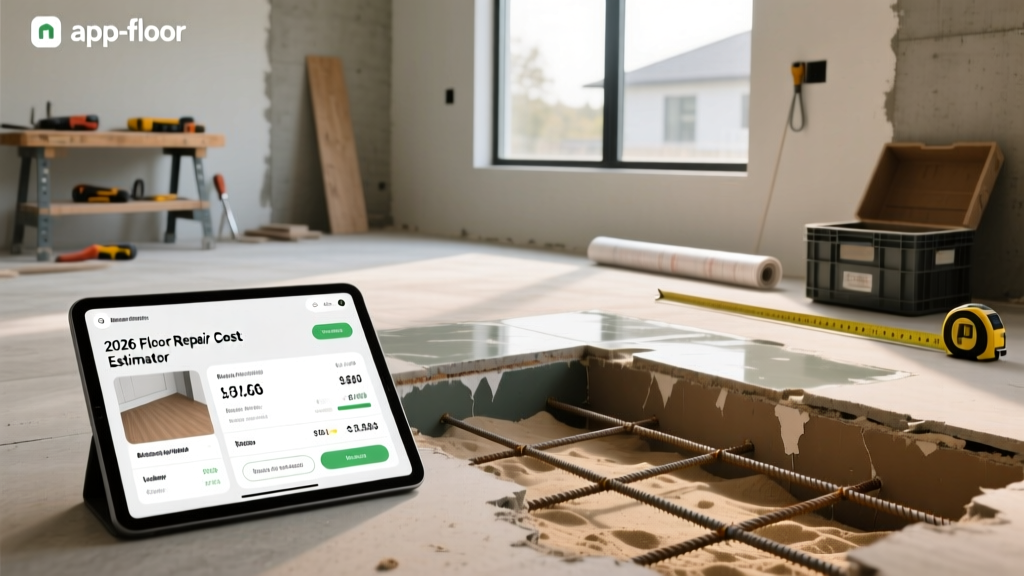
The True Cost of Floor Repair: Beyond the Surface
Accurate floor repair estimation requires calculating far more than the visible finish material. Surface damage—whether cracked porcelain, gouged oak, or buckling luxury vinyl plank (LVP)—frequently masks underlying structural deflection or moisture intrusion. In 2026, material costs for specialty repair compounds and uncoupling membranes have stabilized, but skilled labor rates for precision extraction and subfloor remediation continue to command a premium. This guide provides the exact formulas, material coverage rates, and labor matrices required to build a comprehensive floor repair estimate, eliminating the guesswork that leads to budget overruns.
Floor Repair Quantity Calculator: Formulas by Material
Hardwood: Board Lacing and Spot Refinishing
Repairing solid or engineered hardwood rarely involves a simple one-to-one square footage swap. 'Board lacing' (or weaving) requires cutting out damaged sections and staggering new boards into the existing field. Because you must cut away undamaged wood to reach the nearest joist or stagger joint, the waste factor is significantly higher than a standard installation.
- Minor Gouge/Scratch Repair: Calculate 1 quart of heavy-body wood filler (e.g., TimberMate) per 40 linear feet of damaged grain. Cost: $18-$24 per quart.
- Board Lacing Formula: (Damaged Area in Sq Ft × 2.5 Waste/Multiplier Factor) + 15% for end-matching. If repairing 10 sq ft of water-damaged oak, order 28.75 sq ft of matching milled lumber.
- Sanding/Finishing: Spot repairs require blending. Calculate a minimum 150 sq ft buffer zone for drum sanding and polyurethane application to ensure a seamless sheen transition.
Ceramic and Porcelain Tile: Chipping and Resetting
Tile repair costs are driven by extraction labor, not material price. Removing a single cracked 12x24 porcelain tile without fracturing the adjacent units requires precision oscillating tool work to sever the grout lines first.
- Extraction Labor: Budget 1.5 to 2 hours of skilled labor per single tile replacement.
- Thinset Mortar: Use a polymer-modified, large-format thinset (e.g., Mapei Ultraflex LFT). One 30 lb bag covers approximately 90 sq ft at a 1/2-inch notch, but for minor repairs, factor in the cost of a full bag ($38-$45) plus a 20% waste factor for drying and cleanup.
- Grout Matching: Cementitious grout batches vary. Always factor in one full box of pre-mixed urethane grout ($65-$85) to guarantee color consistency, as partial bags from previous installations will have oxidized.
If tile cracking is recurrent (more than two tiles in a single room), the substrate is failing. Standard thinset repairs will fail again within 12 months. You must factor in the installation of an uncoupling membrane like Schluter Ditra over the repaired concrete slab before resetting the tile, adding $1.85 to $2.40 per sq ft in materials.
2026 Labor & Material Cost Matrix
The following matrix outlines current national averages for professional floor repair. Regional variances (e.g., coastal metros vs. rural Midwest) can shift labor rates by ±22%.
| Flooring Type | Minor Repair (Per Sq Ft) | Major Repair / Reset (Per Sq Ft) | Subfloor Prep Adder |
|---|---|---|---|
| Solid Hardwood (3/4') | $6.50 - $9.00 (Fill/Sand) | $14.00 - $22.00 (Lacing) | +$4.50 - $7.00 (Joist Sistering) |
| Porcelain Tile (12x24) | $12.00 - $18.00 (Grout) | $18.00 - $28.00 (Reset) | +$2.50 - $4.00 (Membrane) |
| LVP / Laminates | $4.00 - $6.00 (Plank Swap) | $8.00 - $12.00 (Unzipping) | +$3.00 - $5.50 (Leveling) |
| Sheet Vinyl / Linoleum | $8.00 - $12.00 (Patch) | $15.00 - $20.00 (Section) | +$3.50 - $5.00 (Embossing Leveler) |
For authoritative guidelines on hardwood repair tolerances and acceptable board lacing practices, consult the National Wood Flooring Association (NWFA) technical manuals. For tile substrate prep and deflection limits (L/360), refer to the Tile Council of North America (TCNA) handbook.
Hidden Cost Variables: Subfloor & Moisture Mitigation
The most common point of failure in floor repair estimates is ignoring the substrate. If a floating floor is buckling or glue-down vinyl is blistering, the concrete or wood subfloor is likely out of tolerance or holding excess moisture.
Self-Leveling Underlayment (SLU) Calculations
Floating floors (LVP, laminate, engineered wood) require a flat substrate, typically tolerating no more than a 3/16-inch deviation over a 10-foot radius. Correcting dips requires a cementitious self-leveling underlayment (SLU) like Ardex K 15 or Mapei Novoplan 710.
- Coverage Rate: One 50 lb bag of premium SLU yields approximately 0.45 cubic feet. At a 1/8-inch thickness, this covers roughly 43 sq ft.
- Primer Requirement: SLU requires a specific primer (e.g., Ardex P 51) to prevent rapid moisture loss and pinholing. Factor in 1 gallon of primer per 200 sq ft of treated slab ($65/gallon).
- Cost Formula: (Total Sq Ft of Dips ÷ 43) × $48.00 (SLU bag cost) + Primer Cost + Labor ($2.50/sq ft).
Moisture Testing Requirements (ASTM F2170)
Before repairing glue-down floors or installing moisture-sensitive wood over concrete, you must perform in-situ relative humidity (RH) testing per ASTM F2170 standards. Surface meters are insufficient for warranty validation.
- Probe Placement: Code requires 3 probes for the first 1,000 sq ft, and 1 additional probe for every 1,000 sq ft thereafter.
- Consumable Cost: Single-use RH probe sleeves cost $12-$18 each. A digital reader (e.g., Wagner Orion 700) costs $450+ but is a capitalized tool, not a per-job consumable.
- Mitigation Adder: If RH levels exceed 75% (or the adhesive manufacturer's limit), you must apply a two-part epoxy moisture vapor barrier (e.g., Mapei Primer EP). Add $5.50 to $7.50 per sq ft for materials and specialized application labor.
DIY vs. Professional Repair: Break-Even Analysis
Determining whether to execute a floor repair in-house or hire a licensed contractor depends on the tooling required and the risk of cascading damage.
Surface-level hardwood screening and recoating, minor LVP plank swaps (if you have the manufacturer's pull-bar and tapping block), and epoxy grout injection for hairline tile cracks. Tool investment is under $150.
When to Hire a Professional:
Hardwood board lacing (requires blind-nailing and dustless drum sanding), tile extraction over radiant heat systems (high risk of severing PEX tubing), and any repair requiring concrete grinding or SLU pouring. Professional liability insurance covers substrate damage that DIYers must absorb out-of-pocket.
Step-by-Step Estimation Workflow
To finalize your floor repair estimate, follow this sequential workflow to ensure no hidden costs are omitted:
- Define the Failure Mode: Is the damage cosmetic (wear layer), mechanical (impact), or systemic (moisture/deflection)? Systemic failures require substrate remediation.
- Calculate Finish Material: Apply the correct waste multiplier (15% for standard tile, 150%+ for woven hardwood lacing).
- Factor Consumables & Prep: Add thinset, grout, SLU, primers, and moisture barriers based on square footage and depth.
- Estimate Extraction Labor: Multiply the damaged area by the hourly labor rate for demolition and debris disposal (factor in a $150-$250 dumpster or Bagster fee for masonry debris).
- Include Finishing Labor: Sanding, staining, sealing, or grouting. Note that cure times (e.g., 72 hours for urethane finishes) may require multiple site visits, increasing minimum trip-charge labor costs.
By utilizing these specific material coverage rates, labor multipliers, and substrate testing protocols, you can generate a highly accurate floor repair estimate that protects your margins and sets correct expectations for the project timeline. For further technical specifications on tile installation and repair tolerances, the National Tile Contractors Association (NTCA) provides extensive reference manuals for substrate preparation.