Strategic Wet Floor Sign Placement & Slip Prevention Playbook
Master wet floor sign placement, OSHA compliance, and flooring-specific drying times to eliminate slip hazards and reduce facility liability.
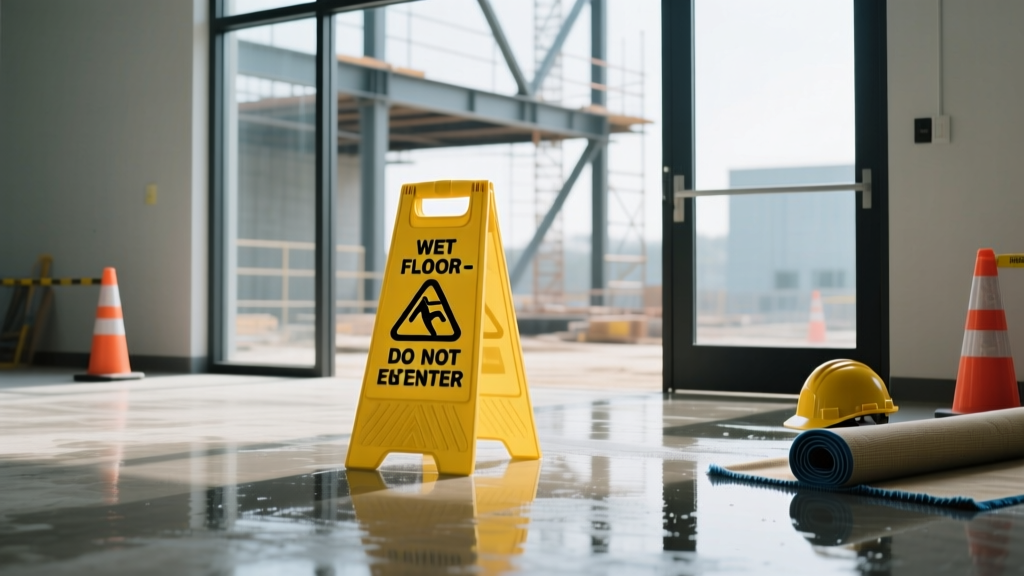
The Hidden Liability of Improper Wet Floor Sign Placement
Slip, trip, and fall incidents remain the leading cause of non-fatal workplace injuries, costing U.S. employers over $11 billion annually in direct workers' compensation claims, according to the National Safety Council. In commercial facility management, the humble wet floor sign is the primary legal and physical shield against these incidents. However, simply owning yellow A-frame signs is insufficient; improper placement, delayed deployment, and premature removal create severe legal vulnerabilities.
In premises liability law, the concept of constructive notice dictates that a facility is liable if a hazard existed long enough that staff should have known about it. If a janitor mops a 5,000-square-foot terrazzo lobby and places a single wet floor sign in the center, they have failed to warn patrons entering from the perimeter. The sign must be deployed at the exact point of entry to the hazard zone before the first drop of water touches the floor.
Under OSHA Standard 1910.22 (Walking-Working Surfaces), employers must ensure floors are maintained in a clean and dry condition. When wet processes are used, drainage must be maintained, and dry standing places must be provided or clearly marked. Failure to deploy signage during active maintenance or spill events can result in OSHA citations starting at $16,131 per violation in 2026, excluding civil liability from personal injury lawsuits.
Decoding ANSI Z535 Standards for Caution Signage
Not all yellow signs are legally compliant. The American National Standards Institute (ANSI) Z535 series governs the design, application, and use of safety signs in facilities. For wet floor hazards, the signage must strictly adhere to the CAUTION signal word protocol.
- Signal Word: Must read 'CAUTION' in black lettering on a safety yellow background. ('WARNING' is reserved for hazards that could cause serious injury or death, such as high-voltage electrical panels; using it for a wet floor dilutes its impact and violates ANSI hierarchy).
- Color Codes: The background must be Safety Yellow (Hex #FFD100, Pantone 109 C). The text and symbol must be solid black.
- Symbol Panel: Must include the universal slip-and-fall pictogram (a stick figure slipping with feet elevated) to bridge language barriers.
- Bilingual Text: In modern 2026 facility management, English/Spanish dual-text ('CAUTION / PRECAUCIÓN - WET FLOOR / PISO MOJADO') is considered the standard of care to ensure comprehension across all demographics.
Flooring-Specific Drying Times & Sign Removal Protocols
A major operational failure in commercial cleaning is sign blindness—the psychological phenomenon where pedestrians ignore safety signs that are left up long after a hazard has passed. If a wet floor sign remains in a hallway for three hours after the floor is dry, patrons will walk around it, assuming it is forgotten. When a genuine spill occurs later, they will ignore the sign, leading to a fall and a lost liability case.
Facility managers must train staff on the exact drying times of their specific flooring materials to ensure prompt sign removal.
| Flooring Material | Standard Mop Drying Time | Finish/Sealer Cure Time | Sign Removal Protocol |
|---|---|---|---|
| Vinyl Composition Tile (VCT) | 10 - 15 minutes | 20 - 30 mins per acrylic coat | Remove 15 mins post-mop; keep up during stripping/waxing. |
| Polished Concrete | 5 - 10 minutes | 2 - 4 hours (penetrating sealer) | Rapid removal post-mop; extended barricade for sealing. |
| Ceramic / Porcelain Tile | 15 - 25 minutes | N/A (grout may remain damp) | Use air movers; remove only when grout lines are dry. |
| Luxury Vinyl Tile (LVT) | 10 - 15 minutes | N/A (factory urethane coat) | Remove immediately upon visual dryness to prevent scuffing. |
| Epoxy / Urethane Resin | 15 - 20 minutes | 12 - 24 hours (new install) | Use physical barricades, not just signs, during cure. |
The 3-Tier Deployment Strategy for High-Traffic Zones
Placing a single sign in the middle of a spill is a critical error. Pedestrians approach from multiple vectors, and sightlines are often blocked by retail displays, lobby furniture, or crowds. Implement a 3-tier deployment framework to establish a legally defensible perimeter.
- Tier 1: The Point of Origin (The Hazard). Place the first sign directly adjacent to the spill or the starting point of the mopping zone. This marks the exact epicenter of the hazard.
- Tier 2: The Approach Vectors (Sightline Intercepts). Place signs 5 to 8 feet away from the hazard at every major intersection, doorway, or elevator bank that feeds into the area. The sign must be visible before the pedestrian commits to the path.
- Tier 3: The Physical Barrier (High-Risk Zones). In areas with blind corners, stairwells, or high-speed pedestrian traffic (like hospital corridors), signs are insufficient. Use retractable belt barricades or safety cones connected with caution tape to physically block the route.
'A wet floor sign placed inside a puddle is a slip hazard itself. Signs must be deployed on the dry perimeter of the hazard zone, facing the direction of approaching foot traffic, ensuring the pedestrian has at least three strides to react and alter their path.'
— Facility Safety Best Practices, BuildMat Insight Maintenance Guidelines
Choosing the Right Sign: A-Frames vs. Cones vs. Smart Beacons
The physical design of your signage must match the environmental conditions of your facility. Drafty corridors, outdoor entryways, and ADA-compliant spaces require specialized equipment.
Standard A-Frame Signs
- Best For: Indoor lobbies, retail aisles, and flat commercial spaces.
- Limitations: Easily blown over by HVAC drafts or automatic door gusts. Standard lightweight models (under 2 lbs) are a liability in entryways.
- Upgrade: Specify dual-sided, heavy-duty A-frames with a minimum weight of 3.5 lbs and a low center of gravity.
Safety Cones with Collars
- Best For: Warehouses, outdoor walkways, and uneven surfaces where A-frames cannot stand.
- Limitations: Cones alone do not provide adequate text warning. They must be fitted with a 2-inch or 3-inch flexible 'CAUTION WET FLOOR' collar sleeve.
2026 Innovation: IoT-Enabled Smart Signs
Leading facility management firms are now deploying Bluetooth Low Energy (BLE) beacon-enabled wet floor signs. These devices integrate directly with the facility's Computerized Maintenance Management System (CMMS). When a janitor deploys the sign, the beacon logs the GPS coordinate and timestamp. When retrieved, it logs the removal time. In the event of a slip-and-fall lawsuit, the facility can produce an immutable digital audit trail proving the sign was deployed within 45 seconds of the incident and remained in place for the exact duration of the hazard.
Maintenance Team Training: Beyond Just Dropping the Cone
Equipment is only as effective as the staff deploying it. Janitorial training programs must move beyond basic mopping techniques to include spatial awareness and hazard communication.
✅ The 5-Point Pre-Cleaning Checklist
- Assess Vectors: Identify all doorways, elevators, and hallways leading to the cleaning zone.
- Deploy Perimeter First: Place all Approach Vector signs before bringing the mop bucket into the area.
- Check Stability: Ensure A-frame hinges are fully locked and the sign is stable against ambient air currents.
- Verify Visibility: Crouch to a pedestrian's eye level (and a wheelchair user's eye level) to ensure the sign is not obscured by displays or furniture.
- Set the Timer: Use a smartwatch or CMMS app to set a reminder for the flooring-specific drying time to prevent sign blindness.
By treating the wet floor sign not as a mere janitorial accessory, but as a critical piece of legal and safety infrastructure, facility managers can drastically reduce incident rates, protect their maintenance staff, and insulate the organization from catastrophic liability claims.