Top Floor Transition Strip Brands & Product Lines Compared
Compare top floor transition strip brands like Schluter, M-D, and Johnsonite. Explore product lines, materials, pricing, and installation specs.
The Critical Engineering Behind Floor Transitions
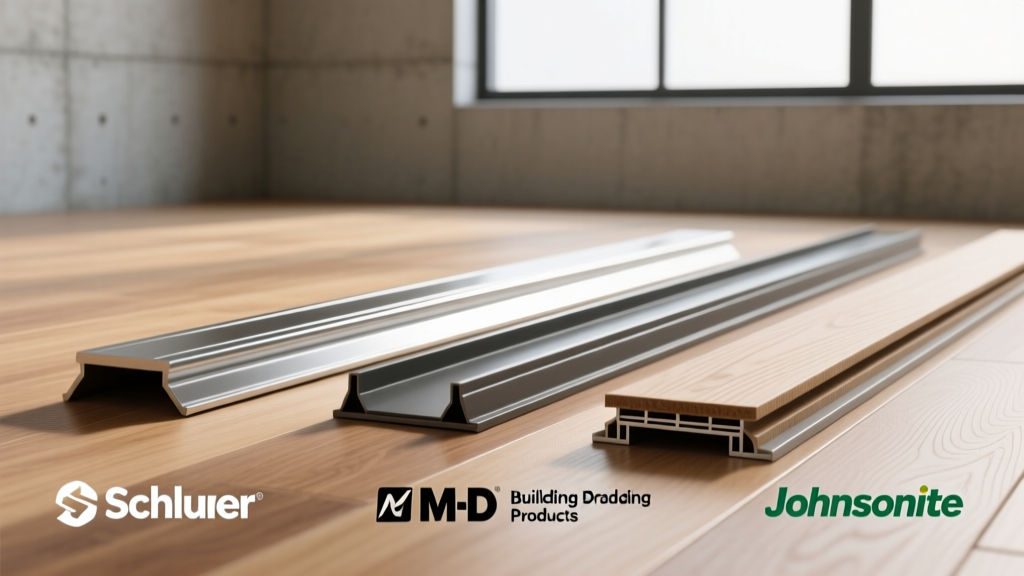
A floor transition strip is not merely a cosmetic trim piece; it is a vital structural component that manages differential expansion rates, bridges uneven subfloor elevations, and ensures compliance with accessibility standards. When bridging materials with vastly different coefficients of thermal expansion—such as ceramic tile and engineered hardwood—the wrong transition profile will inevitably lead to buckling, adhesive failure, or trip hazards. This deep dive analyzes the product lines of three dominant manufacturers—Schlüter Systems, M-D Building Products, and Johnsonite—breaking down their specific metallurgical and polymer formulations, pricing structures, and ideal application matrices.
Schlüter Systems: Premium Metal Profiles
Schlüter dominates the high-end residential and commercial tile-to-hardwood market with its RENO series. Unlike standard aluminum extrusions, Schlüter profiles are engineered with specific geometric tolerances to accommodate the natural movement of floating floors and the rigid nature of thin-set tile installations.
Core Product Lines
- Schlüter-RENO-T: A symmetric T-profile designed for same-height transitions (e.g., tile to tile, or tile to same-thickness hardwood). The visible surface is 2.5 inches wide, providing ample coverage for the mandatory 1/4-inch expansion gap on either side.
- Schlüter-RENO-V: A variable-height transition profile featuring a sloped flange. It is engineered to bridge height differentials from 1/8 inch up to 1/4 inch, making it ideal for transitioning from thick porcelain tile to thinner luxury vinyl plank (LVP).
- Schlüter-RENO-RAMP: A heavy-duty ramp profile designed for significant height drops, commonly used where tiled entryways meet lower sunken living rooms or commercial carpet zones.
M-D Building Products: Wood, Laminate, and Multi-Purpose Tracks
While Schlüter owns the tile transition space, M-D Building Products is the industry standard for wood, laminate, and LVP transitions. Their product lines focus on aesthetic continuity and versatile track systems that accommodate floating floor dynamics.
The 4-in-1 EasyTrim System
M-D’s flagship innovation is the multi-purpose track system. Instead of purchasing separate T-moldings, reducers, and end caps, contractors install a single aluminum or heavy-duty PVC sub-track into the subfloor. The interchangeable top caps snap into the track:
- T-Molding Cap: For floors of equal height.
- Reducer Cap: Angled down for transitioning to a lower surface like carpet or thin vinyl.
- End Cap Cap: L-shaped profile for terminating the floor at a sliding glass door or fireplace hearth.
- Stair Nose Cap: Overlapping bullnose for step-downs.
Pricing: The PVC track and cap kits range from $18 to $28 per 36-inch or 72-inch kit, while solid hardwood versions (oak, hickory, maple) range from $35 to $60 per 78-inch length. According to the National Wood Flooring Association (NWFA), solid wood transitions must be acclimated to the same moisture content as the adjacent field flooring to prevent seasonal gapping.
Johnsonite & Tarkett: Commercial & ADA-Compliant Profiles
In commercial, healthcare, and institutional environments, aesthetics take a backseat to ADA compliance, rolling load resistance, and chemical durability. Johnsonite (a Tarkett brand) manufactures vulcanized rubber and rigid vinyl transition strips specifically engineered for these high-abuse zones.
A500 and A600 Series Rubber Reducers
These profiles are extruded from high-durometer (85 Shore A) vulcanized rubber. Unlike standard PVC, which can become brittle and shatter under hospital bed wheels or heavy pallet jacks, vulcanized rubber compresses and rebounds.
ADA Compliance Factor: The Americans with Disabilities Act (ADA) mandates strict rules for floor transitions to prevent wheelchair caster catches and trip hazards. As outlined in the 2010 ADA Standards for Accessible Design, vertical changes in level up to 1/4 inch (6.4 mm) can be vertical, but changes between 1/4 inch and 1/2 inch (13 mm) must be beveled with a slope no greater than 1:2. Johnsonite’s A600 series features precisely engineered 1:2 bevels to ensure legal compliance in public corridors.
Brand & Application Comparison Matrix
| Brand | Primary Product Line | Core Material | Avg. Cost (per linear ft) | Best Application | Installation Method |
|---|---|---|---|---|---|
| Schlüter | RENO-T / RENO-V | Anodized Aluminum / Stainless Steel | $2.20 – $5.80 | Tile to Hardwood / Tile to LVP | Thin-set mortar embedment or polyurethane adhesive |
| M-D Products | 4-in-1 EasyTrim / Solid Wood | MDF, Solid Hardwood, PVC Track | $1.50 – $4.50 | Laminate, LVP, Engineered Wood | Track-and-snap or direct nail/glue |
| Johnsonite | A500 / A600 Reducers | Vulcanized Rubber / Rigid Vinyl | $2.00 – $3.50 | Commercial VCT, Sheet Vinyl, Carpet | Contact cement or double-sided flooring tape |
Critical Installation Failure Modes & Edge Cases
Even the most expensive Schlüter or Johnsonite profile will fail if the underlying installation mechanics are misunderstood. Below are the three most common field failures and their engineered solutions.
Failure Mode 1: The 'Floating Floor Lock'
Symptom: Laminate or LVP flooring buckles, peaks, or separates at the seams 3 to 6 months after installation, specifically radiating outward from a doorway transition.
Cause: The installer nailed or glued a solid wood T-molding directly through the floating floor, pinning it to the subfloor. Floating floors require continuous, unobstructed lateral movement (up to 1/2 inch per 30 feet of span). Pinning the floor creates immense compressive stress.
Fix: Always use a track system (like the M-D EasyTrim) for floating floors. The track is fastened to the subfloor, and the floating floor slides freely beneath the overlapping lip of the snap-in cap. Alternatively, use a floating transition strip that glues only to the transition itself, not the subfloor.
Failure Mode 2: Adhesive Incompatibility on Metal Profiles
Symptom: A metal Schlüter RENO-T profile lifts out of the thin-set or adhesive bed, creating a hollow sound and a trip hazard.
Cause: Using standard silicone or acrylic latex caulk to secure metal profiles to wood subfloors. Silicone lacks the sheer strength to resist the lateral foot traffic and thermal expansion forces exerted by the adjacent hardwood.
Fix: For wood subfloors, secure metal profiles using a high-quality, moisture-curing polyurethane construction adhesive (such as PL Premium or Bostik Ultra-Set). For concrete subfloors, embed the profile's anchoring leg directly into the polymer-modified thin-set mortar used for the adjacent tile.
Failure Mode 3: Ignoring the Expansion Void
Symptom: The transition strip bows upward in the center or snaps at the seams during peak summer humidity.
Cause: Failing to cut the adjacent flooring back to create a true 1/4-inch expansion void beneath the transition strip. If the hardwood or laminate expands and hits the rigid metal or wood track, the kinetic energy has nowhere to go but up.
Fix: Use a specialized undercut saw or an oscillating multi-tool to ensure the expansion gap beneath the transition lip is completely clear of debris, drywall mud, and flooring offcuts. Consult the Schlüter Systems profile technical data for exact void clearance requirements based on the specific profile depth.