Floor Squeegee Performance Specs: Blade Durometer & Material Guide
Master floor squeegee performance specs. Compare blade durometer, Shore A ratings, and edge profiles for epoxy, concrete, and industrial cleaning.
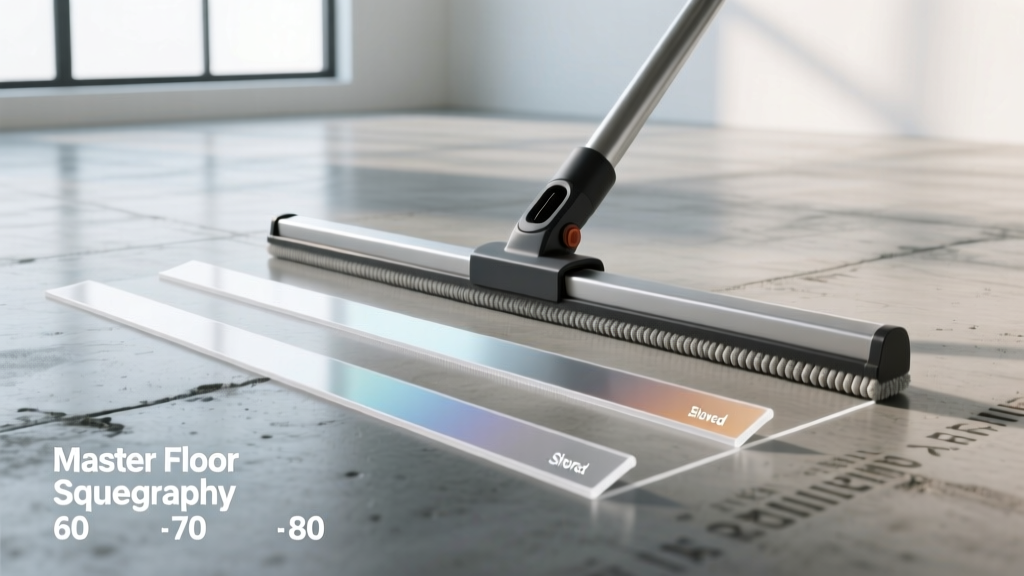
Core Performance Metrics for Industrial and Resinous Flooring
Selecting the correct floor squeegee is a critical variable in resinous flooring installation, concrete slurry management, and industrial facility maintenance. Unlike standard consumer cleaning tools, professional-grade floor squeegees are engineered to specific durometer ratings, chemical resistance thresholds, and edge tolerances. Using an improperly specified blade can result in uneven mil-thickness in self-leveling epoxies, streaking in polyurethane topcoats, or inadequate slurry evacuation during concrete grinding.
Quick Spec Reference: The Big Three
- Durometer (Shore A): Dictates blade flexibility and substrate conformity.
- Edge Profile: Determines fluid dynamics, metering accuracy, and debris clearance.
- Polymer Composition: Governs chemical resistance to solvents like MEK, xylene, and acetone.
Blade Material and Shore A Durometer Ratings
The hardness of a squeegee blade is measured using the Shore A durometer scale, standardized under ASTM D2240. This scale ranges from 0 (extremely soft, gel-like) to 100 (hard, rigid plastic). For flooring applications, blades typically fall between 50A and 90A. The durometer rating directly impacts how the blade interacts with microscopic pores and undulations in concrete substrates.
Neoprene (60A - 75A)
Neoprene is the industry standard for spreading self-leveling epoxy and polyaspartic coatings. A 60A neoprene blade offers high flexibility, allowing it to conform to the natural profile of shot-blasted concrete (CSP 2 to CSP 4). This conformity ensures the resin is pushed into the pores rather than floating over them. However, neoprene is susceptible to swelling when exposed to aggressive solvents for prolonged periods.
Polyurethane (80A - 95A)
Polyurethane blades are significantly stiffer and offer superior abrasion resistance. They are primarily used for heavy-duty slurry evacuation during wet concrete grinding and for pushing heavy, aggregate-filled mortar systems. An 85A polyurethane blade will not conform to minor substrate pitting, making it unsuitable for thin-film topcoats, but it excels at scraping dried debris and moving high-viscosity materials without deforming under lateral load.
EVA Foam (Closed-Cell)
Ethylene-vinyl acetate (EVA) foam squeegees operate outside the traditional Shore A scale but function similarly to a 40A-50A rating. EVA is completely non-absorbent and highly resistant to chemical degradation. These are specified for delicate polished concrete maintenance and cleanroom environments where leaving behind microscopic rubber particulates from degrading neoprene is unacceptable.
| Material | Shore A Range | Primary Flooring Application | Solvent Resistance |
|---|---|---|---|
| Neoprene | 60A - 75A | Self-leveling epoxy, polyaspartic topcoats | Moderate (Swells in MEK) |
| Polyurethane | 80A - 95A | Concrete slurry, aggregate mortars, scraping | High |
| EVA Foam | N/A (Soft) | Polished concrete, cleanrooms, daily washing | Excellent (Non-absorbent) |
| Nitrile Rubber | 65A - 80A | Chemical plant maintenance, acid spill cleanup | Superior (Oil/Acid resistant) |
Edge Profiles: Flat, Beveled, and V-Notch
The geometry of the blade edge dictates fluid displacement and film thickness control. Specifying the correct profile is just as critical as selecting the durometer.
- 90-Degree Flat Edge: Designed for pushing high volumes of water, slurry, or debris. The blunt edge creates a strong seal against flat substrates but will skip over uneven concrete, leaving puddles behind. Best for flat-sawn concrete and sealed surfaces.
- Single or Double Bevel (1/16" to 1/8"): The beveled edge acts as a wedge, sliding under thin films of liquid. This is the mandatory specification for self-leveling epoxy installation, as it allows the installer to meter the resin smoothly without creating ridges or trapping air bubbles.
- V-Notch (1/16", 1/8", 1/4"): Often integrated into combination squeegee/gauge rake tools. The notches dictate the maximum wet mil thickness of the coating. Technical Insight: Pulling a 1/8" notched squeegee at a 45-degree angle yields a thinner wet film than pulling it at a strict 90-degree angle due to the geometric reduction in the notch opening relative to the substrate.
Handle Ergonomics and Chassis Threading
While the blade interacts with the floor, the chassis and handle dictate the installer's mechanical advantage and fatigue levels. Modern 2026 flooring systems often require rapid installation across thousands of square feet, making handle specifications vital.
Thread Standard Warning: Always specify ACME (American National Standard) trapezoidal threads for heavy-duty flooring squeegees. Standard NPT (National Pipe Taper) threads, commonly found on consumer-grade push brooms, will strip under the lateral torque required to move high-viscosity epoxy or heavy concrete slurry. ACME threads provide a square, load-bearing surface that prevents cross-threading and failure.
Chassis brackets should be constructed from extruded aluminum or magnesium alloys. Aluminum provides the necessary rigidity to prevent the blade from bowing in the center during a 36-inch or 48-inch pull. If the chassis bows, the center of the blade lifts off the substrate, resulting in a thick ridge of epoxy in the middle of the pass and thin edges—a primary cause of coating delamination.
Chemical Degradation and Blade Replacement Cycles
Resinous flooring installers frequently use methyl ethyl ketone (MEK), xylene, and acetone for tool cleanup. These solvents actively degrade squeegee polymers over time. Neoprene blades exposed to MEK will absorb the solvent, leading to volumetric swelling and a permanent drop in Shore A hardness. A 70A neoprene blade can degrade to an effective 50A after just four hours of continuous solvent exposure, rendering it useless for precision topcoat application.
Maintenance Protocol for Epoxy Installers
To maximize blade lifespan and maintain durometer integrity, wipe neoprene blades with a dry rag immediately after use. If solvent washing is required, use a fast-evaporating solvent like acetone, and hang the blade vertically in a ventilated area to allow trapped vapors to escape. Never store squeegees resting on their blade edges, as the polymer will take a permanent set (deformation) within 48 hours, creating a flat spot that will leave streaks on your next job.
Sizing Guidelines and Overlap Mathematics
Choosing the correct squeegee width minimizes installation time while ensuring proper overlap. The general rule for resinous flooring is to select a blade width that allows for a 2-inch to 4-inch overlap on the previous pass.
- 18-inch to 24-inch: Specified for residential garages, commercial bathrooms, and tight corridor spaces. Allows for high maneuverability around floor drains and plumbing penetrations.
- 36-inch: The standard for open commercial spaces, retail showrooms, and standard warehouse aisles. Requires a rigid aluminum chassis to prevent center-bow.
- 48-inch to 60-inch: Reserved for large-scale industrial facilities and aviation hangars. These require two installers or specialized weighted handles to maintain uniform downward pressure across the entire blade span. Using a 60-inch blade with insufficient downward pressure will result in the edges biting into the substrate while the center glides over the resin.
Compliance and Safety Considerations
Beyond installation, the floor squeegee is a critical safety tool for facility maintenance. Proper slurry and water evacuation directly impacts compliance with OSHA Walking-Working Surfaces standards. Leaving standing water or slippery grinding slurry on a concrete floor creates an immediate slip hazard. Facilities utilizing wet-grinding protocols must equip maintenance teams with 80A polyurethane beveled squeegees to aggressively evacuate silica-laden water into designated wet-vacuum containment zones, ensuring both slip-prevention and silica dust mitigation.