Matching Wet Floor Signs to Commercial Flooring Scenarios
Match wet floor signs to commercial flooring types. Learn OSHA compliance, base engineering, and scenario-specific deployment for maximum slip safety.
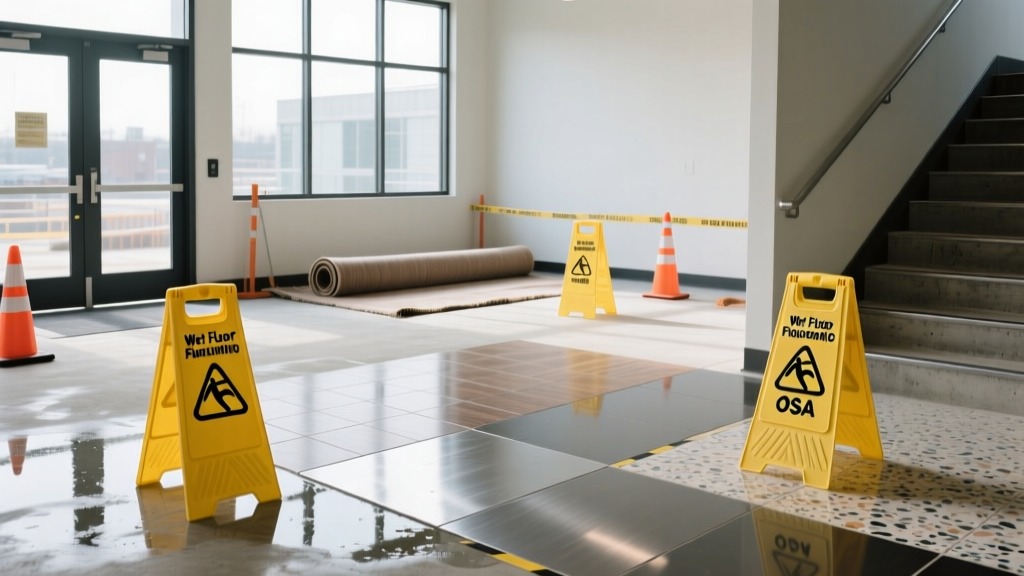
The True Cost of Ignoring Flooring-Specific Signage
Slips, trips, and falls remain one of the most expensive liabilities in commercial facility management. According to the Liberty Mutual Workplace Safety Index, these incidents cost United States employers billions annually in direct workers compensation claims. When a flooring surface transitions from a high-traction asset to a frictionless hazard due to moisture, the deployment of wet floor signs is not merely a courtesy; it is a strict regulatory requirement under OSHA standard 29 CFR 1910.22 for Walking-Working Surfaces.
However, a critical failure point in facility management is treating all wet floor signs as universally interchangeable. A standard lightweight plastic A-frame sign that works adequately on textured ceramic tile will slide uncontrollably across wet polished concrete and fail to adhere to smooth epoxy. Matching the physical engineering of the warning sign to the specific coefficient of friction (COF) and surface texture of the underlying flooring material is essential for both legal compliance and actual pedestrian safety.
Scenario Matching: Pairing Sign Types with Floor Finishes
Different floor finishes react differently to moisture, and the signage deployed must counteract those specific physical properties. The National Floor Safety Institute (NFSI) categorizes floor surfaces by their dynamic coefficient of friction (DCOF). When a floor's DCOF drops below 0.42 due to water, the warning sign must remain perfectly stationary despite being bumped by carts, footwear, or air currents.
| Flooring Material | Wet Surface Behavior | Ideal Sign Type | Required Base Engineering |
|---|---|---|---|
| Polished Concrete | Near-zero friction; highly slippery when wet. | Weighted A-Frame (3-5 lbs) | Thermoplastic Rubber (TPR) treads for high-grip anchoring. |
| Terrazzo | Smooth but prone to micro-scratching from hard plastics. | Low-Profile A-Frame | Non-marring felt or soft silicone pads to protect acrylic sealants. |
| Epoxy / Urethane | Ultra-smooth resin; standard feet will hydroplane. | Suction-Cup Base or Cone | Vacuum-seal suction cups or heavy rubberized cone bases. |
| Luxury Vinyl Tile (LVT) | Moderate slip risk; wear layer can be gouged. | Standard A-Frame | Smooth, rounded plastic feet without exposed metal screws. |
| Textured Ceramic Tile | High friction, but deep grout lines prevent flat sealing. | 360-Degree Cone Sign | Weighted, flexible base that conforms to uneven grout joints. |
Base Engineering: Protecting the Floor While Securing the Sign
The underside of a wet floor sign interacts directly with the flooring finish. Facility managers frequently overlook how the sign itself can cause thousands of dollars in floor damage over time.
Standard injection-molded A-frame signs often have microscopic burrs or sharp edges on their plastic feet from the manufacturing mold line. When dragged across Vinyl Composition Tile (VCT) or Luxury Vinyl Tile (LVT), these burrs act like sandpaper, permanently scratching the polyurethane wear layer. Always specify signs with injection-molded TPR (Thermoplastic Rubber) over-molded feet for resilient flooring.
For ultra-smooth surfaces like metallic epoxy or highly polished terrazzo, gravity alone is insufficient to keep a sign upright if a pedestrian's shoe catches the edge. Suction-cup equipped signs, such as those utilizing a 4-inch silicone vacuum base, create an airtight seal against the non-porous resin, requiring upward force to remove rather than lateral force. This prevents the sign from being accidentally kicked into a walkway, which creates a secondary tripping hazard.
Overcoming Sign Blindness in High-Traffic Corridors
In large retail environments or hospital corridors, pedestrians develop 'sign blindness' to standard yellow A-frames. To combat this, safety engineers utilize 360-degree visibility solutions. Cone-style wet floor signs, which feature a 28-inch height and four-sided messaging, are highly effective in wide-aisle retail environments where shopping carts might obscure a traditional bi-fold A-frame.
Furthermore, aerodynamics play a hidden role in sign deployment. In corridors with high-velocity HVAC return air vents or exterior entryways subject to wind drafts, lightweight signs will tip over. For these scenarios, facility teams must deploy barricade-style signs with wide, weighted stanchion bases that lower the center of gravity and resist lateral wind loads up to 15 mph.
Specialty Environments: Healthcare and Industrial Flooring
Healthcare (Sheet Vinyl and Linoleum)
Hospitals utilize homogeneous sheet vinyl and linoleum for their seamless, bacteria-resistant properties. When these floors are wet-mopped with quaternary ammonium disinfectants, they become exceptionally slick. In healthcare, wet floor signs must also comply with strict infection control protocols. Signs used in these environments should be made of non-porous, high-density polyethylene (HDPE) that can be sprayed down and wiped with hospital-grade disinfectants without degrading the plastic or fading the ANSI-compliant yellow pigments.
Industrial (Urethane Cement and Epoxy)
Food processing plants and commercial kitchens rely on urethane cement flooring, which is heavily textured with aluminum oxide or quartz aggregates to maintain a high COF even when covered in oils and water. Standard A-frame signs are useless here; the textured floor prevents flat feet from resting evenly, causing the sign to wobble and fall. In these environments, heavy-duty, 3-pound weighted cones with flexible bases are mandatory. The weight forces the base into the aggregate valleys, while the bright yellow cone remains visible above the sightlines of forklift masts and pallet jacks.
Deployment and Retrieval Protocols for Maximum Compliance
Deploying the correct sign is only half the battle; the timing of deployment and retrieval is heavily scrutinized in slip-and-fall litigation. According to ANSI Z535 standards for safety colors and signal words, the yellow 'CAUTION' header is specifically designated for slip hazards.
OSHA and legal precedents dictate that a wet floor sign must be deployed before the mopping process begins, and it must remain in place until the floor is completely dry to the touch. Leaving a sign up on a completely dry floor for hours contributes to sign blindness, while removing it while the floor is still damp constitutes gross negligence.
For large commercial spaces, implement a 'leapfrog' deployment protocol. Custodial staff should place a sign at the leading edge of the wet area, mop backward, and place a second sign at the trailing edge. This creates a clearly defined hazard zone. Once the trailing edge is verified dry using a moisture meter or visual inspection, the trailing sign is retrieved, ensuring the warning footprint shrinks in real-time with the drying floor.
By aligning the physical properties of your wet floor signs with the specific material science of your commercial flooring, you transition from a reactive liability posture to a proactive, engineered safety environment.