Bathroom Floor Tile Ideas: Cost & Quantity Calculator
Calculate exact costs and quantities for your bathroom floor tile ideas. Includes 2026 waste factors, thinset yields, and waterproofing material budgets.
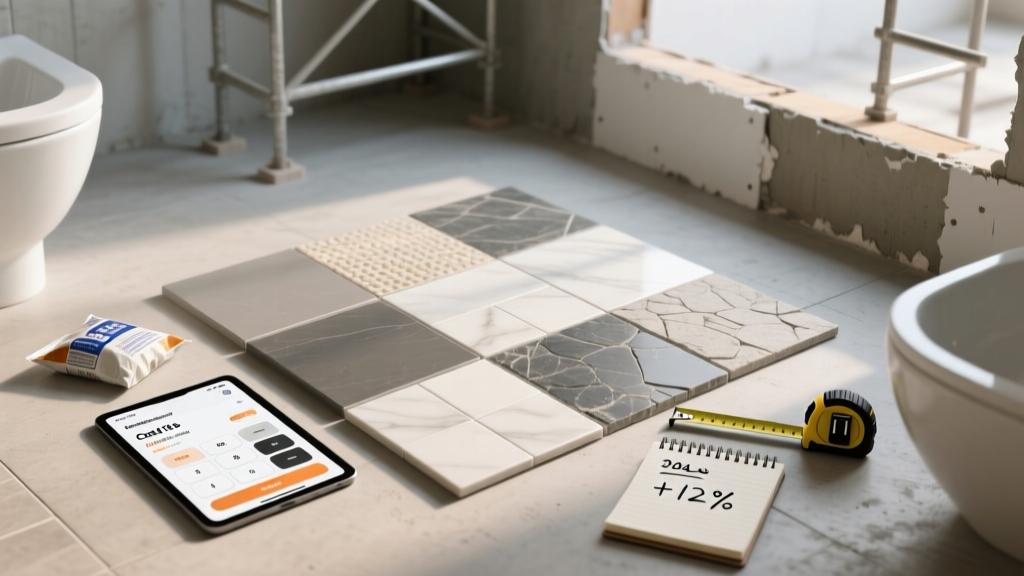
The Hidden Math Behind Bathroom Floor Tile Ideas
When browsing bathroom floor tile ideas, homeowners and designers typically focus on aesthetics: the veining in a Calacatta marble, the matte finish of a concrete-look porcelain, or the vintage charm of a hexagonal mosaic. However, every aesthetic choice dictates a strict mathematical reality for your budget. The shape, size, and installation pattern of your chosen tile directly impact the waste factor, the required trowel notch size for thinset, and the labor multiplier applied by professional installers.
A standard 50-square-foot bathroom might require 55 square feet of large-format tile, but that same space laid in a herringbone pattern could require 65 square feet of material, twice the amount of epoxy grout, and a 40% higher labor premium. To accurately estimate your project, you must align your design vision with precise quantity calculations. This guide bridges the gap between popular bathroom floor tile ideas and the hard data required to budget them accurately in 2026.
The industry-standard advice to 'add 10% for waste' only applies to square or rectangular tiles laid in a standard grid or brick-joint pattern in a perfectly square room. For diagonal layouts, herringbone, or complex mosaics in small bathrooms with multiple fixtures (toilet flanges, vanity kickplates, tub curves), a 10% buffer will result in material shortages, forcing you to buy from a different dye-lot batch and ruining the visual continuity of the floor.
Material Quantity Calculator by Tile Style
Different bathroom floor tile ideas demand different material overages. The table below outlines the precise waste factors and labor multipliers for the most popular 2026 bathroom tile trends, based on data synthesized from the National Tile Contractors Association (NTCA) guidelines.
| Tile Style & Idea | Nominal Size | Required Waste Factor | Labor Multiplier |
|---|---|---|---|
| Large Format Porcelain (Grid) | 24' x 48' | 15% | 1.2x |
| Hexagonal Mosaic (Sheeted) | 1' Hex (12'x12' sheets) | 12% | 1.1x |
| Wood-Look Plank (Herringbone) | 6' x 36' | 20% - 25% | 1.5x - 1.8x |
| Penny Round (Unsheeted/Bulk) | 3/4' Round | 18% | 2.0x |
Large Format Porcelain (The 'Spa' Look)
Large format tiles (any tile with one edge greater than 15 inches) minimize grout lines, creating a seamless, high-end spa aesthetic. However, according to the Tile Council of North America (TCNA), large tiles are prone to lippage (uneven edges) if installed in a 50% offset brick pattern. To prevent this, installers must use a 33% offset or a straight stack bond. Furthermore, the sheer size of a 24x48 tile means that cutting around a standard 6-inch toilet flange or a curved bathtub apron often destroys the remainder of the tile, pushing the waste factor to a mandatory 15%.
Hexagonal & Penny Mosaics (The 'Vintage' Look)
Mosaics are highly forgiving on uneven subfloors and offer exceptional slip resistance due to the high grout-to-tile ratio. While sheeted hexagonal mosaics are relatively easy to install (12% waste), unsheeted penny rounds require meticulous hand-placement and specialized floating techniques, drastically increasing labor costs. If your bathroom floor tile ideas involve loose mosaics, expect to pay a premium for the installer's time, even though the material itself might be inexpensive.
Herringbone Wood-Look Planks (The 'Classic' Look)
Herringbone patterns require a 45-degree or 90-degree angle cut at every room perimeter and fixture. In a small 5x8 bathroom, the ratio of perimeter cuts to field tiles is exceptionally high. You must calculate a 20% to 25% waste factor. Additionally, the 90-degree intersecting joints require perfect substrate flatness (no more than 1/8' deviation in 10 feet), often necessitating a self-leveling underlayment pour before installation begins.
Step-by-Step Cost Estimation Framework
To build an accurate budget, follow this sequential calculation framework rather than relying on generic online square-footage calculators.
- Calculate Net Square Footage: Measure the length and width of the room. Subtract the exact footprint of built-in vanities or cast-iron tubs that sit directly on the subfloor (do not subtract the toilet, as tile must run under the flange).
- Apply the Pattern-Specific Waste Factor: Multiply the net square footage by the waste factor from the table above (e.g., Net 45 sq ft x 1.20 for herringbone = 54 sq ft of tile to purchase).
- Calculate Linear Footage for Trim: Measure the perimeter of the room. Add 10% for miter cuts at outside corners. This determines your Schluter-RONDEC or bullnose trim requirements.
- Determine Thinset Volume: Match your tile size to the required trowel notch (see cheat sheet below) to calculate how many bags of mortar you need.
- Calculate Grout Volume: Use the manufacturer's coverage chart based on your specific tile thickness and joint width.
Thinset & Grout Yield Cheat Sheet
Using the wrong trowel size is the leading cause of tile failure in wet areas. The TCNA mandates specific notch sizes to ensure adequate mortar coverage (minimum 80% for dry areas, 95% for wet areas like bathroom floors).
| Material Type | Trowel / Joint Size | Coverage per Unit | 2026 Est. Unit Cost |
|---|---|---|---|
| Modified Thinset (50 lb bag) | 1/4' x 1/4' Square Notch | 90 - 100 sq ft | $22.00 |
| Large Format Mortar (50 lb bag) | 1/2' x 1/2' Square Notch | 45 - 55 sq ft | $38.00 |
| Cementitious Grout (25 lb bag) | 1/8' Joint (Standard Tile) | 120 - 150 sq ft | $24.00 |
| Epoxy Grout (2-Gallon Kit) | 1/8' Joint (Mosaic/Hex) | 60 - 75 sq ft | $85.00 |
Budgeting for Underlayment and Waterproofing
Tile is only as good as the substrate beneath it. In a bathroom, waterproofing the floor is non-negotiable to prevent structural rot and mold. You generally have two paths for bathroom floor underlayment, and their material costs often surprise DIYers who assume traditional methods are cheaper.
Path A: Uncoupling Membrane (Schluter-DITRA)
- Material Cost: ~$1.65 per sq ft.
- Installation: Embedded directly into unmodified thinset over plywood or concrete.
- Height Build-up: 1/8 inch (ideal for transitioning to hardwood in adjacent hallways).
- Waterproofing: Inherent when seams are banded with KERDI-BAND.
- Verdict: Higher upfront material cost, but saves labor time and prevents floor height issues.
Path B: Cement Board + Liquid Membrane
- Material Cost: ~$0.60 per sq ft (HardieBacker) + $0.85 per sq ft (RedGard liquid membrane) = $1.45 per sq ft.
- Installation: Requires mechanical fastening (screws every 8 inches) and thinset underneath the board, plus painting and drying time for the liquid membrane.
- Height Build-up: 1/2 inch (often requires transition reducers at doorways).
- Verdict: Slightly cheaper in raw materials, but significantly higher labor cost and creates floor height transition headaches.
Real-World Cost Scenarios (2026 Pricing)
To illustrate how different bathroom floor tile ideas impact the final bottom line, consider these two scenarios for a standard 50-square-foot bathroom (5' x 10').
Scenario A: The Modern Minimalist
Design: 24' x 48' matte concrete-look porcelain, straight stack layout.
- Tile Material: 58 sq ft (15% waste) @ $4.50/sq ft = $261.00
- Underlayment: 50 sq ft DITRA @ $1.65/sq ft = $82.50
- Mortar & Grout: 2 bags Large Format Mortar ($76) + 1 bag high-performance cement grout ($24) = $100.00
- Total Material Cost: $443.50 (approx. $8.87 per sq ft)
- Estimated Professional Labor: $6.00 - $8.00 per sq ft = $300 - $400
Scenario B: The Historic Restoration
Design: 1' unglazed porcelain hexagonal mosaic, sheeted, with a 6-inch border.
- Tile Material: 56 sq ft (12% waste) @ $8.00/sq ft = $448.00
- Underlayment: 50 sq ft DITRA @ $1.65/sq ft = $82.50
- Mortar & Grout: 1 bag modified thinset ($22) + 1 kit Epoxy Grout ($85 - required for unglazed hex to prevent staining) = $107.00
- Total Material Cost: $637.50 (approx. $12.75 per sq ft)
- Estimated Professional Labor: $9.00 - $12.00 per sq ft = $450 - $600
By mapping your specific bathroom floor tile ideas to these mathematical realities, you eliminate budget overruns and ensure you purchase the correct materials, thinset formulations, and waterproofing systems required for a lasting installation.