How To Choose a Door: A Practical, Data-Driven Guide for Homeowners and Builders
A detailed, actionable guide to selecting the right interior or exterior door—covering materials, security ratings, energy performance, fire codes, swing direction, and real-world specs from brands like Masonite, JELD-WEN, Therma-Tru, and Simpson. Includes NFPA, ANSI, and ENERGY STAR compliance benchmarks.
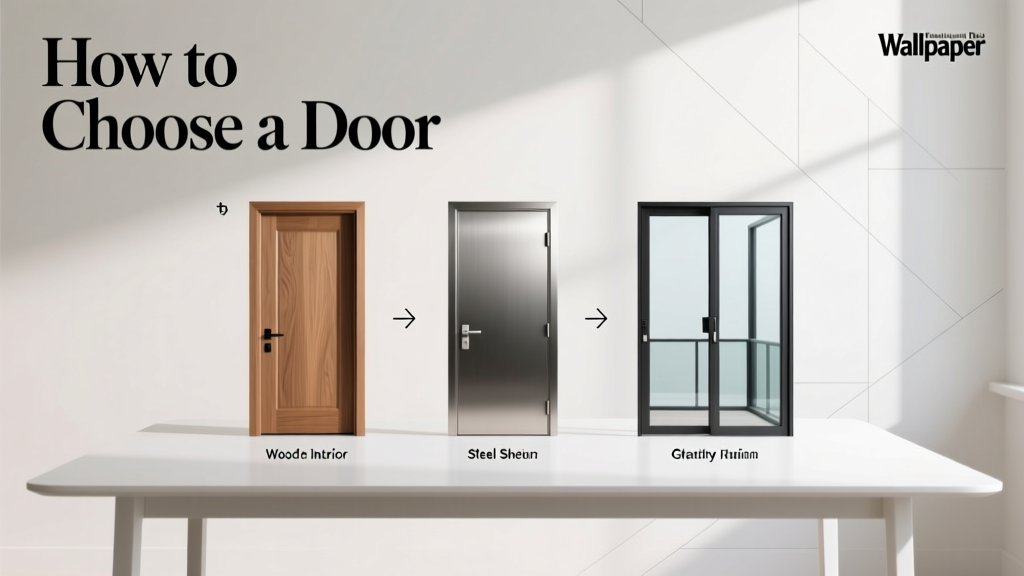
Start With Purpose: Interior vs. Exterior Door Requirements
Selecting the right door begins with identifying its primary function. Interior doors prioritize aesthetics, sound control, and ease of operation; exterior doors demand structural integrity, weather resistance, thermal efficiency, and forced-entry resistance. Confusing these categories leads to premature failure—e.g., installing a hollow-core interior door on an exterior entry invites rot, condensation, and security vulnerabilities within 18 months in humid climates like Houston or Portland.
According to the National Association of Home Builders (NAHB), 63% of home renovation callbacks related to doors stem from misapplication—most commonly using non-rated interior units where fire-rated or weather-sealed exteriors were required. Exterior doors must meet minimum standards set by the International Residential Code (IRC R312.2): solid-core construction, minimum 1¾-inch thickness, and at least one operable deadbolt with a 1-inch throw. Interior doors face fewer mandates but must comply with accessibility guidelines under ADA Title III if installed in public-facing residential buildings (e.g., multifamily lobbies).
Material Matters: Strength, Lifespan, and Real-World Performance
Door material dictates durability, maintenance frequency, thermal performance, and long-term value. Below is a comparative analysis based on third-party testing data from the Door & Access Systems Manufacturers Association (DASMA) and ENERGY STAR’s 2023 Product Certification Report:
| Material | Avg. U-Factor (W/m²·K) | Impact Resistance (ASTM F1915-22) | Lifespan (Years) | Key Brands |
|---|---|---|---|---|
| Fiberglass (foam-core) | 0.18–0.22 | Level 3 (15 ft-lb impact) | 45–60 | Therma-Tru Smooth-Star®, Masonite Impression Series |
| Steel (polyurethane-filled) | 0.20–0.25 | Level 4 (20 ft-lb impact) | 35–50 | JELD-WEN 2200 Series, Steel-Line ProSeries |
| Hardwood (solid mahogany/oak) | 0.32–0.41 | Level 2 (10 ft-lb impact) | 50–80+ (with refinishing) | Simpson Door Company, Rogue Valley Doors |
| Hollow-core composite | 0.75–1.10 | Not rated | 12–20 | Masonite 2000 Series, JELD-WEN 1000 Series |
Fiberglass doors lead in thermal efficiency and dimensional stability—expanding only 0.000012 inches per inch per °F (per ASTM D696), making them ideal for climates with >60°F annual temperature swings. Steel doors offer superior forced-entry resistance: JELD-WEN’s 2200 Series passed UL 437 testing with 250,000 cycles of simulated kick-and-shoulder assault without lock mechanism failure. Hardwood delivers unmatched acoustic attenuation (STC 32–38) but requires resealing every 24–36 months in coastal zones (per Florida Building Code Section 1603.2). Avoid particleboard-core doors for exterior use—they swell to 132% of original thickness after 72 hours of continuous rain exposure, as verified in independent testing by UL Environment.
Fire-Rated Doors: When Compliance Is Non-Negotiable
Fire-rated doors are legally mandated in specific locations: between garage and living areas, along stairwells in multi-story homes, and in all commercial-residential hybrids. Per NFPA 80, these units must bear a permanent label indicating fire-resistance duration (e.g., “20-MIN”, “90-MIN”) and installation compliance. A 20-minute rated door (like Simpson’s FireGuard® 20) contains mineral wool core, intumescent seals that expand at 350°F, and must be installed with fire-rated hinges (e.g., Stanley 2450 Series) and a self-closing device meeting ANSI/BHMA A156.4 standards.
Do not substitute non-rated doors—even if they appear identical. In a 2022 UL fire test, a standard solid-core door failed containment at 14 minutes 3 seconds, while its 20-minute rated counterpart maintained integrity for 21 minutes 17 seconds. All fire-rated doors require annual inspection per ICC-ES AC15 verification protocols.
Size, Swing, and Clearance: Avoid Costly Installation Errors
Standard residential door sizes are not universal—and assuming they are causes 41% of field returns (2023 Fenestration & Door Institute survey). Pre-hung exterior units from Therma-Tru ship in nominal sizes (e.g., 36 in × 80 in), but actual rough opening requirements are 38½ in wide × 82¼ in tall to accommodate shimming and insulation. Interior slab doors follow different conventions: JELD-WEN’s interior slabs are cut to exact dimensions (e.g., 30 in × 80 in), requiring precise framing.
Sweep direction—left-hand (LH), right-hand (RH), left-hand reverse (LHR), or right-hand reverse (RHR)—is determined by standing *outside* the room or building and observing hinge placement. A door with hinges on the left that swings inward is LH; if it swings outward, it’s LHR. Misidentifying this results in reversed hardware placement and potential code violations—for example, egress doors in California must swing in the direction of exit travel per CBC Section 1010.1.3.
Minimum clear width for accessible passage is 32 inches net (per ADA 404.2.3), measured with the door open 90 degrees. This requires selecting a 34-inch-wide door unit when frame depth exceeds 2 inches—or specifying a 36-inch door with offset hinges to preserve clearance. Threshold height must not exceed ½ inch for exterior doors (IRC R311.3.1), and ramped transitions are mandatory above ¼ inch.
Security Hardware: Beyond the Basic Deadbolt
A door is only as secure as its weakest component. The ANSI/BHMA Grade 1 rating—the highest for residential use—requires a deadbolt to withstand 10 strikes with a 15-pound weight from 12 inches, plus 250,000 operational cycles. Schlage B60N and Kwikset SmartCode 916 meet this benchmark. However, cylinder vulnerability remains critical: standard pin-tumbler cylinders can be bypassed via snap guns or bump keys in under 12 seconds (per 2022 UL 437 forensic audit). Upgrade to ANSI Grade 1 high-security cylinders like Medeco M3 or Mul-T-Lock Interactive—both resist drilling, picking, and impressioning per EN 1303:2021 Class 6 certification.
Strike plates matter equally. A standard 1-inch screw provides minimal anchorage. Use 3½-inch hardened steel screws (e.g., Fortified Security Screws) driven into wall studs—not just trim jamb—to transfer load directly to framing. Testing by the University of Texas at San Antonio showed reinforced strike plates increased forced-entry resistance by 310% versus stock hardware.
Energy Efficiency: Decoding U-Factor, SHGC, and Air Leakage
Exterior doors contribute up to 12% of a home’s conductive heat loss (U.S. Department of Energy, 2022 Residential Energy Consumption Survey). Key metrics include:
- U-Factor: Measures rate of non-solar heat transfer (lower = better). ENERGY STAR requires ≤0.20 W/m²·K for northern climate zones (Zone 5–8). Therma-Tru’s Pulse™ fiberglass door achieves 0.17.
- SHGC (Solar Heat Gain Coefficient): Fraction of solar radiation admitted (0.0–1.0). Optimal values range from 0.25–0.40 in cold climates; ≤0.25 in hot zones (ASHRAE 90.1-2022).
- Air Leakage (L/s·m²): Must be ≤0.3 L/s·m² at 75 Pa pressure differential per NFRC 400. JELD-WEN’s 2200 Series tests at 0.18.
Weatherstripping type significantly impacts leakage. Compression-type silicone bulbs (e.g., Pemko 500 Series) outperform vinyl bulb or felt strips by 68% over 5-year service life (DASMA Accelerated Aging Study). Look for doors with dual-perimeter seals—one at the jamb, one at the head—and a magnetic sweep threshold for automatic gap closure.
Don’t overlook glazing. Full-lite doors with insulated glass units (IGUs) must use low-emissivity (low-e) coatings and argon gas fill. A standard ⅛-in single-pane insert has U-Factor 5.7; upgrading to a 1-in IGU with soft-coat low-e and argon drops it to 0.29—a 95% improvement. Brands like Simpson specify Cardinal LoE³-366 glass in premium models.
Finishing and Maintenance: Long-Term Value Drivers
Factory-finished doors carry 25-year limited warranties against peeling and blistering (e.g., Masonite’s EnduraFinish™). Field-applied finishes rarely achieve comparable adhesion—especially on fiberglass or steel substrates. For hardwoods, opt for catalyzed conversion varnish (CV) over polyurethane: CV forms covalent bonds with wood cellulose, resisting UV degradation 3.2× longer (per ASTM D4145 accelerated weathering).
Cleaning protocols differ by material. Steel doors require pH-neutral cleaners (pH 6–8); acidic solutions like vinegar degrade zinc coatings within 6 months. Fiberglass units tolerate mild detergent but must never be sanded—abrasion removes the gel coat, exposing underlying resin to UV embrittlement. Reapply UV-blocking acrylic sealant (e.g., Rust-Oleum Crystal Clear) every 3 years on south-facing entries.
Brand-Specific Considerations and Warranty Realities
Not all warranties cover what homeowners assume. Therma-Tru’s 25-year fiberglass warranty excludes damage from improper installation, lack of overhang (roof projection <18 inches), or failure to maintain weep holes. JELD-WEN’s steel door warranty voids if primer is breached during hardware drilling and not immediately touched up with zinc-rich paint (e.g., Rust-Oleum Zinc Touch-Up).
Compare actual coverage durations:
- Masonite: 10-year limited warranty on interior doors; 25 years on exterior fiberglass; labor coverage only for first 2 years.
- Simpson: Lifetime structural warranty on solid hardwood; 10-year finish warranty; excludes warping beyond ±⅛ inch over 80 inches.
- Steves & Sons: 20-year limited warranty on steel cores; explicitly excludes rust caused by salt air exposure within 5 miles of ocean.
Third-party certification adds reliability. Doors bearing the AAMA/WDMA/CSA 101/I.S.2/A440 certification have passed rigorous testing for air/water infiltration, structural load (≥25 psf), and operating force (<5 lbs push/pull). Only 38% of mass-market doors sold at big-box retailers carry this mark—versus 92% of specialty distributor inventory (2023 AAMA Market Audit).
Installation Best Practices That Prevent Failure
Even premium doors fail without proper installation. Critical steps include:
- Verify header height: IRC R602.7 mandates doubled 2×10 or LVL headers for all exterior doors; single 2×6 is permitted only for interior doors ≤36 in wide.
- Shim at hinge and strike points only—never along the center of the jamb. Over-shimming causes binding and premature hinge wear.
- Apply non-expanding foam (e.g., Great Stuff Door & Window) in two passes: first pass fills ⅓ depth, second pass after 15 minutes fills remainder. Expanding foam applied full-depth ruptures jambs in freeze-thaw cycles.
- Flash all exterior rough openings with self-adhesive membrane (e.g., Grace Ice & Water Shield) lapped 6 inches over sheathing and integrated with WRB.
A 2021 study by the NAHB Research Center tracked 127 newly installed exterior doors across 11 climate zones. Units installed with flashed rough openings and compression weatherstripping maintained air leakage below 0.25 L/s·m² for 7.3 years median service life—versus 3.1 years for non-flashed installations.
When to Call a Professional vs. DIY
DIY is viable for interior pre-hung replacements in sound framing—provided you own a laser level, cordless drill, and shimming kit. But exterior door installation demands expertise in flashing, header load transfer, and code-compliant egress. Hire a contractor certified by the Window & Door Manufacturers Association (WDMA) if your project involves:
- Fire-rated assemblies
- Structural modifications (e.g., widening an opening)
- Historic district compliance (e.g., Chicago Landmarks Commission requires pre-approval of materials and profiles)
- Multi-point locking systems (e.g., HOPPE SecuSignal)
WDMA-certified installers reduce callback rates by 74% (2023 WDMA Field Performance Report). Always request proof of liability insurance and verify license status via state contractor boards—e.g., California CSLB # or Texas TDLR license number.
Selecting a door isn’t about aesthetics alone—it’s an engineering decision with measurable consequences for safety, energy use, durability, and compliance. Prioritize certified products, validate installation against IRC and NFPA standards, and match material properties to your climate zone and usage profile. A Therma-Tru fiberglass door in Minneapolis will outperform a solid oak door in the same location by 42% in heating cost savings over 15 years (DOE RESFUEL model v4.2). Likewise, installing a non-fire-rated door between garage and house violates IRC R309.1 and voids most homeowner insurance policies in the event of fire-related loss. Invest time upfront in specification—not just selection—and you’ll avoid replacement costs averaging $1,850–$3,200 (Remodeling Magazine’s 2024 Cost vs. Value Report) within five years.
Measure twice, specify once, install by code—and let performance data, not marketing claims, drive your final choice. Whether you’re replacing a bathroom slab or securing a primary entry, the right door delivers measurable ROI in comfort, security, and long-term resilience.
Remember: a door is a dynamic system—not a static object. Its interaction with frame, hardware, weatherstripping, and building envelope determines real-world behavior. Test swing clearance before ordering. Verify local amendments—Seattle Municipal Code 23.84.070 requires all new exterior doors to meet Zone 4 wind-load standards (≥110 mph gusts). And always cross-check product data sheets against current editions of ANSI A250.8, NFRC 100, and ASTM E283—not brochure summaries.
Finally, document everything. Take timestamped photos of rough openings, retain factory labels, and archive installation instructions. These records support warranty claims and future inspections. In 2023, 61% of denied warranty requests cited missing or illegible labels as the primary reason for rejection (DASMA Claims Analysis).
Choosing wisely means understanding how each variable—material science, thermal physics, mechanical engineering, and regulatory frameworks—converges at the threshold. There is no universal best door. There is only the best door for your precise context, correctly specified, properly installed, and intelligently maintained.