Jaipur Rugs Carpet Cost Estimator: Sizing, Pricing, and Budgeting
Calculate exact Jaipur Rugs carpet costs with our sizing and pricing guide. Learn to estimate square footage, custom sizing, and premium installation budgets.
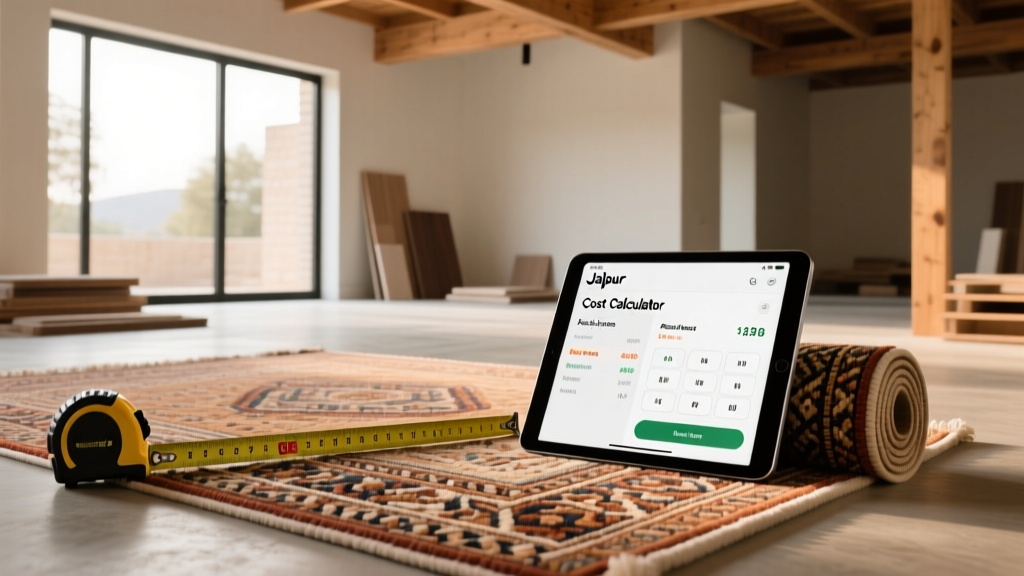
Understanding the Jaipur Rugs Carpet Pricing Tiers
Estimating the budget for a premium, artisanal floor covering requires moving beyond standard big-box store square-footage calculations. When specifying a Jaipur Rugs carpet for a residential or commercial project, you are investing in hand-knotted or hand-tufted textiles where pricing is dictated by material provenance, knot density, and loom complexity. Unlike machine-made alternatives, the cost of a Jaipur Rugs carpet fluctuates based on the specific collection and the artisanal labor required to execute the design.
To build an accurate cost estimator, you must first identify the material tier and knot density metrics (Knots Per Square Inch, or KPSI) of your chosen design. Higher KPSI allows for intricate, high-resolution patterns but exponentially increases the weaving time and final cost.
| Collection Tier | Primary Materials | Avg. Knot Density (KPSI) | Estimated Cost per Sq. Ft. |
|---|---|---|---|
| Contemporary / Hand-Tufted | New Zealand Wool, Cotton Canvas | N/A (Tufted) | $18 - $32 |
| Traditional / Hand-Knotted | 100% New Zealand Wool | 60 - 90 KPSI | $45 - $75 |
| Luxury / Silk Blends | Wool and Bamboo Silk / Pure Silk | 100 - 150+ KPSI | $95 - $180+ |
| Custom / Bespoke Loom | Client-Specified Blends | Variable | $120 - $250+ |
The Custom Sizing and Quantity Calculator
The most common error in high-end rug procurement is miscalculating the required square footage for custom dimensions. Jaipur Rugs offers bespoke looming, allowing you to order a carpet to the exact inch. However, calculating the quantity requires accounting for architectural realities and the physical properties of hand-woven textiles.
The Handmade Variance Tolerance
Calculating for Anchored vs. Floating Layouts
Your quantity calculator must adjust based on the furniture layout framework:
- The Anchored Layout (All Legs On): Calculate the outer perimeter of your furniture grouping, then add exactly 18 to 24 inches to all four sides. For a 90x100 inch sofa and coffee table grouping, your minimum rug calculation is 126x136 inches (119.7 square feet).
- The Floating Layout (Front Legs Only): Measure the front-foot footprint of your seating arrangement and extend the rug boundary 12 inches past the front legs. This reduces total square footage by roughly 20% compared to the anchored method, significantly lowering the cost of high-KPSI silk blends.
- The Dining Clearance Rule: For dining rooms, measure the table at its maximum extension (with all leaves inserted) and add 30 inches to all sides to ensure chairs do not catch the rug edge when pulled out.
Ancillary Costs: Padding, Shipping, and Acclimation
A comprehensive Jaipur Rugs carpet cost estimator must include the sub-surface and logistical requirements. Hand-knotted wool and silk carpets are exceptionally heavy, often weighing 3 to 5 pounds per square foot. Standard rubber or mesh pads will degrade under this weight and fail to provide adequate acoustic dampening.
Required Padding Specifications
For hand-knotted Jaipur Rugs carpets, specify a 40-ounce needle-punched felt pad or a high-density viscoplastic pad. These materials grip the heavy textile without relying on aggressive adhesives that could damage the cotton foundation of the rug.
- 40oz Felt Pad: $2.50 - $4.00 per sq. ft. (Best for hard surfaces like oak or polished concrete).
- Viscoplastic / Rubber-Felt Hybrid: $3.50 - $5.50 per sq. ft. (Required for radiant heated floors to prevent off-gassing and melting).
Freight and White-Glove Delivery
Because custom Jaipur Rugs carpets are often shipped in heavy, reinforced tubes directly from artisan cooperatives in India or via Jaipur Rugs official distribution channels, standard parcel shipping is rarely viable for sizes exceeding 8x10 feet. Budget an additional $350 to $800 for LTL (Less Than Truckload) freight and white-glove indoor delivery, which includes unrolling, initial vacuuming, and pad installation.
Material Yield and Custom Looming Lead Times
When utilizing a quantity calculator for a bespoke Jaipur Rugs carpet, time is a financial variable. Custom looming is not an off-the-shelf transaction. The procurement timeline directly impacts project scheduling and carrying costs.
Expert Procurement Note: A standard 9x12 hand-knotted rug at 100 KPSI requires approximately 3 to 4 artisans working full-time for 4 to 6 months. When estimating project completion dates, always factor in a minimum 16 to 24-week lead time for custom bespoke orders, plus 2 weeks for ocean freight and customs clearance.
Dye Lot and Batch Matching
If your square footage calculator indicates you need multiple runners or a modular carpet system for a large commercial space (e.g., a boutique hotel lobby), you must order all pieces in a single production batch. Natural dyes used in premium Jaipur Rugs collections—such as indigo, madder root, and pomegranate—vary slightly between dye lots. Ordering an additional 10% of material later to cover a miscalculation will result in a visible color mismatch.
Step-by-Step Budget Estimation Formula
To finalize your project budget, apply the following formula to your specific room dimensions and chosen collection tier:
- Base Area Calculation: (Target Length in feet) x (Target Width in feet) = Base Square Footage.
- Variance Buffer (For Built-ins Only): Multiply Base Square Footage by 0.95 to account for the 5% expansion tolerance.
- Textile Cost: Adjusted Square Footage x Collection Price per Sq. Ft.
- Sub-surface Cost: Adjusted Square Footage x $3.50 (Average high-density pad cost).
- Logistics & Installation: Flat rate of $600 (Freight, white-glove delivery, and professional stretching/acclimation).
By rigorously applying these material tolerances, knot-density pricing tiers, and sub-surface requirements, you can generate a highly accurate budget for a Jaipur Rugs carpet installation. This prevents the common pitfall of underestimating the true landed cost of artisanal, hand-knotted flooring textiles.