Outdoor Flooring Specs: Slip, UV, and Freeze-Thaw Ratings
Master outdoor flooring specifications. Compare slip resistance (DCOF), UV stability, and freeze-thaw ratings for tile, composite, and concrete pavers.
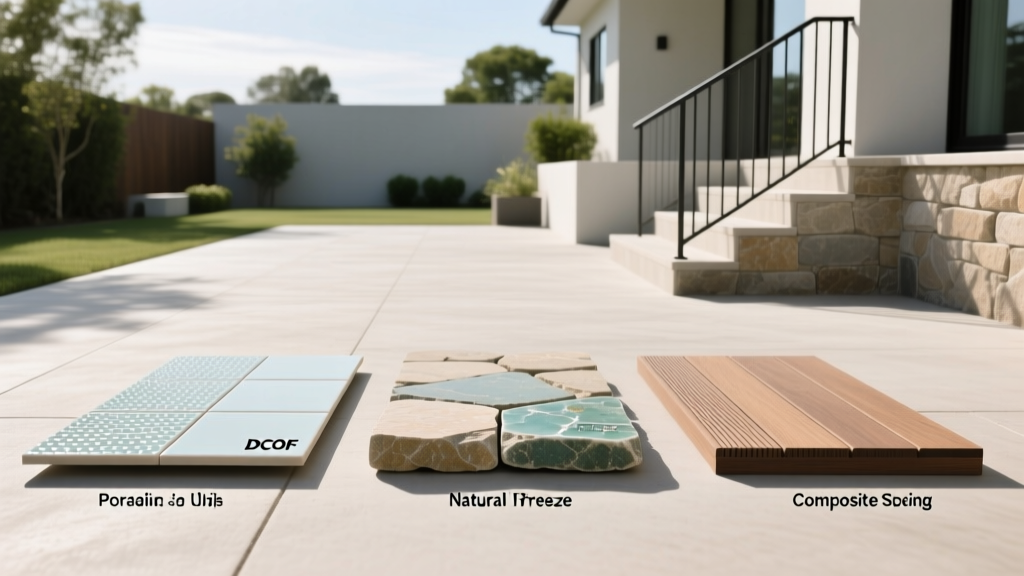
The Hidden Metrics of Exterior Surfaces
Selecting outdoor flooring requires moving beyond aesthetic preferences to evaluate rigorous performance specifications. Exterior surfaces face extreme environmental stressors: hydrostatic pressure, ultraviolet radiation, thermal shock, and heavy dynamic loads. Relying on marketing terms like "weather-resistant" or "textured" often leads to catastrophic failures, such as spalling pavers in freezing climates or severe slip-and-fall liabilities around pool decks. This guide decodes the exact industry standards, testing methodologies, and numerical thresholds you must specify when sourcing exterior flooring materials.
Slip Resistance: DCOF vs. DIN R-Ratings
Slip resistance is the most critical safety specification for exterior hardscapes. In North America, the standard metric is the Dynamic Coefficient of Friction (DCOF), measured using the Bot 3000E digital tribometer with a soapy water solution as mandated by the Tile Council of North America (TCNA) and ANSI A326.3. In Europe and for many imported materials, the DIN 51130 ramp test (R-ratings) is the standard.
Application-Specific DCOF Thresholds
While ANSI A137.1 requires a minimum DCOF of 0.42 for level interior spaces, outdoor environments demand significantly higher friction coefficients due to the presence of algae, standing water, and organic debris.
- Covered Patios & Dry Walkways: Minimum DCOF of 0.50 (Equivalent to DIN R10).
- Uncovered Patios & Pool Decks: Minimum DCOF of 0.60 (Equivalent to DIN R11).
- Pool Copings & Ramp Entries: Minimum DCOF of 0.70+ (Equivalent to DIN R12/R13).
Thermal Shock and Freeze-Thaw Durability
In climates where temperatures fluctuate above and below freezing, water absorption is the primary predictor of outdoor flooring lifespan. When moisture penetrates a porous material and freezes, it expands by 9%, generating internal hydrostatic pressure that causes spalling, micro-cracking, and eventual structural failure.
The definitive test for this is ASTM C373, which measures water absorption rates by boiling the material and calculating the weight differential. Materials are classified into three critical tiers:
| Classification | Absorption Rate | Freeze-Thaw Suitability | Common Materials |
|---|---|---|---|
| Impervious | ≤ 0.5% | Excellent (All Climates) | Porcelain pavers, Granite |
| Vitreous | 0.5% to 3.0% | Moderate (Mild Winters) | Ceramic tile, Dense Sandstone |
| Semi-Vitreous | 3.0% to 7.0% | Poor (Will Spall) | Limestone, Terracotta, Concrete |
UV Degradation and Color Fastness
Ultraviolet radiation breaks down the chemical bonds in polymers and organic lignins, leading to chalking, embrittlement, and severe color fading. This is particularly relevant for Wood-Plastic Composites (WPC) and stained concrete.
Evaluating Composite Decking and Pavers
First-generation, uncapped composites typically experience a 15% to 20% color shift within the first 12 months as the exposed wood flour degrades. Modern specifications must mandate fully capped polymer-shell composites. To verify UV stability, check the manufacturer's Technical Data Sheet (TDS) for testing under ISO 105-B02 (Color Fastness to Artificial Light) or ASTM G154 (Accelerated Weathering). A material passing ISO 105-B02 with a Grey Scale rating of 4 or higher (out of 5) will exhibit virtually no perceptible fading over a 10-year period.
Thermal Expansion Coefficients (CTE)
UV exposure also drives extreme surface heat. Dark-colored composite boards can reach 140°F (60°C) in direct summer sunlight. You must calculate the Coefficient of Thermal Expansion (CTE) to determine proper gapping. For example, a 16-foot PVC deck board with a CTE of 3.5 x 10^-5 in/in/°F will expand nearly 1/4 inch across a 50-degree temperature swing. Failure to specify 3/16-inch expansion gaps at butt joints will result in severe buckling.
Load-Bearing Capacities and Structural Specs
Outdoor flooring must support dynamic loads without fracturing. The specifications vary wildly depending on whether the surface is pedestrian-only or vehicular.
Concrete Paver Compressive Strength
According to ASTM C936, standard concrete pavers must achieve a minimum average compressive strength of 8,000 PSI. However, thickness dictates load application:
- Pedestrian Patios & Walkways: 2 3/8 inches (60mm) thickness is sufficient for foot traffic and light patio furniture.
- Driveways & Fire Lanes: 3 1/8 inches (80mm) thickness is mandatory to prevent shear failure under the point-loads of vehicle tires.
Composite Joist Span Limits
Unlike interior hardwood, outdoor composites lose stiffness when heated and saturated. While a standard interior floor joist span is 16 inches on-center (OC), exterior composite flooring must be installed at 12 inches OC for straight layouts, and 8 inches OC for diagonal (45-degree) layouts to prevent sagging and bounce under live loads.
Master Material Specification Matrix
Use this comparison matrix to align your project requirements with the correct material specifications.
| Material Type | Target DCOF / R-Rating | Max Water Absorption | UV Standard | Ideal Application |
|---|---|---|---|---|
| Exterior Porcelain Pavers | ≥ 0.60 / R11 | ≤ 0.5% | Inorganic (No fade) | Pool decks, Commercial plazas |
| Capped WPC Composite | ≥ 0.50 / R10 | ≤ 1.0% | ISO 105-B02 (Grade 4+) | Residential decks, Balconies |
| Dense Granite / Basalt | ≥ 0.70 / R12 (Flamed) | ≤ 0.4% | Inorganic (No fade) | High-traffic walkways, Coping |
| Concrete Pavers | ≥ 0.55 / R11 | ≤ 5.0% (Air-entrained) | ASTM G154 (Pigment stable) | Driveways, Permeable patios |
Sourcing and Verifying Manufacturer Data
Never accept a product brochure as proof of performance. Always request the manufacturer's Technical Data Sheet (TDS) and independent third-party test reports. When reviewing a TDS for outdoor flooring, verify that the testing was conducted by an ISO/IEC 17025 accredited laboratory. If the DCOF, absorption, or compressive strength metrics are listed as "N/A" or "Meets Industry Standards" without citing the specific ASTM, ANSI, or ISO standard number, reject the submittal and source an alternative product with transparent, verifiable engineering data.