Kodiak Commercial Grade Rolled Rubber Flooring: Lifespan & Durability Analysis
Analyze the durability, expected lifespan, and failure modes of Kodiak commercial grade rolled rubber flooring for high-traffic facilities.
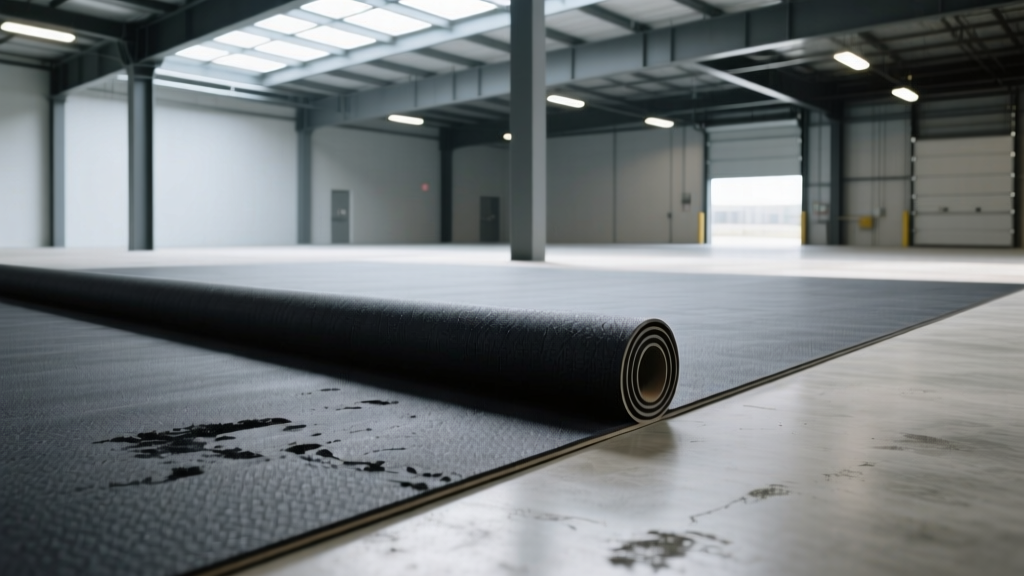
The Anatomy of Kodiak Commercial Rolled Rubber
When facility managers evaluate resilient surfaces for high-impact environments, Kodiak commercial grade rolled rubber flooring consistently emerges as a benchmark for heavy-duty performance. Unlike standard residential rubber tiles, the Kodiak commercial profile is engineered from a dense blend of Styrene Butadiene Rubber (SBR) and recycled natural rubber, often fortified with EPDM (Ethylene Propylene Diene Monomer) color flecks for UV stability and aesthetic depth. The defining characteristic of this material is its vulcanization process, which cross-links the polymer chains to achieve a Shore A Durometer (hardness) rating between 65 and 70. This specific hardness range provides the critical balance required for commercial spaces: rigid enough to resist permanent indentation from heavy rolling loads (like pallet jacks and hospital beds), yet elastic enough to absorb acoustic impact and provide underfoot ergonomic fatigue relief.
According to the Whole Building Design Guide, rubber flooring's inherent resilience makes it uniquely suited for corridors, laboratories, and industrial staging areas where point-load pressures frequently exceed 250 psi. Standard commercial rolls are typically manufactured in 3/16-inch (4.8mm) to 1/4-inch (6.4mm) thicknesses, weighing approximately 2.2 to 2.8 pounds per square foot, which inherently dampens impact noise transmission (IIC ratings often exceeding 55).
Expected Lifespan: By the Numbers
The longevity of Kodiak rubber flooring is not a single static number; it is a variable heavily dependent on traffic volume, rolling load frequency, and subfloor preparation. Below is a data-driven breakdown of expected service life under varying commercial conditions.
| Environment Profile | Average Daily Traffic | Rolling Load Frequency | Expected Lifespan | Wear Layer Degradation Rate |
|---|---|---|---|---|
| Heavy Industrial / Warehouse | High (Forklifts, Pallet Jacks) | Continuous | 12 - 15 Years | ~0.5mm per decade |
| Healthcare Corridors | Very High (Foot traffic, Beds) | Frequent | 18 - 22 Years | ~0.2mm per decade |
| Commercial Gymnasiums | Moderate to High (Dropping weights) | Rare | 20 - 25 Years | Negligible (Impact only) |
| Retail / Educational Hallways | High (Foot traffic only) | Infrequent (Carts) | 25+ Years | ~0.1mm per decade |
Primary Failure Modes and Edge Cases
Despite its formidable tensile strength, Kodiak commercial grade rolled rubber flooring is not invincible. Understanding the specific mechanisms that cause premature failure is essential for maximizing your return on investment. Industry data, as highlighted by ArchDaily's material analysis, shows that 80% of rubber flooring failures are due to improper installation or chemical degradation, not mechanical wear.
1. Chemical Degradation vs. Mechanical Wear
Mechanical wear on a 65-durometer rubber floor takes decades to penetrate the surface. Chemical degradation, however, can destroy the floor in months. SBR and natural rubber blends are highly susceptible to petroleum-based solvents, ketones, and pine-oil-based cleaners. When facility staff use unauthorized heavy-duty degreasers or quaternary ammonium compounds (quats) at high concentrations, the chemicals break down the sulfur cross-links in the vulcanized rubber. This causes the floor to soften, become tacky, and eventually tear under rolling loads. Only neutral-pH (7.0 to 9.0) cleaners specifically formulated for rubber should be used.
2. Subfloor Moisture Vapor Transmission (MVT)
Rubber is largely impermeable to moisture. If installed over a concrete slab with high Moisture Vapor Transmission Rates (MVTR) without the proper adhesive or mitigation system, hydrostatic pressure builds up beneath the roll. This leads to adhesive emulsification, resulting in bubbling, telegraphing, and eventual delamination.
3. Point-Load Indentation
While the floor resists rolling loads beautifully, static point loads can cause permanent compression set. Heavy machinery resting on small, rigid casters or stiletto heels (which can exert up to 2,000 psi) will permanently dent a 3/16-inch roll. For areas with heavy static loads, specify a 1/4-inch or 3/8-inch thickness, or mandate the use of load-distributing caster cups.
Lifecycle Cost Analysis: Rubber vs. Alternatives
The initial capital expenditure for Kodiak commercial grade rolled rubber flooring is higher than traditional resilient options. Material costs typically range from $2.50 to $4.50 per square foot, with professional installation adding $1.75 to $3.00 per square foot. However, analyzing the Total Cost of Ownership (TCO) over a 20-year lifecycle reveals a different financial reality.
- Vinyl Composition Tile (VCT): Initial cost is low ($1.50 - $2.50/sq ft installed). However, VCT requires aggressive annual stripping and waxing, costing approximately $1.25 to $1.75 per square foot annually in labor and chemicals. Over 20 years, maintenance costs exceed $25.00 per square foot.
- Luxury Vinyl Tile (LVT): Mid-range initial cost ($3.00 - $5.00/sq ft). Requires less maintenance than VCT but is prone to scratching and edge-curling in high-rolling-load environments, often requiring partial replacement at year 10-12.
- Kodiak Rolled Rubber: Higher initial cost ($4.50 - $7.50/sq ft installed). Requires no stripping or waxing. Maintenance consists solely of daily dust mopping and damp mopping with neutral cleaner, costing roughly $0.15 to $0.25 per square foot annually. Over 20 years, maintenance costs total less than $5.00 per square foot.
When factoring in the elimination of waxing chemicals, reduced labor hours, and the floor's ability to remain in service without downtime for stripping, Kodiak rubber achieves cost parity with VCT by year 7, and becomes significantly cheaper by year 15.
Maintenance Protocols to Maximize Longevity
To ensure the flooring reaches its 20+ year lifespan, facility maintenance teams must adhere to a strict, non-abrasive protocol. The goal is to preserve the factory-applied finish and prevent the micro-pores of the rubber from trapping particulate matter.
- Daily Dry Maintenance: Use a microfiber dust mop to remove abrasive silica and grit. Avoid treated dust mops, as the oils can leave a residue that attracts dirt and dulls the rubber.
- Weekly Damp Mopping: Use an automatic scrubber or flat mop with a neutral-pH cleaner diluted exactly to the manufacturer's specifications. Over-concentrating the cleaner will leave a sticky film that traps soil.
- Annual Burnishing: To restore the original sheen and close micro-scratches, burnish the floor using a high-speed buffer (1,000 to 1,500 RPM) equipped with a natural hog-hair or soft synthetic pad. Do not use aggressive scrubbing pads (like red or black pads), which will permanently scar the surface.
'The most common mistake in commercial rubber maintenance is treating it like VCT. Applying acrylic floor finishes or waxes to rubber creates a slippery hazard and traps dirt, ultimately requiring harsh chemical strippers that degrade the rubber matrix.' — Facility Maintenance Industry Standard Guidelines
FAQ: Kodiak Rubber Flooring Durability
Can Kodiak rolled rubber be installed outdoors?
Standard SBR-based Kodiak rolls are not recommended for fully exposed outdoor environments. Prolonged UV exposure and ozone will cause the rubber to oxidize, chalk, and become brittle over time. For outdoor applications, specify a 100% EPDM or vulcanized natural rubber roll with UV inhibitors.
Does the flooring emit VOCs after installation?
High-quality commercial rubber flooring is typically low-VOC and can contribute to LEED credits for indoor environmental quality. However, a mild 'tire-like' odor is normal for the first 30 to 60 days post-installation. Ensure the HVAC system is running at full capacity with fresh air intake during this off-gassing period.
How does it handle welding sparks or extreme heat?
While rubber is naturally flame-retardant and will self-extinguish (typically meeting ASTM E648 Class 1 fire ratings), it is not heat-proof. Direct contact with welding slag or dropped cigarettes will cause localized melting and permanent scorch marks. In welding bays, use protective drop mats over the rubber flooring.