Performance Ratings for a Large Carpet Area: Expert Specs
Master the performance specs for a large carpet area. Learn critical pile density, tuft bind, and backing requirements to prevent buckling and seam failure.
The Physics of Large-Span Carpeting: Why Standard Specs Fail
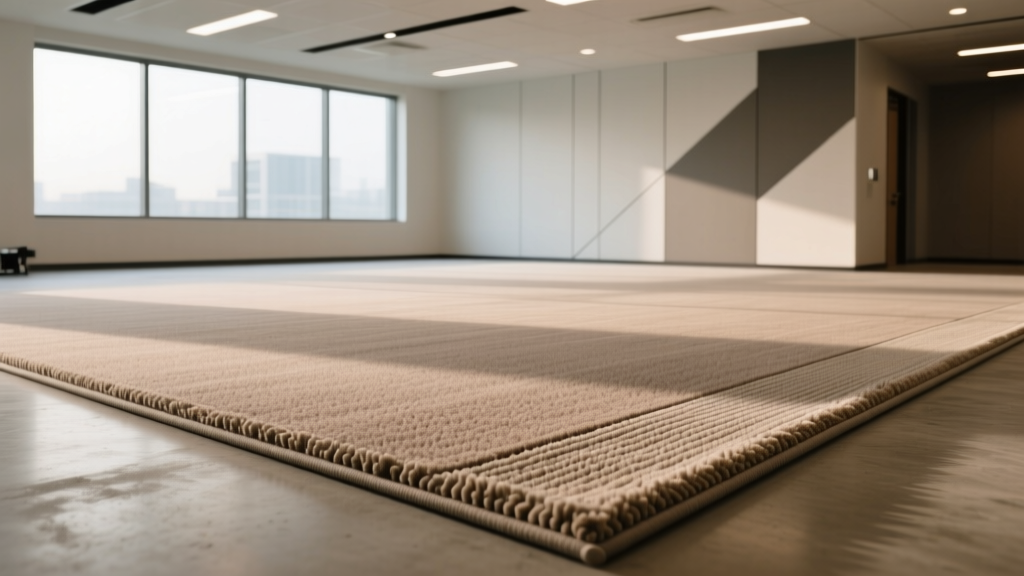
When specifying flooring for a large carpet area—typically defined as continuous spans exceeding 1,000 square feet or widths surpassing 20 feet—standard residential metrics become dangerously inadequate. In expansive floorplans, mechanical stresses are amplified. Lateral tension from foot traffic, thermal expansion and contraction of the subfloor, and the cumulative drag of heavy furniture create forces that can easily delaminate inferior backings or cause seams to peak. A large carpet area acts as a single, unified membrane; if the dimensional stability of the material is compromised, the failure will manifest in the center of the room, far from the perimeter tack strips where tension is anchored.
To prevent catastrophic installation failures, specifiers must look beyond basic face weight and evaluate a matrix of structural performance ratings. This guide details the exact specifications required to ensure longevity, seam integrity, and aesthetic retention in expansive residential great rooms, commercial open-plan offices, and large-scale institutional spaces.
Core Performance Metrics: Density, Weight, and Tuft Bind
The foundation of carpet performance in high-traffic, large-scale environments relies on three interdependent metrics. Relying on face weight alone is a common specification error that leads to premature crushing in the primary traffic lanes of a large carpet area.
| Performance Metric | Minimum for Large Residential | Minimum for Large Commercial | Testing Standard |
|---|---|---|---|
| Face Weight | 40 oz/yd² | 60 oz/yd² | ASTM D5848 |
| Pile Density | 180,000 | 250,000+ | ASTM D4269 |
| Tuft Bind (Cut Pile) | 8.0 lbs | 10.0 lbs | ASTM D1335 |
| Tuft Bind (Loop Pile) | 6.0 lbs | 8.0 lbs | ASTM D1335 |
| Twist Level (Cut Pile) | 4.0 turns/inch | 5.0+ turns/inch | ASTM D1244 |
Calculating Pile Density for Expansive Floorplans
Pile density is the single most critical factor in preventing matting and crushing across a large carpet area. It measures how closely the yarn tufts are packed together. The Carpet and Rug Institute (CRI) Testing Services outlines the standard calculation for this metric, which directly correlates to the carpet's ability to support heavy rolling loads and resist permanent compression.
Density = (Face Weight in oz × 36) ÷ Pile Height in inchesExample Calculation: A carpet with a 50 oz face weight and a 0.5-inch pile height yields a density of 3,600 (50 × 36 = 1800; 1800 ÷ 0.5 = 3600). For a large commercial area, you want the resulting number to be as high as possible, ideally exceeding 5,000 for ultra-heavy traffic zones.
Dimensional Stability: Backing Systems for Large Carpet Areas
In a 2,500-square-foot open-plan office, the carpet backing is subjected to massive shear forces. Traditional SBR (Styrene Butadiene Rubber) latex backings are prone to moisture absorption, which causes the backing to expand and contract with ambient humidity changes. In a large carpet area, this micro-movement accumulates across the span, resulting in visible buckling or 'rippling' in the center of the room, even if the perimeter is securely anchored.
For expansive installations, specify high-performance backing systems:
- Polyurethane (PU) Backings: PU systems chemically bond the primary and secondary backings, creating a moisture-impermeable barrier. This prevents delamination and provides superior dimensional stability, ensuring the carpet remains flat across vast concrete slabs where moisture vapor transmission (MVT) is a concern.
- Reinforced Fiberglass Backings: Often utilized in modular carpet tiles for large commercial zones, fiberglass-reinforced backings (such as GlasBac RE) offer near-zero thermal expansion and contraction, maintaining strict dimensional tolerances regardless of HVAC fluctuations.
- High-Density Urethane (HDU) Cushion: For broadloom large carpet areas requiring underfoot comfort, an attached HDU cushion provides acoustic dampening while maintaining the structural rigidity required to prevent seam separation.
Seam Integrity and CRI 104/105 Installation Standards
The most vulnerable point in any large carpet area is the seam. When spanning widths greater than 12 or 15 feet (the standard manufacturing widths of broadloom carpet), seams are unavoidable. The Carpet and Rug Institute (CRI) Installation Standards (CRI 104 for Residential and CRI 105 for Commercial) mandate specific protocols to ensure seams do not peak, ravel, or separate under lateral tension.
"In large expanses, the cumulative drag of foot traffic and rolling chairs exerts continuous lateral force on seams. A knee kicker is entirely insufficient for achieving the required tension; a mechanical power stretcher must be utilized to anchor the carpet properly to the perimeter tack strips."
Seam peaking occurs when the edges of the carpet at the seam lift upward, creating a visible ridge. In large carpet areas, this is almost always caused by improper seaming tape width or inadequate heat application. Specify a minimum 3-inch wide hot-melt seaming tape for commercial broadloom, and ensure the installer uses a seaming iron with a digital temperature gauge to maintain the exact melting point of the adhesive (typically between 350°F and 400°F).
Step-by-Step Seam Specification Checklist
- Edge Sealing: Apply a continuous bead of latex or polyurethane seam sealer to the cut edges of both carpet sections to prevent edge raveling before joining.
- Tape Alignment: Center the 3-inch (or wider) hot-melt tape precisely under the seam line, ensuring the glue side faces up.
- Heat and Fusion: Melt the adhesive using a calibrated seaming iron. Press both edges into the molten adhesive simultaneously.
- Rolling: Immediately use a 100-lb carpet seam roller, rolling in multiple directions (parallel and perpendicular to the seam) to ensure a flush, invisible bond before the adhesive cools.
Failure Modes: Edge Cases in 2,000+ Square Foot Installations
Understanding how large carpet areas fail allows specifiers to engineer preventative measures into the initial material selection. Below are the most common edge-case failures and their specification-based solutions.
1. Edge Raveling at Transition Strips
In large areas transitioning to hard surface flooring (like LVT or polished concrete), the carpet edge is subjected to intense shear stress from foot traffic crossing the threshold.
Specification Fix: Require a minimum tuft bind of 10 lbs (ASTM D1335) and mandate the use of a hot-melt edge sealer on all cut perimeter edges, not just seams. Specify commercial-grade transition moldings with a minimum 1/2-inch carpet grip depth.
2. Depressing from Heavy Point Loads
In large residential great rooms or commercial conference areas, heavy furniture (e.g., grand pianos, massive boardroom tables) creates permanent point-load depressions in standard cut-pile carpets.
Specification Fix: Transition to a high-density, low-profile loop pile (Berber) for these specific zones, or specify a carpet with a rigid polyurethane backing that distributes point loads across a wider surface area, preventing the subfloor from bearing the concentrated force.
3. VOC Off-Gassing in Enclosed Volumes
When installing thousands of square feet of carpet simultaneously, the cumulative volatile organic compound (VOC) emissions can severely degrade indoor air quality, especially in newly constructed, tightly sealed commercial buildings.
Specification Fix: Mandate that all specified carpets, adhesives, and cushions carry the CRI Green Label Plus certification. For large-scale installations, review the EPA Indoor Air Quality Guidelines to ensure HVAC flush-out protocols are executed post-installation to clear residual off-gassing before occupancy.
Strategic Specification Summary
Specifying for a large carpet area requires shifting focus from purely aesthetic considerations to rigorous mechanical and structural performance. By mandating high pile densities (exceeding 200,000 for commercial zones), specifying moisture-impervious polyurethane backings for dimensional stability, and enforcing strict adherence to CRI 104/105 power-stretching and seaming protocols, you eliminate the primary vectors for large-span carpet failure. The upfront cost of high-performance specifications is routinely offset by the elimination of premature replacement, seam repairs, and the aesthetic degradation that plunders poorly specified expansive floorplans.