Natural Stone Backsplash Brands: MSI vs Daltile Product Deep-Dive
Compare top natural stone backsplash product lines from MSI, Daltile, and Emser. Get 2026 pricing, SKU details, and installation specs.
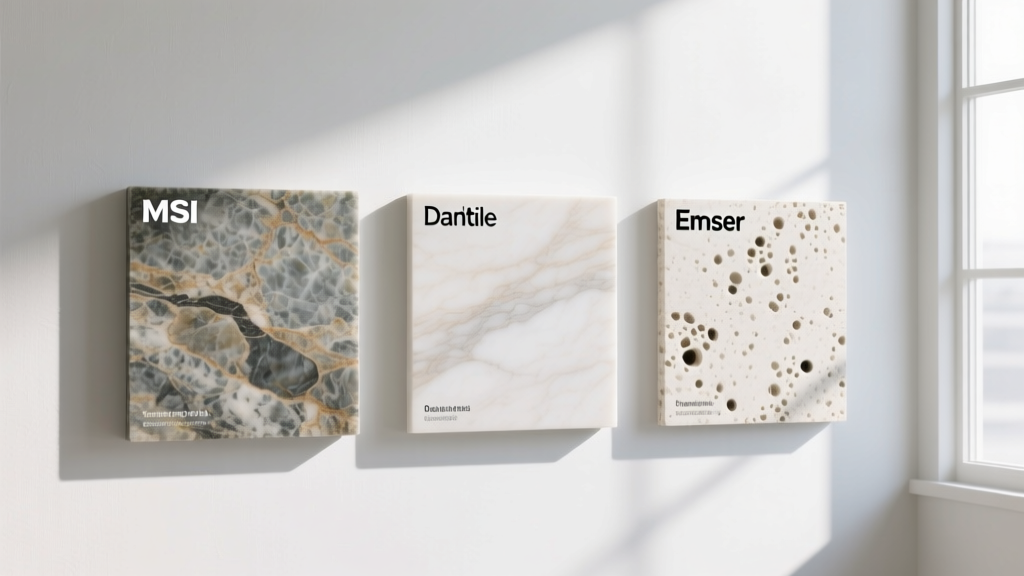
The Floor-to-Wall Continuity Trend in Natural Stone
As kitchen and bathroom designs evolve in 2026, the strict boundary between flooring and wall applications has dissolved. Homeowners and designers are increasingly specifying natural stone backsplash materials that either match or intentionally contrast with adjacent stone flooring. This 'floor-to-wall' continuity leverages the durability and premium aesthetics of natural stone, but it introduces complex installation variables. Unlike glazed ceramic or porcelain, natural stone is porous, structurally variable, and highly reactive to alkaline adhesives and moisture.
This deep-dive analyzes three dominant product lines in the natural stone backsplash category: MSI Surfaces' split-face ledger panels, Daltile's honed marble collections, and Emser Tile's gauged slate veneers. We will break down specific SKUs, 2026 market pricing, required setting materials, and the non-obvious failure modes that frequently ruin high-end stone installations.
Brand Deep-Dive: MSI Surfaces (Ledger Panels & Mosaics)
MSI Surfaces dominates the stacked stone veneer market with their interlocking ledger panel lines. These panels are engineered to mimic the look of hand-laid masonry while offering the installation speed of a modular tile. For backsplashes, the 6x24-inch split-face format is the industry standard.
Product Line Spotlight: Silver Travertine & Arctic White Ledger Panels
The Silver Travertine and Arctic White ledger panels feature a dramatic, rugged split-face profile. Because the stone is split rather than sawn, the surface variation can exceed 3/4 of an inch in depth.
- 2026 Average Pricing: $7.50 to $11.00 per square foot.
- Grout Joint Requirement: Zero. These are dry-stacked (butt-jointed). Grouting split-face stone is a catastrophic mistake that traps moisture and ruins the aesthetic.
- Adhesive Specification: A high-quality polymer-modified thinset mortar, such as LATICRETE 254 Platinum or Custom Building Products ProLite, is mandatory to support the heavy weight (approx. 5.5 lbs per panel).
Split-face ledger panels are highly porous. If installed directly over unsealed drywall near a kitchen sink, moisture from the drywall or the thinset curing process will migrate through the stone, depositing white, powdery alkaline salts (efflorescence) on the surface. Always apply a liquid waterproofing membrane (like RedGard) to the substrate before tiling, and ensure the stone is sealed with a breathable, impregnating sealer post-installation.
Brand Deep-Dive: Daltile (Honed & Tumbled Collections)
While MSI excels in rustic textures, Daltile's natural stone lines focus on refined, architectural finishes. Their honed and tumbled marble and travertine collections are frequently used to create sophisticated, transitional backsplashes that pair seamlessly with large-format stone flooring.
Product Line Spotlight: Asian Statuary Honed Marble
Daltile's Asian Statuary honed marble, particularly in the 3x12 and 4x12 subway formats, offers a soft, matte aesthetic with subtle gray veining. Honed marble is notoriously unforgiving during installation due to its susceptibility to staining and 'picture framing'.
| Specification | Asian Statuary Honed (3x12) | Travertine Classics Tumbled (4x4) |
|---|---|---|
| 2026 Avg. Price / Sq Ft | $14.00 - $18.50 | $8.50 - $11.00 |
| Required Grout Joint | 1/16" to 1/8" (Non-sanded or fine-sanded) | 1/4" to 3/8" (Sanded, to match tumbled edges) |
| Thinset Color Requirement | BRIGHT WHITE ONLY | White or Gray acceptable |
| Pre-Grout Sealing | Mandatory (Impregnator) | Highly Recommended |
Brand Deep-Dive: Emser Tile (Slate & Quartzite Veneers)
Emser Tile provides some of the most durable, high-traffic natural stone options on the market. Their gauged slate and quartzite lines are often purchased for flooring but are increasingly utilized as heavy-duty backsplashes in outdoor kitchens, mudrooms, and rustic interior spaces.
Product Line Spotlight: Rustic Slate and Golden White Quartzite
Emser's Rustic Slate features a natural cleft surface with dramatic color variation, while the Golden White Quartzite offers a harder, more crystalline structure. Quartzite is significantly denser than slate, requiring different cutting and setting approaches.
- Cutting Protocol: Slate cuts cleanly with a continuous rim diamond blade on a wet saw. Quartzite, however, is harder than glass and requires a premium turbo-rim diamond blade; otherwise, the edges will chip severely, ruining the backsplash sightlines.
- Surface Preparation: Natural cleft slate has high lippage. When installing 12x12 or 16x16 slate tiles on a wall, use a 1/2" x 1/2" square-notched trowel and back-butter every single tile to ensure 95% adhesive coverage, preventing hollow spots that can crack if the wall deflects.
Technical Framework: Adhesives, Grouts, and Sealers
Selecting the correct chemical companions for your natural stone backsplash is where most DIY installations fail. According to the Tile Council of North America (TCNA), natural stone requires specific mortars to account for its dimensional instability and porosity.
The Decision Matrix for Setting Materials
- White Marble / Light Travertine: Must use a bright white, polymer-modified thinset (e.g., LATICRETE 254 Platinum White). Gray thinset will bleed through the stone, causing permanent darkening.
- Dense Quartzite / Large Format Slate: Requires a high-bond, non-sag mortar (e.g., Custom Building Products MegaLite) to hold the heavy stone on vertical surfaces without slipping during the cure time.
- Split-Face Ledger Panels: Standard polymer-modified thinset is sufficient, but the substrate must be structurally sound. Never install ledger panels over standard 1/2" drywall if the total assembly exceeds 5 lbs per square foot; upgrade to 5/8" drywall or cement backer board.
Sealing Protocols: Impregnating vs. Topical
The Natural Stone Institute strictly advises against topical sealers for kitchen backsplashes. Topical sealers create a plastic-like film that traps moisture, yellows under UV exposure, and alters the natural texture of the stone. Instead, use penetrating impregnating sealers like Aqua Mix Sealer's Choice Gold or Miracle Sealants 511 Impregnator. These sealers penetrate the pores and repel water and oil from within, leaving the natural cleft or honed finish completely unaltered.
Real-World Failure Modes and Edge Cases
Even with premium materials, natural stone backsplashes are prone to specific failure modes if edge cases are ignored during the planning phase.
Symptom: A dark, permanent halo appears around the edges of white marble tiles a few days after grouting.
Cause: The edges of the marble are more porous than the face. If the stone is not pre-sealed, moisture from the grout is absorbed into the unsealed edges, carrying microscopic grout pigments into the stone.
Fix: Always apply a heavy coat of impregnating sealer to the stone (especially the edges) 24 hours before grouting. Use a high-quality, polymer-fortified grout with low water-retention characteristics.
Symptom: Dark, irregular splotches appear on split-face or tumbled stone directly behind the cooktop.
Cause: Airborne cooking oils condense on the highly textured stone and penetrate the pores. Standard impregnating sealers repel water but may struggle with heavy, hot grease over time.
Fix: For the 18 inches directly behind a gas or induction range, consider using a honed, dense stone (like quartzite or bluestone) rather than highly porous split-face travertine. If split-face is mandatory, install a discrete, flush-mounted stainless steel backsplash panel behind the burners, or commit to degreasing the stone monthly with a specialized stone-safe alkaline cleaner.
Final Specifications for the 2026 Build
When specifying a natural stone backsplash, treat it as a continuous system rather than just a decorative wall covering. Ensure your substrate is rigid, your adhesive is color-matched to the stone's translucency, and your sealer is breathable. By selecting the right product line—whether it is MSI's rugged ledger panels for a rustic focal point, Daltile's refined honed marble for a transitional kitchen, or Emser's durable slate for heavy-duty applications—you guarantee a backsplash that performs as flawlessly as it looks.