2026 Resilient Flooring Cost Calculator & Material Estimator
Calculate exact 2026 resilient flooring costs. Get material, labor, and waste estimates for LVT, WPC, SPC, and sheet vinyl with our detailed pricing guide.
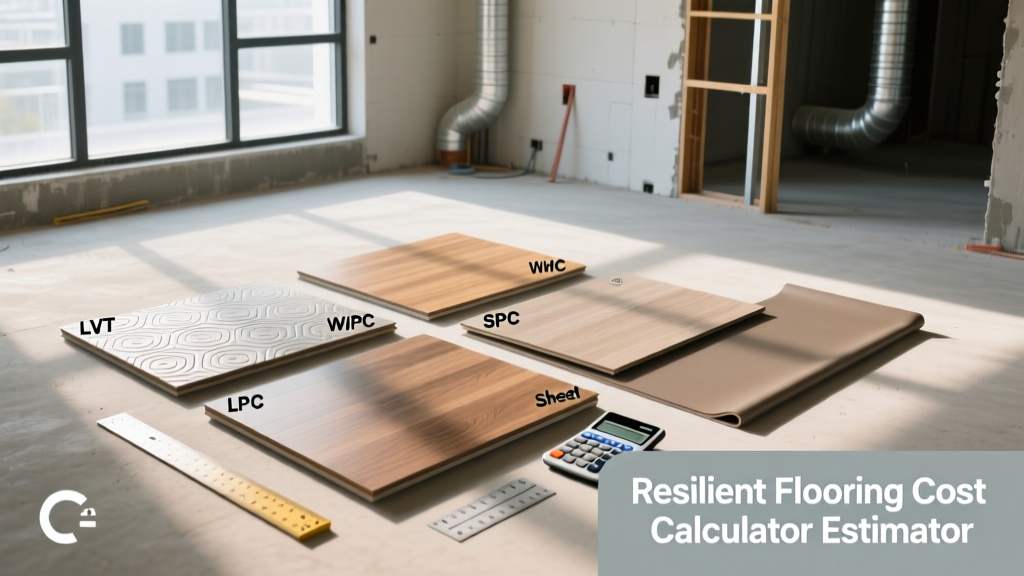
The True Cost of Resilient Flooring in 2026
Estimating the cost of resilient flooring requires moving beyond simple length-by-width calculations. Resilient flooring—a category encompassing Luxury Vinyl Tile (LVT), Wood Plastic Composite (WPC), Stone Plastic Composite (SPC), sheet vinyl, and linoleum—features distinct material properties, installation methods, and subfloor requirements that drastically alter the final invoice. According to Angi's comprehensive vinyl flooring cost guide, national averages can fluctuate by up to 40% depending on whether you choose a glue-down commercial LVT or a floating residential WPC.
This calculator framework provides the exact unit costs, waste matrices, and hidden prep variables you need to build an accurate 2026 budget for any resilient flooring project.
Material Cost Breakdown by Resilient Type
Resilient materials are priced based on their core composition and wear layer thickness. A 12-mil wear layer is standard for residential use, while 20-mil to 28-mil wear layers are required for commercial or high-traffic residential applications.
| Material Type | Material Cost (per sq. ft.) | Labor Cost (per sq. ft.) | Total Installed Range | Best Application |
|---|---|---|---|---|
| Sheet Vinyl (Fiberglass backed) | $1.50 - $3.50 | $2.00 - $4.50 | $3.50 - $8.00 | Bathrooms, budget kitchens |
| LVT (Glue-Down, 20-mil) | $2.50 - $5.50 | $2.50 - $4.00 | $5.00 - $9.50 | Commercial, large open areas |
| SPC (Rigid Core Click) | $3.50 - $7.50 | $1.50 - $3.00 | $5.00 - $10.50 | Kitchens, basements, over tile |
| WPC (Waterproof Core) | $4.50 - $8.50 | $1.50 - $3.00 | $6.00 - $11.50 | Bedrooms, living areas (comfort) |
| Linoleum (e.g., Forbo Marmoleum) | $5.00 - $9.00 | $3.50 - $6.00 | $8.50 - $15.00 | Eco-friendly builds, healthcare |
The Waste Factor Matrix: Calculating Overages
Ordering exact square footage guarantees a failed installation. Resilient flooring requires a waste factor to account for cutting, pattern matching, and defective planks. The required overage depends entirely on the room geometry and the chosen installation pattern.
Waste Factor Calculator Matrix
- Standard Straight Lay (Square/Rectangular Rooms): Add 7% to 10%
- Standard Straight Lay (Irregular Rooms, Closets, Bay Windows): Add 10% to 12%
- Diagonal Installation (45-degree angle): Add 12% to 15%
- Herringbone or Chevron Pattern (SPC/LVT): Add 15% to 20%
- Sheet Vinyl (Seamless/Large Rolls): Add 5% to 8% (based on roll width optimization)
Subfloor Preparation: The Hidden Budget Killer
Resilient flooring is unforgiving. Unlike thick hardwood, SPC and LVT will telegraph subfloor imperfections, leading to joint failure, ridging, or wear layer delamination. The Bob Vila resilient flooring cost analysis notes that subfloor prep can add $1.00 to $4.00 per square foot to a project if neglected during initial estimation.
Moisture Testing and Mitigation
Before installing any floating or glue-down resilient floor over a concrete slab, you must conduct an ASTM F2170 Relative Humidity (RH) test. In-situ RH probes cost roughly $45 per test hole (minimum 3 holes for the first 1,000 sq. ft.). If RH levels exceed the manufacturer's limit (typically 75% to 85%), you must apply a moisture mitigation system.
- Roll-on Moisture Barriers (e.g., Bostik GreenForce): $0.75 - $1.25 per sq. ft.
- Epoxy Moisture Mitigation (e.g., Mapei Prime & Seal): $2.50 - $4.00 per sq. ft.
Leveling and Flatness Tolerances
Most rigid core SPC and WPC manufacturers require a subfloor flatness tolerance of 3/16-inch over a 10-foot radius. If your subfloor fails this test, self-leveling underlayment (SLU) is required. Budget $1.50 to $3.00 per square foot for SLU, including the cost of primer and mixing labor. For wood subfloors, sanding high spots or screwing down loose OSB/plywood will cost roughly $0.50 to $1.00 per square foot in labor.
Trim, Transitions, and Underlayment Variables
The perimeter and transition points of resilient flooring require specific moldings that are rarely included in the base square-footage price. When calculating your final estimate, measure the linear footage of all doorways, stairs, and perimeter gaps.
| Accessory Type | Average Cost (2026) | When It Is Required |
|---|---|---|
| T-Molding (Transitions) | $35 - $65 per piece (78-inch) | Doorways between two floating floors of equal height |
| Reducer Molding | $35 - $60 per piece (78-inch) | Transitioning from resilient floor to lower carpet/tile |
| Stair Nose (Flush/Overlap) | $45 - $90 per linear foot | Finished edges of stair treads (flush is required for SPC) |
| Quarter Round / Base Shoe | $1.50 - $3.50 per linear foot | Covering the 1/4-inch expansion gap at baseboards |
| Cork/Rubber Underlayment | $0.75 - $1.50 per sq. ft. | Required for glue-down LVT or click floors lacking attached pads |
Step-by-Step Estimation Workflow: Real-World Example
To demonstrate how these variables synthesize into a final budget, consider a 400-square-foot kitchen renovation using a mid-tier SPC herringbone pattern.
- Base Area: 400 sq. ft.
- Waste Factor: Herringbone pattern requires 18% waste. (400 x 1.18 = 472 sq. ft. to order).
- Material Cost: 472 sq. ft. x $5.50/sq. ft. = $2,596.
- Subfloor Prep: 100 sq. ft. requires self-leveler. (100 x $2.25 = $225).
- Labor: Herringbone installation carries a premium. 400 sq. ft. x $3.75/sq. ft. = $1,500.
- Trim: 60 linear feet of quarter round at $2.50/ft = $150. Two T-moldings at $45 each = $90.
- Total Estimated Project Cost: $4,561 (or $11.40 per usable square foot).
Expert Tips for Budget Optimization
According to Architectural Digest's guide to resilient materials, the market has seen a surge in high-definition printed wear layers that mimic natural stone and hardwood at a fraction of the cost. To maximize your budget without sacrificing durability:
- Choose Attached-Pad WPC/SPC: Products with a pre-attached 1mm or 1.5mm IXPE foam pad eliminate the need for a separate underlayment roll, saving $0.75 to $1.50 per square foot and reducing installation time.
- Optimize Sheet Vinyl Roll Widths: If installing sheet vinyl in a 12-foot wide room, order from a 12-foot roll to eliminate seaming costs and reduce waste to under 5%.
- Verify Lot Numbers: When purchasing LVT or SPC on clearance, ensure all boxes share the same dye-lot number. Mixing lots in resilient flooring often results in visible color banding across the floor, forcing a costly tear-out.
- Skip the Glue in Residential: Unless installing in a sunroom with extreme temperature fluctuations or over a radiant heat system that specifically mandates it, utilize floating click-lock systems. Glue-down installation adds $1.00 to $1.50 per square foot in adhesive and trowel labor.