Porcelain Floor Tile Durability: PEI Ratings, Lifespan, and Wear
Analyze porcelain floor tile durability, PEI wear ratings, and lifespan. Learn to select the right thickness and finish for high-traffic residential areas.
The Material Science of Porcelain Durability
Porcelain floor tile is engineered for extreme density and minimal porosity. Unlike standard ceramic tiles, which are fired at lower temperatures and exhibit water absorption rates between 3% and 7%, true porcelain is composed of refined kaolin clay, feldspar, and silica quartz. This mixture is pressed under high pressure and fired in kilns at 1,200°C to 1,400°C. The resulting vitrification process yields a water absorption rate of 0.5% or less, the strict threshold defined by ASTM C373 and the Porcelain Tile Certification Agency (PTCA). This near-zero porosity is the foundational reason porcelain resists freeze-thaw cycling, chemical staining, and moisture-induced degradation over a 75- to 100-year lifespan.
Decoding PEI Ratings: Measuring Surface Abrasion
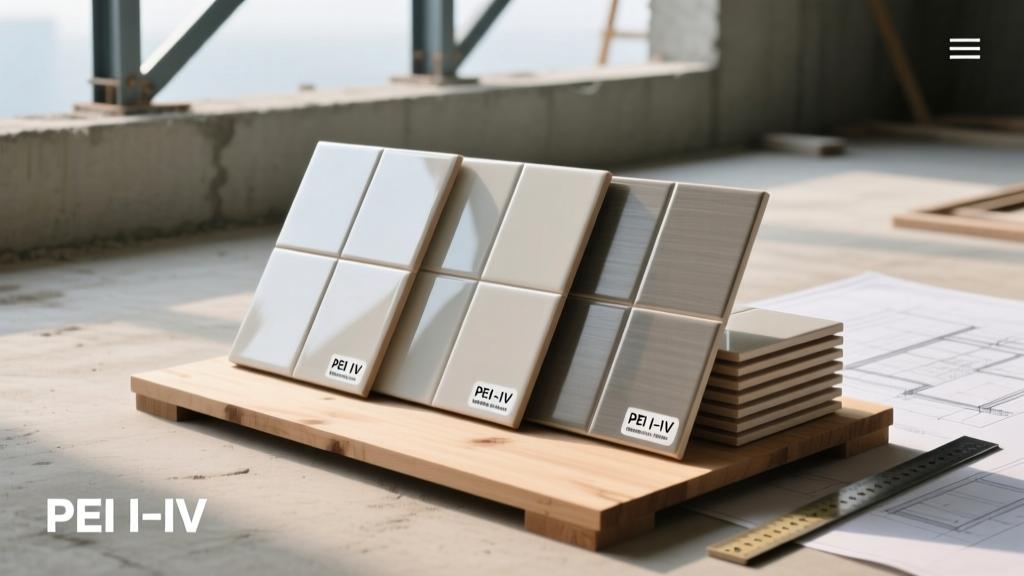
When evaluating porcelain floor tile durability, the Porcelain Enamel Institute (PEI) rating is the industry standard for surface wear resistance. Governed by ISO 10545-7, the PEI test measures how many revolutions of an abrasive load a glazed tile can withstand before visible wear occurs. It is critical to understand that PEI measures glaze abrasion, not structural impact resistance.
| PEI Class | Abrasion Resistance | Recommended Application | Residential Suitability |
|---|---|---|---|
| PEI I | Very Low | Wall-only, no foot traffic | Not for floors |
| PEI II | Low | Bathrooms, barefoot/soft-soled areas | Master baths (low use) |
| PEI III | Moderate | Residential floors, light commercial | Bedrooms, living rooms |
| PEI IV | High | Heavy residential, medium commercial | Kitchens, hallways, entries |
| PEI V | Extreme | Heavy commercial, industrial | Overkill for residential |
A PEI V tile will not scratch easily, but it can still shatter if a heavy cast-iron pan is dropped on it. Impact resistance is dictated by the tile's breaking strength and the substrate's deflection limits, not the PEI glaze rating.
Glazed vs. Through-Body: The Chipping Factor
For high-traffic zones where dropped objects are common, the construction of the porcelain body dictates long-term aesthetic durability.
- Standard Glazed Porcelain: Features a decorative printed glaze over a lighter or darker clay bisque. If a heavy object chips the surface, the contrasting bisque color is exposed, making the damage highly visible.
- Color-Body (Unglazed/Through-Body) Porcelain: The pigments are mixed throughout the entire clay body before firing. If the tile chips, the exposed cross-section matches the surface color, effectively hiding the damage. This is the mandatory choice for commercial lobbies and heavy-use residential kitchens.
- Double-Loaded Porcelain: A premium manufacturing technique where a 2-3mm layer of highly refined, pigmented clay is pressed onto a standard structural base. It offers the aesthetic depth of through-body tile at a slightly lower manufacturing cost.
Structural Integrity: Breaking Strength and Thickness
According to ANSI A137.1 standards published by the Tile Council of North America (TCNA), standard porcelain floor tile must exhibit a minimum breaking strength of 250 lbf (1,112 Newtons). However, for large-format tiles (any edge longer than 15 inches) or areas subject to rolling loads, specifying tiles with a breaking strength exceeding 350 lbf is highly recommended.
Thickness Variations and Load-Bearing
Standard residential porcelain ranges from 8mm to 10mm thick. For garages, workshops, or areas supporting point loads (like kitchen island legs or heavy gun safes), 12mm to 20mm paver-grade porcelain is required. A 20mm porcelain paver can support up to 2,200 lbs of concentrated point load when installed over a properly compacted sand/gravel base or a fully bonded mortar bed.
Real-World Failure Modes: Why Porcelain Cracks
Porcelain tile itself rarely degrades. When a porcelain floor fails, it is almost always a systemic failure of the installation assembly. The National Tile Contractors Association (NTCA) identifies three primary culprits for cracked porcelain:
- Substrate Deflection: Wood-framed floors must meet an L/360 deflection limit under standard live loads. For large-format porcelain (edges >15"), the industry mandates an L/720 deflection limit. If the joists bounce beyond this threshold, the rigid tile will snap.
- Point Load Concentrations: Installing heavy, narrow-footed appliances or furniture without load-distributing pads concentrates force onto a single square inch of tile, exceeding the material's tensile strength.
- Inadequate Mortar Coverage: ANSI A108 requires a minimum 80% mortar contact for dry residential areas and 95% for wet or exterior areas. Voids in the mortar bed create unsupported spans; stepping on a voided section causes a cantilever effect that fractures the tile.
'The tile is only as strong as the substrate beneath it. A 12mm porcelain tile installed over a deflecting plywood subfloor with 60% mortar coverage will fail faster than an 8mm tile installed over a perfectly rigid, fully-bonded uncoupling membrane.' — NTCA Reference Manual Guidelines
Lifespan Expectancy: The Grout Weak Link
While the porcelain tile will easily last 75 to 100 years, the installation assembly's lifespan is dictated by the grout. Standard cementitious grout is porous, prone to cracking from micro-movements, and requires sealing every 12 to 18 months. Its functional lifespan in a wet area is often just 10 to 15 years before it requires complete removal and replacement.
The Solution: High-Performance Grouts
To match the lifespan of the porcelain, specify advanced grout chemistries:
- 100% Solid Epoxy Grout (e.g., Laticrete Spectralock, Mapei Kerapoxy CQ): Impervious to water, chemicals, and staining. Lifespan matches the tile (50+ years). Requires skilled installation due to rapid cure times and high viscosity.
- Single-Component Urethane/Acrylic Grout (e.g., Prism, Flexcolor CQ): Offers excellent stain resistance and flexibility to absorb minor substrate movement without cracking. Easier to install than epoxy, with a 30- to 40-year functional lifespan.
Selection Matrix: Matching Tile to Traffic and Environment
Use this framework to specify the exact porcelain floor tile parameters for your project.
| Environment | Required PEI | Thickness | Finish / DCOF Rating | Grout Specification |
|---|---|---|---|---|
| Master Bathroom (Wet) | PEI III | 8mm - 10mm | Textured / Matte (DCOF ≥ 0.42) | Epoxy or Urethane |
| Kitchen / Main Hallway | PEI IV | 9mm - 12mm | Satin / Semi-Polished | Urethane or Polymer-Modified |
| Mudroom / Exterior Entry | PEI IV or V | 10mm - 12mm | Grip / Abrasive (DCOF ≥ 0.50) | Epoxy (Freeze-Thaw Stable) |
| Garage / Workshop | PEI V | 12mm - 20mm | Unpolished / Through-Body | 100% Solid Epoxy |
Always verify the Dynamic Coefficient of Friction (DCOF) for wet areas. The ANSI A326.3 standard requires a DCOF of 0.42 or greater for level interior floors expected to be walked on when wet. Note that highly polished porcelain (DCOF often < 0.30) becomes dangerously slick when wet and should be restricted to dry, low-traffic residential zones.