Matching Carpet Hall Runner Rugs to Your Home's Traffic Scenarios
Discover how to match carpet hall runner rugs to specific home scenarios. Learn pile heights, fiber types, and sizing for high-traffic and pet-friendly halls.
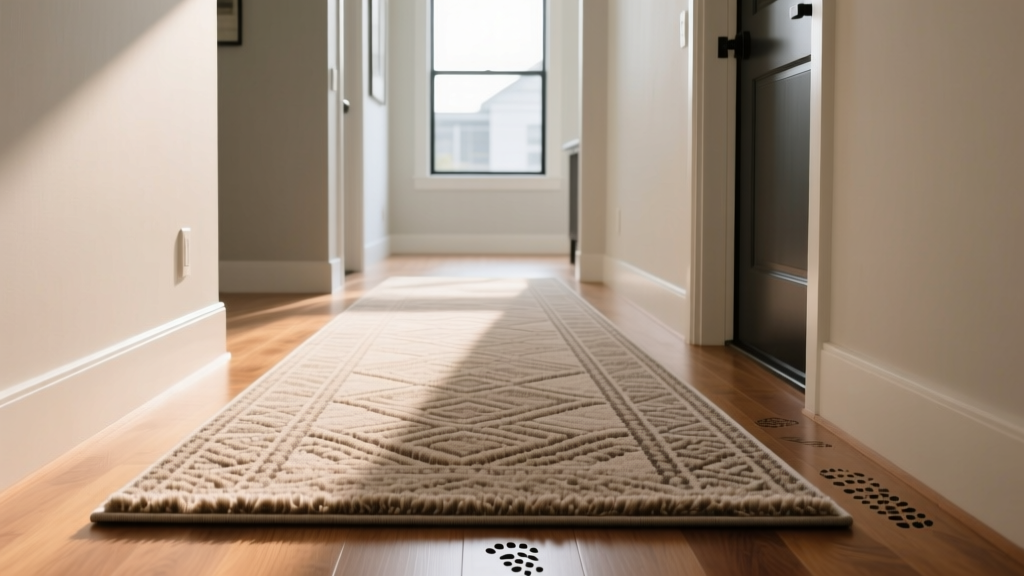
The Hallway Scenario-Matching Matrix
Hallways act as the primary arteries of a home, funneling foot traffic, pet claws, and outdoor debris between rooms. Selecting carpet hall runner rugs requires moving beyond aesthetic preferences to evaluate structural durability, subfloor protection, and spatial geometry. A runner that performs flawlessly in a low-traffic guest wing will rapidly degrade in a main entry corridor. The matrix below maps specific household scenarios to the exact material specifications required for long-term performance.
| Hallway Scenario | Optimal Fiber Type | Pile Height & Density | Required Pad Type | Est. Cost (2026) |
|---|---|---|---|---|
| High-Traffic Main Corridor | Nylon 6,6 (BCF) | 1/4" to 3/8" low pile, 50+ oz face weight | 1/4" needle-punched felt | $5.00 - $9.00 / sq ft |
| Pet-Heavy & Muddy Entry | Solution-Dyed Polypropylene | 1/8" to 1/4" flatweave or loop pile | 1/8" rubber-grip felt hybrid | $3.50 - $6.00 / sq ft |
| Formal / Low-Traffic Gallery | 100% New Zealand Wool | 1/2" to 5/8" cut pile, 40 oz face weight | 1/4" natural felt or jute | $8.00 - $15.00 / sq ft |
| Narrow / Wheelchair Accessible | Commercial Grade Nylon | 1/8" level loop, high density | 1/8" low-profile non-slip | $4.00 - $7.50 / sq ft |
Fiber Chemistry & Face Weight Specifications
The longevity of carpet hall runner rugs is dictated by fiber polymer structure and face weight (the ounces of fiber per square yard). According to testing standards published by the Carpet and Rug Institute (CRI), residential hallways demand a minimum face weight of 40 ounces, though 50 to 60 ounces is optimal for main thoroughfares.
Nylon 6,6 vs. Standard Nylon 6
For high-traffic corridors, specify Nylon 6,6 rather than standard Nylon 6. The dual-carbon molecular structure of Nylon 6,6 provides a higher melting point and superior resilience against crushing. When compressed by heavy footfalls or rolling luggage, Nylon 6,6 bounces back to its original height 30% faster than Nylon 6. Furthermore, insist on Bulked Continuous Filament (BCF) construction rather than staple fiber. BCF yarns are extruded as single, continuous strands, virtually eliminating the shedding and fuzzing that plagues staple-fiber rugs in high-friction zones.
Solution-Dyed Polypropylene for Moisture Zones
If the hallway connects to a mudroom or exterior door, solution-dyed polypropylene is the mandatory choice. Unlike surface-dyed fibers where color penetrates only the outer layer, solution-dyed polypropylene incorporates pigment into the liquid polymer before extrusion. This makes the fiber entirely colorfast, allowing you to scrub out mud, road salt, and pet accidents with a 50/50 bleach-water solution without degrading the rug's pattern.
Wool for Formal Galleries
New Zealand wool offers natural soil resistance due to its overlapping scale structure and high lanolin content. However, wool absorbs moisture and stains easily if not treated. For formal, low-traffic hallways, wool provides unmatched acoustic dampening and underfoot luxury, but it requires a strict no-shoes policy and immediate enzymatic cleaning for organic spills.
Dimensional Tolerances & Door Clearance Gotchas
A frequent installation failure occurs when carpet hall runner rugs impede interior door swings. Standard pre-hung interior doors are manufactured with a 3/4-inch to 1-inch bottom clearance. When calculating total thickness, you must account for both the rug pile and the underlying pad.
Regarding width, the industry standard for hallway proportion dictates leaving 4 to 6 inches of exposed hard flooring on either side of the runner. For a standard 36-inch wide hallway, purchase a 24-inch or 27-inch wide runner. This border prevents the rug from visually choking the space and ensures baseboards remain visible, maintaining architectural continuity.
Subfloor Protection: Pad Selection & Chemical Off-Gassing
The pad beneath your runner is just as critical as the rug itself, particularly when protecting engineered hardwood or luxury vinyl plank (LVP). Many mass-market runners feature a factory-applied synthetic latex or PVC (polyvinyl chloride) backing marketed as 'non-slip.' These backings are highly destructive to modern floor finishes.
The Plasticizer Migration Problem
PVC backings rely on chemical plasticizers to remain flexible. Over time, especially when exposed to UV light or ambient heat, these plasticizers migrate out of the rug backing and chemically bond with the polyurethane or aluminum oxide topcoats on hardwood floors. This results in permanent yellowing, sticky residue, and finish delamination that requires a full floor sanding and refinishing to repair. Always purchase runners with a woven textile backing and pair them with a separate, high-quality pad.
Approved Pad Materials
- 100% Recycled Felt (Needle-Punched): The gold standard for hardwood. Provides excellent cushion, absorbs sound, and contains no reactive chemicals. Look for pads certified by CRI Green Label Plus to ensure low VOC emissions.
- Natural Rubber & Felt Hybrids: Features a felt top layer for floor protection and a natural rubber bottom layer for grip. Ensure the rubber is 100% natural (vulcanized), not synthetic SBR rubber, which can off-gas and stain.
- Silicone-Grip Pads: For ultra-thin profiles needed under doors, modern silicone-dot pads provide aggressive grip without the chemical reactivity of PVC. Verify that the pad is explicitly rated as safe for polyurethane finishes by checking for EPA Safer Choice or equivalent non-toxic certifications.
Edge Cases: Stairs, Radiant Heat, and Transitions
Hallways rarely exist in isolation; they intersect with stairs, heating systems, and varying floor heights. Addressing these edge cases requires specialized installation techniques.
Staircase Transitions and Bullnose Wrapping
When a hallway runner transitions into a staircase, the material must be flexible enough to wrap tightly over the stair bullnose (the protruding edge of the tread). Cut-pile rugs thicker than 3/8-inch will 'smile' or gap at the stair edge, creating a severe trip hazard. For stair transitions, specify a tight level-loop or flatweave construction. The runner must be secured on every stair using heavy-duty upholstery staples (minimum 1/2-inch crown, 3/8-inch leg) driven into the tread-to-riser junction, supplemented by double-sided carpet tape rated for high shear strength.
Radiant Heat Compatibility
If your hallway features hydronic or electric radiant floor heating, the thermal resistance (R-value) of your runner and pad combined must remain below 1.5. Thick wool rugs and dense rubber pads act as insulators, trapping heat beneath the floor, which can cause engineered wood to delaminate or trigger the heating system's high-limit safety shutoffs. For radiant-heated halls, use a 1/8-inch low-density felt pad and a synthetic or thin-wool runner to allow efficient upward heat transfer.
Height Transitions to Adjacent Rooms
Where the hallway meets a lower-profile floor (like tile or thin LVP), the runner edge creates a tripping hazard. Avoid standard aluminum Z-bars, which are visually disruptive. Instead, use a flush-mount wood transition strip or a low-profile ramp reducer that overlaps the runner edge by exactly 1/4 inch, securing the rug while providing a smooth, ADA-compliant slope down to the adjacent flooring.