Vinyl Floor Material Taxonomy: SPC, WPC, and LVP Selection Guide
Master the vinyl floor material taxonomy. Compare SPC, WPC, and LVP cores, decode wear layer metrics, and select the exact specification for your project.
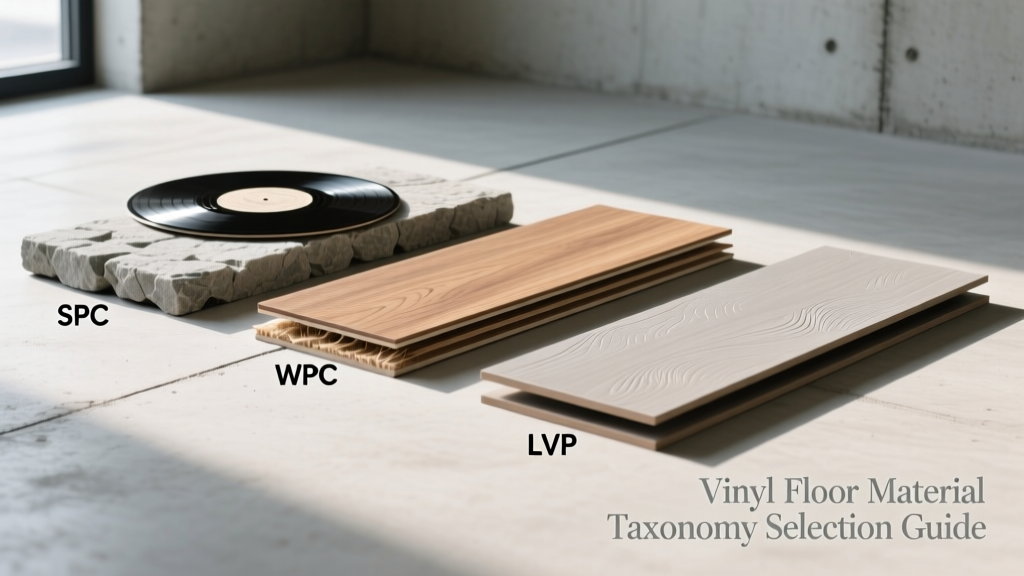
The Core Taxonomy: Decoding Vinyl Floor Construction
The term 'vinyl floor' encompasses a broad spectrum of synthetic flooring products, but treating them as a monolith leads to catastrophic specification errors. Modern vinyl flooring is defined by its core construction, which dictates dimensional stability, indentation resistance, and acoustic performance. According to the Resilient Floor Covering Institute (RFCI), the market has largely shifted from flexible sheet goods to dimensionally stable rigid core products, but flexible options still hold specific niche applications.
Flexible LVP vs. Rigid Core
Traditional Luxury Vinyl Plank (LVP) features a flexible PVC core. It conforms to minor subfloor imperfections but is highly susceptible to telegraphing—where subfloor bumps eventually show through the surface. Rigid core vinyl solves this through composite extrusion, splitting into two primary categories: SPC and WPC.
| Core Type | Composition | Density & Weight | Indentation Resistance | Best Application |
|---|---|---|---|---|
| Flexible LVP | 100% Virgin or Recycled PVC | Lightweight, highly flexible | Low (prone to furniture dents) | Low-budget flips, temporary spaces |
| SPC (Stone Plastic Composite) | Limestone powder + PVC stabilizers | Heavy, ultra-rigid | Exceptional (handles heavy point loads) | Commercial, high-traffic, rolling loads |
| WPC (Wood Plastic Composite) | PVC + foaming agents + wood/plastic dust | Medium weight, semi-rigid | Moderate (foamed core can compress) | Residential living areas, multi-family acoustics |
Wear Layer and AC Ratings: The True Measure of Durability
The printed design layer of a vinyl floor is purely aesthetic; the clear urethane wear layer above it dictates the product's lifespan. Misunderstanding wear layer metrics is the most common purchasing error in the category.
The Mil vs. Millimeter Trap
Wear layers are measured in mils (one-thousandth of an inch), not millimeters. A 20-mil wear layer is approximately 0.5 mm thick. If a retailer advertises a '5 mm wear layer,' they are either misleading you or confusing the total plank thickness with the wear layer. A 5 mm wear layer would be a quarter-inch of solid plastic, which does not exist in this category.
- 6 to 8 mil: Light residential. Suitable for guest bedrooms or low-traffic areas. Will show micro-scratches within 2-3 years from pet claws.
- 12 mil: Standard residential. The baseline for living rooms and hallways. Look for aluminum oxide or ceramic bead additives for scratch resistance.
- 20 to 22 mil: Premium residential / Light commercial. Required for homes with large dogs, heavy foot traffic, or light retail spaces.
- 28+ mil: Heavy commercial. Necessary for grocery stores, hospitals, and high-rolling-load environments.
Always verify the wear layer specification on the manufacturer's technical data sheet (TDS), not the retail box. Some big-box store brands obscure the wear layer thickness, substituting it with the total plank thickness to inflate perceived durability.
Room-by-Room Selection Framework
Selecting the right vinyl floor requires matching the core and wear layer to the specific environmental stressors of the room.
Wet Areas (Bathrooms, Mudrooms, Laundry)
Moisture resistance is the primary concern. While all vinyl is inherently water-resistant, the joints are the vulnerability. Select an SPC core with a tight, angle-angle or drop-lock click mechanism. Avoid glue-down LVP in wet areas unless you are using a moisture-cured urethane adhesive. Ensure the product features a waterproof attached pad; cork underlayments attached to the back of some WPC products will wick moisture and mold if water breaches the seams.
Basements and Below-Grade Concrete
Concrete slabs emit alkaline moisture vapor. Before installing any vinyl floor over below-grade concrete, perform a calcium chloride test or use a relative humidity (RH) probe. If moisture vapor emission rates (MVER) exceed the manufacturer's limit (typically 5 lbs per 1,000 sq ft over 24 hours), you must apply a penetrating epoxy moisture mitigation sealer. For the flooring itself, SPC is superior to WPC here, as the limestone core is entirely impervious to the alkaline degradation that can break down the foaming agents in WPC over time.
Multi-Family and Second-Story Residential
Acoustic transfer is the governing constraint. Look for products with high IIC (Impact Insulation Class) and STC (Sound Transmission Class) ratings. An IIC rating of 50 or higher is typically required by building codes for multi-family dwellings. WPC naturally outperforms SPC in acoustic dampening due to its lower density. Alternatively, specify an SPC plank with a high-density, pre-attached IXPE (cross-linked polyethylene) acoustic pad of at least 1.5mm thickness.
Subfloor Tolerance and Installation Realities
Rigid core vinyl floors are often marketed as 'forgiving' over imperfect subfloors. This is a dangerous half-truth. While SPC and WPC will not telegraph subfloor bumps like flexible LVP, they are highly susceptible to joint failure if the subfloor is not flat.
According to Shaw Floors installation guidelines and general industry standards, the subfloor must be flat to within 3/16 of an inch over a 10-foot radius, and 1/8 inch over a 6-foot radius. If a floor dips beyond this tolerance, the click-lock joints will experience sheer stress every time someone steps on the hollow spot. Over time, this causes the locking mechanisms to snap or separate, leading to gapping and water infiltration.
Aesthetic Taxonomy: EIR and Bevel Profiles
Beyond structural taxonomy, the visual realism of a vinyl floor is dictated by its embossing and edge profiling.
- Embossed in Register (EIR): The highest tier of visual realism. The physical texture of the wear layer perfectly aligns with the printed wood grain or stone grout lines. When evaluating samples, run your fingernail across a knot or grain line; if the physical dip matches the visual dark spot, it is true EIR.
- Painted Bevels: The edges of the plank are painted to simulate a routed edge. Avoid cheap painted bevels on wood-look vinyl, as the paint will chip over time, revealing the light-colored PVC core underneath and ruining the illusion.
- Micro-Bevels: A slight, physical routing of the edge. This is the most durable edge profile for wood-look vinyl, as it hides minor height variations between adjacent planks without relying on fragile paint.
2026 Pricing and Cost Expectations
Pricing for vinyl flooring has stabilized following the supply chain disruptions of the early 2020s, but material costs vary strictly by core type and wear layer specification.
- Flexible LVP (Glue-Down): $1.50 – $2.50 per sq. ft. (Material only)
- Entry-Level SPC (12 mil wear layer): $2.50 – $3.50 per sq. ft.
- Premium WPC/SPC (20+ mil, EIR, attached pad): $4.00 – $6.50 per sq. ft.
- Professional Installation: $1.75 – $3.00 per sq. ft., heavily dependent on subfloor prep requirements and room complexity.
When budgeting, allocate an additional 10% for waste on standard layouts, and 15% for diagonal layouts or complex floor plans with numerous penetrations. Always verify that the product carries FloorScore or GREENGUARD Gold certification to ensure compliance with strict indoor air quality standards regarding VOC emissions, as recommended by the EPA guidelines on indoor air quality.
Frequently Asked Questions
Can I install a vinyl floor over existing ceramic tile?
Yes, but the grout lines must be addressed. Rigid core vinyl will not immediately telegraph grout lines, but over time, the repeated flexing over the recessed grout joints will cause the click-lock mechanisms to fatigue and fail. You must skim-coat the existing tile with a self-leveling underlayment to create a perfectly flat, monolithic surface before installing the vinyl.
Is WPC or SPC better for radiant heating systems?
SPC is significantly better for radiant heating. The limestone composite core conducts heat efficiently and remains dimensionally stable under temperature fluctuations. WPC's foamed core acts as a thermal insulator, reducing the efficiency of the radiant system, and the trapped heat can cause the foaming agents to expand and contract, leading to plank cupping. Always check the manufacturer's maximum surface temperature limit, typically capped at 85°F (29°C).