What Is LVP Flooring? Anatomy and Top Brand Product Lines
Discover what is LVP flooring through a technical deep-dive into its anatomy, core materials, and top brand product lines like COREtec.
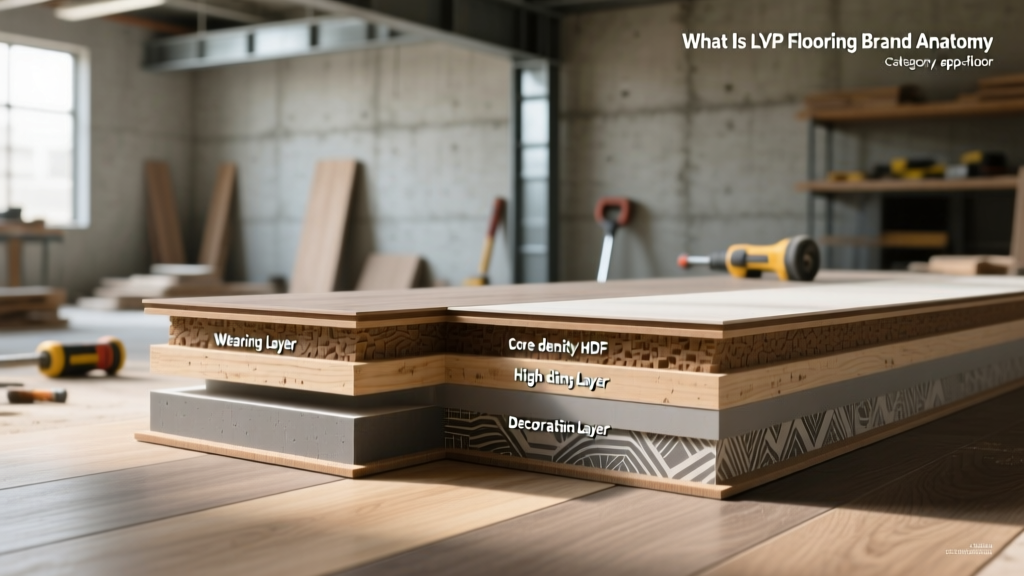
Defining the Category: What is LVP Flooring?
Luxury Vinyl Plank (LVP) is a multi-layer synthetic flooring system engineered to replicate the dimensional stability of hardwood while providing complete waterproof performance. Unlike traditional sheet vinyl or peel-and-stick tiles, modern LVP utilizes rigid core technology and precision-milled click-lock mechanisms. According to the Resilient Floor Covering Institute (RFCI), LVP has become the fastest-growing segment in the hard surface flooring market, driven by advancements in high-definition photographic printing and extruded core densities.
To understand what is LVP flooring from a procurement and installation standpoint, you must look past the surface aesthetic and evaluate the structural anatomy and the specific engineering choices made by leading manufacturers.
The 5-Layer Anatomy of Rigid Core LVP
Every premium LVP product is constructed through a thermal lamination process that fuses five distinct layers. The failure or success of the flooring depends on the chemical composition and thickness of each stratum.
1. UV-Cured Urethane Topcoat
The absolute top layer is a microscopic clear coat, typically fortified with aluminum oxide or ceramic beads. This layer dictates the floor's stain resistance, sheen retention, and scuff visibility. Premium brands use a matte or low-luster finish (10-15 gloss units) to hide micro-scratches.
2. The Wear Layer
Measured in mils (1 mil = 1/1000th of an inch), this clear PVC layer protects the printed design. Residential standard: 12 to 20 mil. Commercial standard: 22 to 28 mil. A 20-mil wear layer is the optimal threshold for high-traffic residential zones, balancing durability with plank flexibility.
3. High-Definition Printed Vinyl Film
Using rotogravure or digital printing, this layer provides the wood grain, stone, or abstract visual. High-end lines feature 'EIR' (Embossed-in-Register) technology, where the physical texture of the wear layer perfectly aligns with the visual grain of the printed film.
4. The Rigid Core (WPC vs. SPC)
This is the structural backbone of the plank. The core composition fundamentally alters the floor's acoustic properties, dent resistance, and installation tolerances.
- WPC (Wood Plastic Composite): A foamed PVC core mixed with wood flour or foaming agents. It is thicker, quieter underfoot, and more forgiving over minor subfloor imperfections, but more susceptible to denting from heavy point-loads (e.g., appliance legs).
- SPC (Stone Plastic Composite): A dense, extruded core made of limestone powder, PVC resin, and stabilizers. SPC is highly dent-resistant, dimensionally stable under temperature fluctuations, and thinner, but it transmits more impact noise and requires a flatter subfloor.
5. Attached Underlayment / Backing
Most premium floating LVP features a pre-attached backing made of cork, EVA foam, or IXPE (cross-linked polyethylene). This layer absorbs minor subfloor irregularities, reduces hollow-sounding footfalls, and acts as a secondary moisture vapor barrier.
Brand Deep-Dive: Top Product Lines Compared
Understanding what is LVP flooring requires analyzing how top manufacturers execute this 5-layer formula. Below is an analysis of three dominant product lines in the current market.
COREtec (USFloors): The WPC Pioneer
COREtec invented the rigid core category. Their flagship COREtec Pro Plus line utilizes an SPC core for commercial-grade dent resistance while maintaining a 20-mil wear layer. COREtec planks are known for their deep micro-bevels and highly realistic EIR textures. Pricing typically ranges from $4.50 to $6.50 per square foot. Their proprietary 5G click-lock system requires a standard tapping block but offers exceptional tensile strength once engaged.
Shaw Floors: Floorté Premier
Shaw's Floorté Premier collection utilizes a high-density SPC core paired with a 22-mil commercial-grade wear layer, making it highly resistant to pet claws and furniture indentation. Shaw integrates the Valinge 5G drop-lock mechanism, which allows for faster installation in tight spaces without requiring a tapping block on the short ends. Retail pricing averages $3.80 to $5.20 per square foot.
Armstrong Flooring: Pryzm
Armstrong approaches LVP with their Pryzm line, which features a solid polymer core (a proprietary SPC variant) and a diamond-like ultra-durable finish. Pryzm planks are slightly narrower and longer than industry standards, mimicking the dimensions of premium hardwood. They excel in wet areas due to their tight seam tolerances, pricing out between $4.00 and $5.80 per square foot.
| Brand / Line | Core Type | Wear Layer | Total Thickness | Click System | Avg. Cost / Sq Ft |
|---|---|---|---|---|---|
| COREtec Pro Plus | SPC | 20 mil | 6.5 mm | Angle-Tap | $4.50 - $6.50 |
| Shaw Floorté Premier | SPC | 22 mil | 5.0 mm | Valinge 5G | $3.80 - $5.20 |
| Armstrong Pryzm | Solid Polymer | 20 mil | 6.0 mm | Angle-Tap | $4.00 - $5.80 |
Installation Edge Cases and Failure Modes
While LVP is marketed as DIY-friendly, professional installers know that the majority of warranty claims stem from improper subfloor preparation and environmental mismanagement. As noted in installation guidelines by The Family Handyman, skipping subfloor prep is the leading cause of joint failure.
The Telegraphing Effect: SPC core LVP is rigid, but it is not structural. If your subfloor has a dip exceeding 3/16 of an inch over a 10-foot radius, the plank will flex when stepped on. Over time, this repetitive flexing will snap the fiberglass-reinforced click-lock joints, leading to plank separation.
Critical Subfloor Tolerances
- Flatness: Must be within 3/16' over a 10-foot radius, and 1/8' over a 6-foot radius. Use a self-leveling compound (SLC) for concrete dips, and sand down plywood humps.
- Moisture (Concrete): Perform a calcium chloride test or Relative Humidity (RH) probe test. While the LVP itself is waterproof, moisture vapor emitting from concrete can become trapped beneath the plank, leading to alkaline salt buildup that degrades the backing adhesive and causes mold growth.
- Acclimation: WPC cores require 48 to 72 hours of acclimation in the installation environment (65°F - 85°F). SPC cores are less sensitive to thermal expansion but should still be acclimated for 24 hours to prevent post-installation shifting.
Maintenance and Chemical Compatibility
The urethane topcoat on LVP is highly resistant to water but vulnerable to specific chemical solvents and extreme heat. To maintain the 20-mil wear layer's integrity, adhere to the following maintenance matrix:
- Approved Cleaners: pH-neutral cleaners specifically formulated for polyurethane surfaces (e.g., Bona Hard Surface Floor Cleaner, Black Diamond Wood & Laminate Cleaner).
- Prohibited Chemicals: Ammonia, bleach, undiluted vinegar, and paste waxes. Acidic or highly alkaline solutions will strip the urethane topcoat, leaving the floor dull and susceptible to staining.
- Furniture Protection: Use felt pads with a minimum surface area of 1.5 inches for heavy furniture. Point-loads from narrow metal furniture legs will permanently dent WPC cores and severely scratch SPC wear layers.
For a comprehensive visual breakdown of resilient flooring categories and their respective wear layer testing standards, consult the technical resources provided by Bob Vila's home improvement guides. Understanding what is LVP flooring at a microscopic and structural level ensures you select a product line that aligns with your specific subfloor conditions, traffic demands, and long-term performance expectations.