Washable Carpet Rugs: Room Scenarios and Application Fit Guide
Match washable carpet rugs to the right rooms. Explore pile heights, washing constraints, and subfloor compatibility for pets, dining, and nurseries.
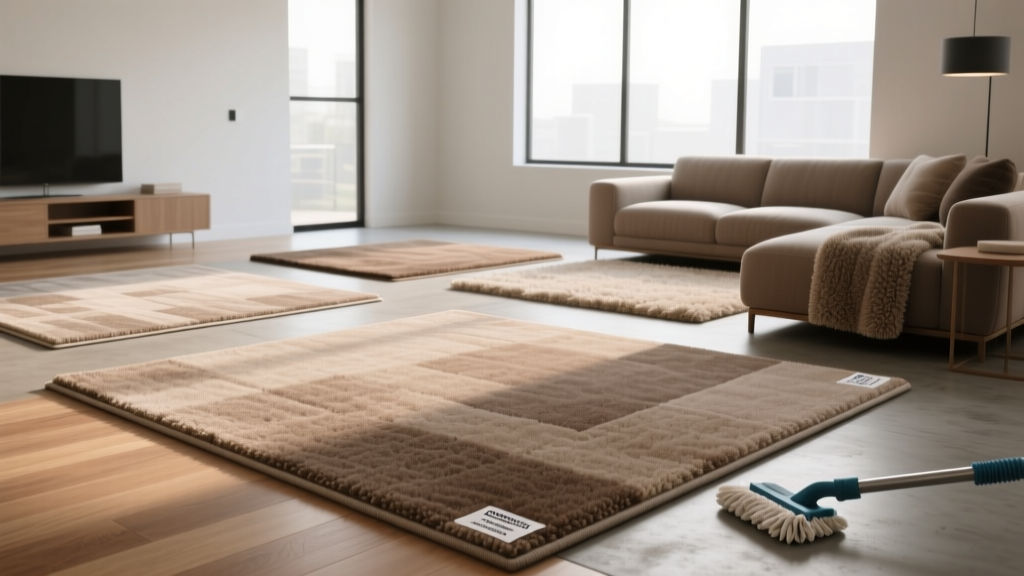
The Anatomy of Washable Carpet Rugs
Washable carpet rugs bridge the gap between the acoustic and thermal comfort of wall-to-wall carpeting and the maintenance ease of hard-surface flooring. However, treating them as a universal replacement for traditional area rugs leads to premature failure. According to testing by Wirecutter, the structural integrity of these rugs relies on a delicate balance between pile density, backing flexibility, and washing machine agitation.
A standard washable rug consists of three distinct layers:
- Face Fiber: Typically solution-dyed polyester, recycled PET, or cotton blends. Polyester dominates the market due to its hydrophobic nature, which resists liquid absorption and prevents staining.
- Primary Backing: A woven or non-woven polyurethane (PU) or thermoplastic polyurethane (TPU) layer that binds the tufts. This layer must remain flexible enough to fold without cracking.
- Secondary Grip Layer: Often made from thermoplastic rubber (TPR) or a specialized non-slip coating. This is the most critical component for subfloor compatibility.
Unlike traditional carpets with pile heights of 0.5 to 0.75 inches, washable carpet rugs are engineered with lower profiles—typically ranging from 0.15 inches (flatweave) to 0.4 inches (plush). This reduced pile height is mandatory to allow water and detergent to penetrate the base during the wash cycle and to ensure the rug dries within 24 hours to prevent mildew.
Scenario Matching Matrix: Where They Thrive vs. Fail
Application-fit is determined by traffic type, spill frequency, and furniture load. Use the matrix below to determine if a washable carpet rug is the correct specification for your space.
| Room Scenario | Traffic & Spill Profile | Recommended Pile Height | Verdict & Edge Cases |
|---|---|---|---|
| Pet-Heavy Living Room | High traffic, urine/vomit risk, claw friction | 0.25' - 0.4' (Plush) | Thrive. Requires TPU waterproof barrier. Avoid looped pile to prevent claw snags. |
| Dining Room | Food spills, heavy chair drag, casters | Under 0.25' (Low Profile) | Thrive. Thick piles catch chair legs. Use a rigid felt pad underneath to prevent bunching. |
| Nursery / Playroom | Medium traffic, high liquid/spit-up risk | 0.3' - 0.5' (Shag/Plush) | Thrive. Must be OEKO-TEX certified. High pile provides impact cushioning for falls. |
| Formal Entryway | High dirt, wet shoes, heavy doors | N/A | Fail. Door clearance is an issue. Dirt grinds into low-pile synthetic fibers, causing premature wear. |
| Under Heavy Sectionals | Static load, low foot traffic | N/A | Fail. Washable rug pads lack the high-density foam required to prevent permanent indentation from 200+ lb furniture. |
High-Stakes Environments: Deep Dive Applications
Pet-Heavy Households and the Waterproof Imperative
For homes with incontinent puppies or senior dogs, a standard washable rug is insufficient if the backing is merely water-resistant. Brands like Tumble utilize a proprietary TPU (Thermoplastic Polyurethane) spillproof barrier that prevents liquids from penetrating through to the hardwood or laminate subfloor. If you opt for a two-piece system (like Ruggable), ensure the underlying pad features a moisture barrier, otherwise, pet urine will pool between the rug cover and the floor, causing severe subfloor damage and odor retention. Furthermore, select cut-pile constructions over looped or Berber styles; pet claws will catch and pull loops, unraveling the rug in a single incident.
Dining Rooms and the Chair Drag Problem
In dining scenarios, the primary failure mode is rug bunching caused by chair legs catching the rug edge or sinking into the pile. Washable carpet rugs with a pile height exceeding 0.3 inches will impede chair movement. For dining rooms, specify a flatweave or low-profile washable rug (such as those from Revival Rugs) and pair it with a 1/4-inch thick felt rug pad. The felt pad adds structural rigidity, preventing the thin rug from rippling when chairs are pushed back, while also protecting the floor from the chair glides.
Washing Machine Capacity Constraints
- 3.0 to 3.5 cu. ft. (Compact/Standard): Maximum rug size 5x7 feet. Attempting to wash an 8x10 in this capacity will cause the machine to become unbalanced during the spin cycle, triggering error codes and halting the wash.
- 4.5 to 5.0 cu. ft. (Large Capacity Front-Loader): Maximum rug size 8x10 feet. Ensure the rug is folded loosely in a fan shape rather than tightly rolled to allow water circulation.
- 6.0+ cu. ft. or Commercial Laundromat: Required for 9x12 feet rugs and large washable shag carpets. The added weight of water trapped in shag fibers exceeds residential machine limits.
Subfloor Compatibility: The LVP Plasticizer Problem
The most frequent catastrophic failure associated with synthetic rugs is plasticizer migration on Luxury Vinyl Plank (LVP) and engineered hardwood. Many washable rugs utilize TPR (Thermoplastic Rubber) or PVC backings to achieve non-slip properties. When exposed to UV light and sustained pressure, the chemical plasticizers in these backings break down and bond with the urethane wear layer of LVP, leaving permanent yellow or brown stains that cannot be cleaned or buffed out.
As highlighted in floor care guidelines referenced by Architectural Digest, protecting your subfloor requires breaking the chemical bond between the rug and the floor. If your washable rug features a TPR or PVC backing, you must place a breathable, 100% natural felt or natural rubber rug pad (such as RugPadUSA's Nature's Grip) between the rug and the LVP. Never place a synthetic-backed washable rug directly onto vinyl, laminate, or polyurethane-finished hardwood without a protective barrier.
Frequently Asked Questions
Do washable carpet rugs require a separate rug pad?
Yes, in almost all scenarios. While the secondary backing provides grip, it lacks the acoustic dampening, thermal insulation, and impact absorption of a dedicated pad. More importantly, a thick felt pad extends the life of the rug by absorbing the compressive force of foot traffic, preventing the thin primary backing from stretching and tearing over time.
Can washable rugs be placed in a dryer?
Most polyester and cotton-blend washable rugs can be tumble dried on a strictly low-heat or air-fluff setting. High heat will melt the TPU or TPR backing, causing it to clump and lose its non-slip properties. However, high-pile or shag washable rugs should always be air-dried, as the dense fibers trap heat and can scorch the synthetic face yarns.
How do you handle edge curling on washable rugs?
Edge curling occurs when the rug cover shrinks slightly during washing while the pad does not, or when the backing dries unevenly. To fix this, lay the rug flat and place heavy, flat objects (like textbooks) on the corners for 48 hours. For persistent curling, apply a specialized carpet seam tape to the underside of the corners, anchoring them directly to the rug pad.
For further industry standards on rug construction and material safety, consult the testing protocols published by the Carpet and Rug Institute (CRI), which provide baseline metrics for fiber durability and backing integrity.