Flooring Options for Outdoor Patio: 2026 Cost Analysis Guide
Compare 2026 costs for outdoor patio flooring options. Detailed breakdown of concrete, porcelain pavers, and natural stone material and labor prices.

The True Cost of Patio Flooring: Beyond the Surface Material
When budgeting for outdoor patio flooring, homeowners frequently make the mistake of calculating costs based solely on the price per square foot of the surface material. In 2026, with masonry labor rates averaging $65 to $95 per hour and material supply chains stabilizing post-pandemic, the surface material typically accounts for only 35% to 45% of the total project cost. The remaining budget is consumed by site preparation, base construction, drainage engineering, and specialized installation labor.
Before any flooring is laid, you must budget for excavation and base preparation. A standard patio requires 6 inches of excavation, followed by a 4-inch base of DOT-spec 3/4-inch crushed aggregate compacted to 98% Proctor density. Expect to pay $3.50 to $5.50 per square foot just for this foundational step. Skipping or cheapening the base will result in frost heave, differential settling, and cracked pavers within two winters.
2026 Patio Flooring Cost Matrix
The following matrix breaks down the fully installed costs for the three most durable and popular outdoor patio flooring options. These figures assume a standard 400-square-foot patio with moderate site access and standard soil conditions.
| Material Type | Material Cost / Sq Ft | Labor & Base / Sq Ft | Total Installed | Expected Lifespan |
|---|---|---|---|---|
| Stamped Concrete | $6.00 - $10.00 | $8.00 - $14.00 | $14.00 - $24.00 | 25 - 30 Years |
| 20mm Porcelain Pavers | $5.00 - $12.00 | $9.00 - $16.00 | $14.00 - $28.00 | 50+ Years |
| Natural Travertine | $9.00 - $18.00 | $12.00 - $18.00 | $21.00 - $36.00 | 40+ Years |
Deep Dive: Material Specifications and Hidden Costs
1. Poured and Stamped Concrete
Concrete remains the most cost-effective option for large footprints, but the specification of the mix dictates its longevity. For exterior patios in climates with freeze-thaw cycles, you must specify a 4,000 PSI air-entrained mix. Air entrainment introduces microscopic bubbles that give water room to expand when it freezes, preventing surface spalling.
According to industry standards for stamped concrete, the slab should be a minimum of 4 inches thick, reinforced with 6x6 W1.4xW1.4 welded wire mesh or synthetic fiber mesh. Control joints must be saw-cut within 12 hours of pouring at intervals no greater than 10 feet to control cracking.
- Hidden Cost: Integral color (mixed into the truck) adds $1.50/sq ft, while topical color hardeners and antiquing release agents add $2.50/sq ft but provide superior UV stability and depth of color.
- Maintenance: Requires resealing with a solvent-based acrylic sealer every 2 to 3 years ($1.50 - $2.50 per sq ft if hired out).
2. 20mm Porcelain Pavers
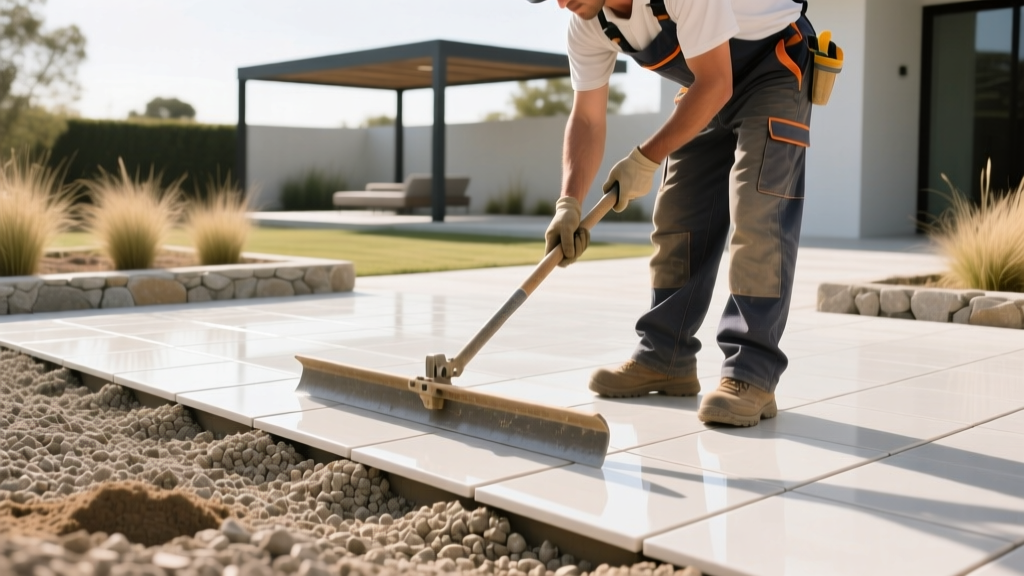
Porcelain pavers have dominated the high-end patio market due to their near-zero water absorption rate (<0.5%), making them completely impervious to frost damage and staining. When selecting porcelain for outdoor use, you must use 20mm (3/4-inch) thick pavers with rectified edges. Standard indoor porcelain tile will crack under point-loads (like patio furniture legs) when installed outdoors.
Installation methods drastically alter the price. A traditional sand-set installation over a compacted gravel base is the most economical. However, for rooftop patios, balconies, or areas requiring complex drainage routing, a pedestal system (such as Bison or ARDEX pedestals) is required. Pedestals elevate the pavers, allowing water to drain freely beneath the surface.
"When installing 20mm porcelain pavers over a pedestal system, ensure the pavers are rated for a minimum break load of 2,000 pounds to safely support heavy outdoor kitchen appliances and concentrated furniture loads." — Tile Council of North America (TCNA) Exterior Guidelines
3. Natural Stone (Travertine and Bluestone)
Natural stone offers unmatched aesthetic appeal and thermal properties. Tumbled Travertine, for instance, reflects solar radiation highly effectively, keeping the surface temperature up to 20% cooler than stamped concrete or composite decking in direct summer sunlight. This makes it the premier choice for pool decks and barefoot traffic areas.
The Natural Stone Institute recommends that exterior stone in freeze-thaw climates be installed using a mud-set method over a fully cured, sloped concrete slab, rather than directly over a sand base, to prevent shifting and water infiltration beneath the stone. This requirement effectively doubles your base cost, as you are paying for both a concrete slab and the stone installation.
- Hidden Cost: Natural stone is porous. Travertine and Bluestone require a high-quality, breathable siloxane-based penetrating sealer immediately after installation and every 3 to 5 years thereafter to prevent efflorescence and biological growth.
Decision Framework: Matching Budget to Site Conditions
Use this practical framework to determine which flooring option aligns with your specific site constraints and financial parameters.
Choose Stamped Concrete If:
- Your patio footprint exceeds 600 sq ft (economies of scale heavily favor concrete).
- You have a strict budget cap of $20/sq ft fully installed.
- The site has heavy clay soil that is prone to minor shifting (a monolithic slab with deep footings handles this better than individual pavers).
Choose Porcelain Pavers If:
- You want a zero-maintenance surface that will never require sealing.
- The patio is adjacent to a pool (porcelain provides excellent slip resistance when textured, and resists chlorine/salt degradation).
- You anticipate needing access to underground utilities (pavers can be unzipped and reinstalled without demolition).
Choose Natural Stone If:
- Barefoot comfort and thermal resistance are top priorities (pool surrounds).
- You are building a luxury property where natural material variance increases the home's appraisal value.
- You have the budget to accommodate the mandatory concrete sub-slab and ongoing sealing maintenance.
10-Year Total Cost of Ownership (TCO)
To understand the true financial impact, we must look past the installation day. The 10-year TCO includes the initial installation, plus a decade of mandatory maintenance, repairs, and sealing for a standard 400-square-foot patio.
| Material | Initial Install (Avg) | 10-Yr Maintenance | 10-Year TCO |
|---|---|---|---|
| Stamped Concrete | $7,600 | $2,400 (Sealing/Crack repair) | $10,000 |
| 20mm Porcelain | $8,400 | $400 (Joint sand top-up) | $8,800 |
| Natural Travertine | $11,400 | $3,200 (Sealing/Stone replacement) | $14,600 |
While stamped concrete wins on initial out-of-pocket costs, 20mm porcelain pavers offer the lowest total cost of ownership over a decade due to the complete elimination of chemical sealing and the structural permanence of the material. When requesting bids from contractors, always demand a line-item breakdown that separates excavation, base aggregate, setting materials, and the surface pavers to ensure you are comparing equivalent structural specifications.
Written by
Sarah WhitfieldSarah Whitfield is a chartered quantity surveyor (MRICS) and construction cost analyst with 15 years of experience in material pricing, procurement strategy, and project budgeting. She earned her degree in Construction Management from the University of Reading (UK) and has worked on projects ranging from $2M custom homes to $180M mixed-use developments across North America and Europe. Sarah currently leads cost estimating for BuildMat Insight, maintaining a proprietary database of 4,000+ material price points updated quarterly. She is a frequent contributor to RSMeans cost data panels and has presented at the International Cost Engineering Council (ICEC) congress. Based in Denver, CO, Sarah is an avid trail runner and volunteer mentor for Women in Construction.
More from Sarah Whitfield
View all
Wood & Lumber
What Are the Different Types of Wood? A Builder's Guide
Compare structural softwoods, finish hardwoods, and engineered lumber. Analyze Janka ratings, MOE values, and 2026 pricing for construction.
Aug 4, 2026

Walls & Panels
Steel Framing vs Wood Framing: Corrosion and Moisture Defense
Compare steel framing vs wood framing for moisture resistance. Learn about galvanized coatings, condensation risks, and corrosion protection strategies.
Jul 21, 2026

Stone & Masonry
How to Cut Stone Veneer: Wet Saw vs Grinder Comparison
Compare the best tools for cutting stone veneer. We review wet saws, angle grinders, and chop saws to help you achieve clean, chip-free cuts.
Jul 21, 2026