Understanding Wood Laminate Flooring AC Ratings and Specs
Master wood laminate flooring specifications. Learn how AC ratings, NALFA certifications, and core densities dictate durability, cost, and lifespan.
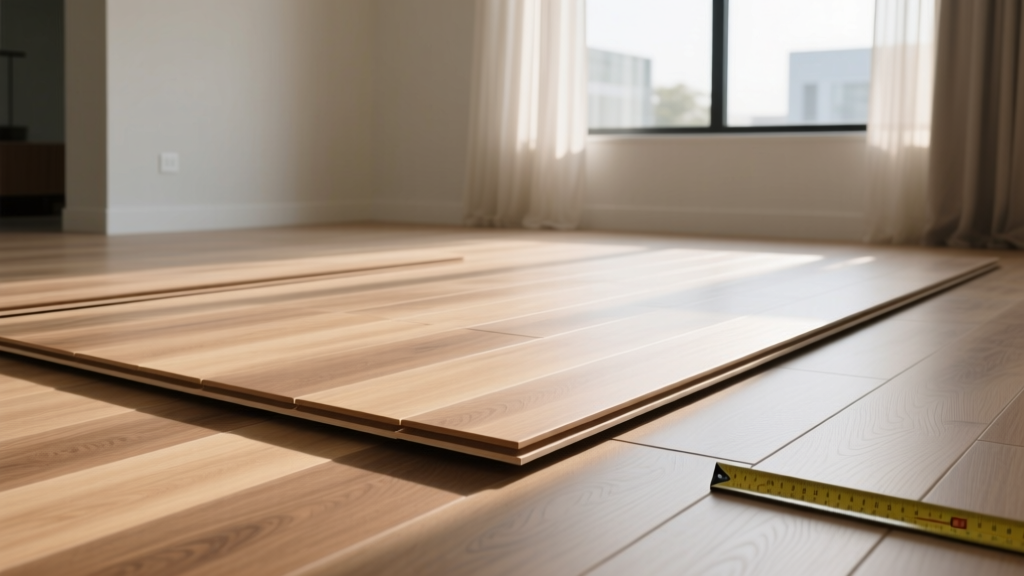
The Anatomy of Wood Laminate Flooring Performance
Visual aesthetics only account for a fraction of wood laminate flooring performance. The true lifespan, structural integrity, and moisture resilience of a laminate plank are dictated by its engineered specifications. Modern laminate is a multi-layer synthetic product fused through a high-pressure lamination (HPL) or direct-pressure lamination (DPL) process. Understanding the exact material composition of these layers is mandatory for specifying flooring that will survive specific environmental and load-bearing demands.
A high-performance laminate plank consists of four distinct strata. The topmost stratum is the wear layer, a transparent coating composed of melamine resin heavily loaded with aluminum oxide (Al2O3) particles. This layer dictates the floor's abrasion resistance. Beneath this sits the decorative layer, a high-resolution photographic paper printed with wood grain imagery and sealed with melamine. The structural backbone is the core board, typically High-Density Fiberboard (HDF), which provides dimensional stability and houses the mechanical locking system. Finally, a melamine-backed balancing layer is fused to the bottom to counteract the tension of the top layers and prevent bowing.
Decoding the AC (Abrasion Class) Rating System
The Abrasion Class (AC) rating, governed by the EN 13329 European standard and widely adopted globally, is the definitive metric for laminate surface durability. The rating is determined using the Taber Abraser test (ASTM D4060), where a specimen is subjected to rotating abrasive wheels until the decorative layer is visibly worn through. The number of cycles required to reach this failure point determines the AC grade.
| AC Rating | Classification | Minimum Taber Cycles | Recommended Application | Aluminum Oxide Density |
|---|---|---|---|---|
| AC1 | Moderate Residential | 1,000 - 1,500 | Bedrooms, low-traffic guest rooms | Low |
| AC2 | General Residential | 1,500 - 2,000 | Living rooms, dining rooms | Medium-Low |
| AC3 | Heavy Residential / Moderate Commercial | 2,000 - 4,000 | Kitchens, hallways, small retail shops | Medium |
| AC4 | General Commercial | 4,000 - 6,000 | Offices, boutiques, high-traffic residential | High |
| AC5 | Heavy Commercial | 6,000 - 8,500 | Department stores, public buildings | Very High |
| AC6 | Extreme Commercial | 8,500+ | Industrial showrooms, heavy machinery areas | Maximum |
For standard residential applications in 2026, AC3 is the absolute minimum acceptable specification for main living areas, while AC4 is strongly recommended for households with large dogs or heavy foot traffic. AC5 and AC6 ratings introduce a higher concentration of aluminum oxide, which can slightly reduce the optical clarity of the decorative layer, giving the surface a marginally more matte or frosted appearance.
Core Board Density: HDF vs. MDF Specifications
The core board is the most critical specification for impact resistance and locking mechanism integrity. While older or budget laminates utilize Medium-Density Fiberboard (MDF) with a density of 600–700 kg/m³, premium wood laminate flooring exclusively uses High-Density Fiberboard (HDF) compressed to 800–950 kg/m³.
Standard HDF will absorb moisture and swell rapidly. For moisture-prone areas, specify Hydrophobic HDF. This core is manufactured with specialized wax emulsions and moisture-blocking resins. Under the EN 317 standard, a high-quality moisture-resistant HDF core must exhibit a thickness swelling rate of less than 8% after 24 hours of complete water immersion, compared to 15-20% for standard HDF.
Core density directly impacts the shear strength of the mechanical locking profiles. High-density cores allow manufacturers to mill micro-bevels and complex 5G locking geometries (such as Välinge 5G or Unilin) without the tongues snapping under tensile stress during installation. If the HDF density drops below 750 kg/m³, the locking joints are highly susceptible to shearing when subjected to heavy rolling loads or subfloor deflection.
Environmental & Health Specifications (Emissions)
Because the HDF core is bound together using urea-formaldehyde or phenol-formaldehyde resins, off-gassing is a primary indoor air quality concern. When specifying laminate, you must verify compliance with strict emission standards rather than relying on generic 'eco-friendly' marketing claims.
- TSCA Title VI & CARB Phase 2: The EPA's TSCA Title VI mandates that HDF core materials emit no more than 0.09 parts per million (ppm) of formaldehyde. CARB Phase 2 enforces the exact same 0.09 ppm limit. Any laminate sold in the US must carry a TSCA Title VI compliance label on the packaging.
- FloorScore Certification: Administered by SCS Global Services, FloorScore tests the final finished product (including the wear layer and adhesives) for 35 individual Volatile Organic Compounds (VOCs), ensuring it meets strict indoor air quality criteria for schools and healthcare facilities.
- Greenguard Gold: A more rigorous certification that tests for over 360 VOCs and enforces lower emission limits than FloorScore, specifically designed for environments with sensitive individuals.
Dimensional Specs: Thickness, Width, and Embossing
Laminate thickness ranges from 6mm to 14mm, but the 8mm to 12mm spectrum dominates the market. Thickness does not inherently increase the AC abrasion rating, but it drastically improves the Impact Insulation Class (IIC) and structural rigidity.
| Specification | 8mm Laminate | 10mm Laminate | 12mm Laminate |
|---|---|---|---|
| Subfloor Tolerance | Requires near-perfect leveling (3/16' over 10') | Forgives minor subfloor undulations | Bridges minor imperfections; highly stable |
| Acoustic Profile (IIC) | Poor (hollow sound without thick underlayment) | Moderate acoustic dampening | Excellent (dense, solid sound underfoot) |
| Max Plank Width | Usually limited to 6' - 7' to prevent warping | Supports 8' - 9' wide planks | Supports 10' - 12' ultra-wide luxury planks |
| Embossing Depth | Standard texture or light EIR | Deep EIR (Embossed-In-Register) | Ultra-deep EIR with micro-grout lines |
Embossed-In-Register (EIR) technology aligns the physical texture of the wear layer precisely with the visual grain of the decorative paper. Achieving deep, realistic EIR requires a thicker wear layer and a robust core to prevent the pressing plates from crushing the HDF during the DPL manufacturing process. Consequently, premium EIR finishes are almost exclusively found on 10mm and 12mm planks.
NALFA Certification: The Ultimate Performance Benchmark
While the AC rating only measures surface abrasion, the North American Laminate Flooring Association (NALFA) certification evaluates the holistic performance of the product. To earn the NALFA Certification Seal, a laminate floor must pass rigorous independent laboratory testing across 10 distinct performance attributes.
These tests include static load resistance (measuring how the floor recovers from heavy furniture legs), impact resistance (dropping a weighted steel ball to test core denting), light resistance (UV exposure testing to ensure the decor paper does not fade), and castor chair testing (simulating years of rolling office chairs). Specifying a NALFA-certified product eliminates the guesswork, ensuring the floor will perform as a unified system rather than just relying on a high AC rating paired with a weak core board.
2026 Pricing Tiers by Performance Specification
Material costs for wood laminate flooring scale directly with core density, AC rating, and dimensional thickness. The following pricing reflects 2026 material-only costs (excluding underlayment, transitions, and labor) for premium residential and light commercial grades.
| Performance Tier | Core / Thickness | AC Rating | Material Cost (per sq. ft.) |
|---|---|---|---|
| Entry-Level Residential | Standard HDF / 8mm | AC3 | $2.10 - $2.80 |
| Premium Residential | Moisture-Resistant HDF / 10mm | AC4 | $3.20 - $4.50 |
| Luxury / Wide Plank | Hydrophobic HDF / 12mm + Attached Pad | AC4 | $4.80 - $6.20 |
| Light Commercial | Ultra-Dense HDF / 12mm | AC5 | $5.50 - $7.50 |
When evaluating quotes, always verify the specific HDF density, the exact AC rating, and the presence of a TSCA Title VI compliance label. A low price point on a 12mm plank often indicates the use of low-density MDF core material, which will result in joint failure and edge swelling within the first 24 months of installation.