WeatherTech Car Floor Mats: 2026 Performance Ratings & Specs
Analyze WeatherTech car floor mats performance ratings, TriFlex TPE material specs, thermal tolerances, and fitment data for 2026 vehicle models.
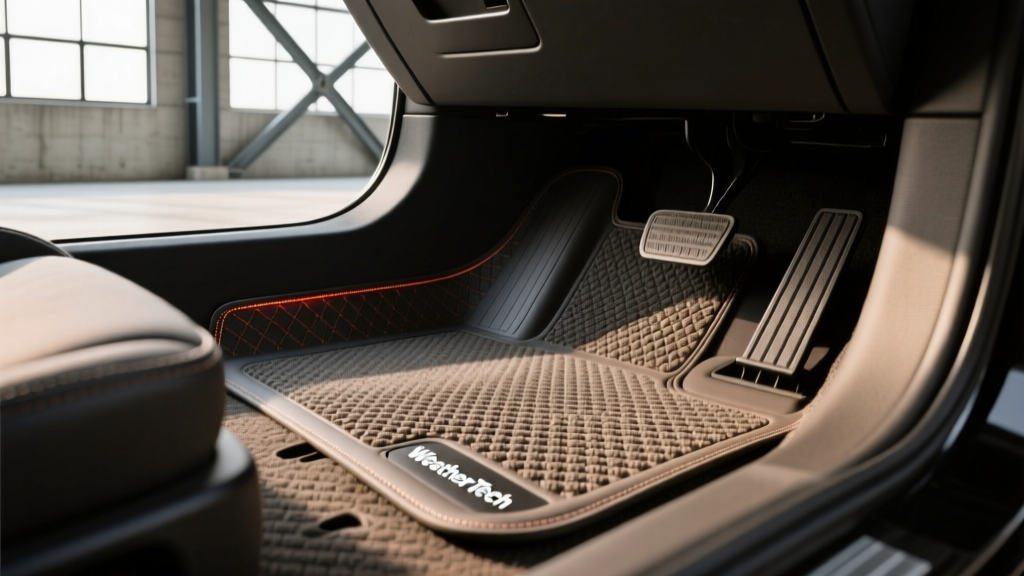
Polymer Engineering: TriFlex TPE vs. Legacy Formulations
The foundational performance of WeatherTech car floor mats relies on their proprietary polymer blends. Historically, automotive floor liners utilized High-Density Vinyl Tri-Extrusion (HDVT) or rigid PVC. However, current 2026 production models predominantly feature TriFlex TPE (Thermoplastic Elastomer). TPE is a block copolymer that bridges the gap between rigid plastics and vulcanized rubbers, offering superior elongation at break and memory retention.
From a materials science perspective, the TriFlex TPE used in the FloorLiner HP series exhibits a Shore A durometer hardness rating between 75 and 82. This specific hardness threshold is critical: it is rigid enough to maintain structural integrity and hold a 3-inch vertical lip without collapsing, yet pliable enough to conform to the complex topography of a vehicle’s floor pan. Unlike PVC, which relies on phthalate plasticizers that leach out over time (causing the material to become brittle and crack), TPE achieves its flexibility through its molecular microstructure, ensuring a lifespan that typically outlasts the vehicle itself.
Dimensional Fitment and Containment Specifications
WeatherTech utilizes advanced 3D laser scanning to map vehicle footwells. The manufacturing tolerance for these laser-measured mats is exceptionally tight, generally held within ±1.5mm of the digital CAD model. This precision is what allows the mats to interface seamlessly with factory retention hooks and dead pedals without impeding throttle or brake travel.
| Specification Metric | Standard FloorLiner (TPE) | FloorLiner HP (Flexible TPE) | All-Weather Mat (HDVT) |
|---|---|---|---|
| Base Material Thickness | 3.0 mm - 3.5 mm | 4.0 mm - 4.5 mm | 2.5 mm - 3.0 mm |
| Front Lip Containment Height | 2.5 inches | 2.75 inches | 0.5 inches (Raised edge) |
| Rear Lip Containment Height | 3.0 inches | 3.25 inches | 0.5 inches (Raised edge) |
| Manufacturing Tolerance | ±1.5 mm | ±1.5 mm | ±2.5 mm |
| Surface Friction Coefficient | 0.65 (Textured) | 0.85 (Anti-slip nibs) | 0.50 (Diamond tread) |
Thermal and Mechanical Performance Ratings
Automotive interiors experience extreme thermal cycling. A vehicle parked in direct sunlight in the American Southwest can see interior floor temperatures exceed 160°F (71°C), while winter nights in northern climates can drop ambient cabin temperatures below -20°F (-29°C). The FloorLiner HP series is engineered to withstand these extremes without suffering from thermal deformation or cold-cracking.
Thermal Performance Data
- Low-Temperature Flexibility: Maintains structural pliability and impact resistance down to -40°F (-40°C) without glass transition or micro-fracturing.
- High-Temperature Deflection: Resists warping and edge curling at sustained temperatures up to 212°F (100°C).
- UV Stabilization: Carbon black and specialized UV inhibitors are compounded directly into the TPE resin, preventing photodegradation and color fading over a 10-year simulated exposure cycle.
Mechanically, the TPE formulations are tested against ASTM International standards for abrasion resistance (ASTM D5963) and tensile strength. The high-density base layer of the FloorLiner HP yields a tensile strength exceeding 1,500 psi, ensuring that the aggressive heel-scuffing from heavy work boots or gravel-embedded footwear will not puncture the containment basin over years of use.
Matrix: FloorLiner HP vs. Standard FloorLiner
Choosing between the standard FloorLiner and the newer FloorLiner HP requires understanding the mechanical trade-offs between rigidity and flexibility. The standard FloorLiner utilizes a semi-rigid TPE core that acts almost like a plastic shell. It offers excellent containment but can be difficult to roll up for cleaning. The HP variant uses a highly flexible, rubber-like TPE that behaves more like a traditional premium rubber mat, but with the deep containment channels of a rigid liner.
| Performance Vector | Standard FloorLiner | FloorLiner HP |
|---|---|---|
| Material Feel | Semi-rigid, hard plastic shell | Flexible, dense rubber-like |
| Pedal Interference Risk | Low (Stiff edges stay put) | Very Low (Heavy base prevents shifting) |
| Acoustic Dampening | Moderate (Can rattle if loose) | High (Absorbs road and foot vibration) |
| Cleaning Ergonomics | Difficult (Must be carried flat) | Easy (Can be rolled and folded) |
| Anti-Slip Mechanism | Molded geometric texture | Underside anti-slip nibs + top texture |
Chemical Compatibility and Maintenance Protocols
A common failure mode in aftermarket automotive flooring is chemical degradation caused by improper cleaning agents. TPE is highly resistant to water, road salt, and mild acids, but it is vulnerable to specific hydrocarbon solvents and silicone-based emulsions.
WARNING: Silicone and Petroleum Distillates
Never apply silicone-based tire shines, interior dressings (e.g., traditional Armor All), or heavy petroleum degreasers to WeatherTech TPE mats. Silicone oils penetrate the microscopic pores of the TPE, causing the polymer chains to swell. This results in a permanent greasy film, loss of the anti-slip friction coefficient, and eventual structural softening. Furthermore, the resulting slick surface on the driver's side mat poses a severe safety hazard regarding pedal slippage.
Approved Maintenance Protocol:
- Extraction: Remove mats from the vehicle. Use a stiff-bristle brush and a high-pressure water nozzle to dislodge embedded silica and gravel from the deep channels.
- Chemical Application: Apply a pH-neutral automotive interior cleaner or a dedicated TPE-safe foaming cleaner (such as WeatherTech TechCare Cleaner). Avoid alkaline heavy-duty degreasers (pH > 9) which can strip the UV inhibitors from the surface layer.
- Agitation and Rinse: Agitate with a microfiber mitt, rinse thoroughly, and allow to air dry out of direct sunlight to prevent water spotting on the dark TPE surface.
- Dressing (Optional): If a matte finish restorer is desired, use only water-based, non-silicone TPE conditioners that absorb into the material rather than sitting on the surface.
Installation Tolerances and Retention Systems
Proper installation is critical to maintaining the safety ratings of the flooring. Modern vehicles utilize factory retention hooks (often twist-lock or push-pin styles) to secure the driver’s side mat. WeatherTech mats feature precision-molded retention holes designed to snap over these factory anchors. If the mat is forced over a misaligned hook, the TPE can tear, or worse, the mat can bunch up under the brake pedal.
Before final seating, verify that the dead pedal cover (if included in your specific vehicle application) aligns perfectly with the factory footrest. The XPE (cross-linked polyethylene) foam backing on select HP models provides an additional 4mm of sound deadening and thermal insulation, but it requires the mat to be seated flat to prevent the foam from compressing unevenly and creating a pivot point under heavy braking loads. Always perform a full range-of-motion test on the accelerator and brake pedals immediately after installation to ensure zero mechanical interference.