How to Clean and Maintain Indoor Carpet Grass Flooring
Master indoor carpet grass maintenance with our expert cleaning playbook. Learn sanitization, stain removal, and grooming for synthetic turf flooring.
Defining Carpet Grass in Modern Flooring
In the flooring industry, 'carpet grass' refers to synthetic turf rolls—typically manufactured from polyethylene (PE) or polypropylene (PP) fibers with a polyurethane (PU) or latex backing—designed for indoor or covered outdoor use. Unlike agricultural carpet grass (Axonopus), this flooring product is heavily utilized in sunrooms, playrooms, pet enclosures, and balcony patios. Because it mimics the pile structure of traditional broadloom carpet but lacks the woven root matrix, maintaining synthetic carpet grass requires a highly specific mechanical and chemical approach.
Standard carpet cleaning methods, such as hot water extraction or rotary shampooing, will destroy the primary backing and melt the synthetic blades. This playbook outlines the exact mechanical grooming, chemical sanitization, and stain extraction protocols required to extend the lifespan of indoor carpet grass flooring from an average of 3 years to over 8 years.
Maintenance Frequency Matrix
- Daily/As-Needed: Spot extraction for organic spills and pet accidents.
- Weekly: Dry debris removal and mechanical pile grooming.
- Quarterly: Deep chemical sanitization and backing flush.
- Annually: Professional inspection of seam adhesives and perimeter tack strips.
The Weekly Grooming and Debris Protocol
The most common failure mode for indoor carpet grass is pile matting. Synthetic fibers lack the natural elasticity of wool or nylon; once PE fibers are crushed underfoot, they require mechanical agitation to stand back up. Furthermore, indoor environments accumulate fine particulate dust that settles deep into the thatch layer, creating an abrasive paste that prematurely wears down the fiber base.
Vacuuming Constraints and Tool Selection
Never use a standard upright vacuum with a motorized beater bar. The stiff bristles and high RPMs will catch the primary backing mesh, causing delamination and tearing.
- Approved Vacuum: Use a commercial canister vacuum or backpack vacuum (e.g., Hoover Commercial Lightweight Backpack) equipped with a hard-floor, suction-only attachment.
- Alternative Dry Extraction: For high-traffic playrooms, a dry carpet sweeper with rubber rollers effectively pulls embedded dust without risking the backing.
Mechanical Grooming Technique
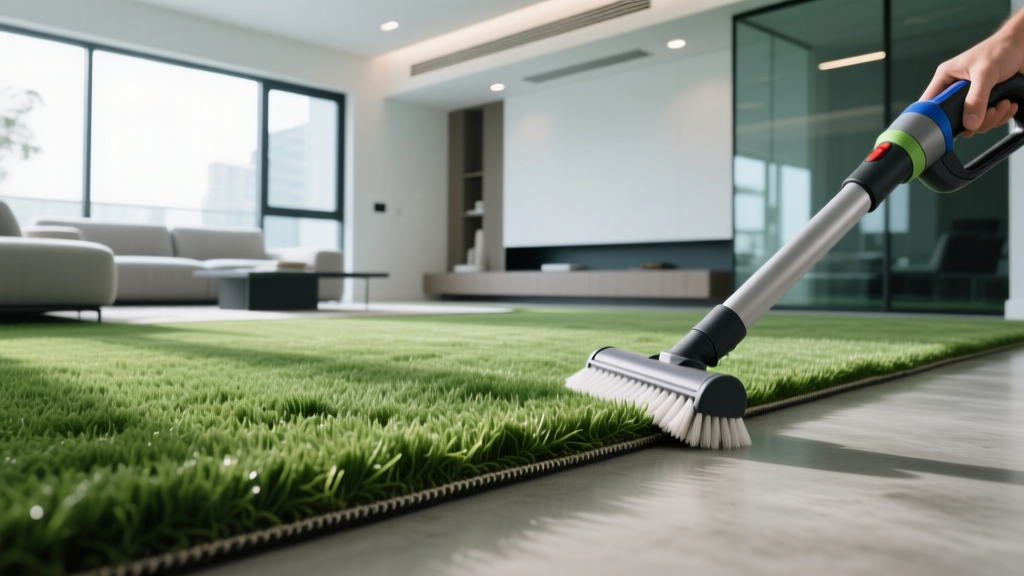
After vacuuming, the pile must be groomed to redistribute the infill (if applicable) and stand the fibers upright. Use a stiff nylon push broom or a specialized turf power broom like the Grandi Groom TurfBroom.
Always brush against the natural grain of the turf installation. Brushing with the grain merely lays the fibers flat, while brushing against it creates the necessary friction to lift the blades.
Deep Cleaning and Sanitization Matrix
Indoor carpet grass lacks the drainage capabilities of outdoor turf, meaning excess moisture can become trapped between the PU backing and the subfloor, leading to mold growth on wood or efflorescence on concrete. All deep cleaning must utilize low-moisture encapsulation or precise spot extraction.
| Contaminant Type | Recommended Agent | Dilution / Application | Dwell Time | Extraction Method |
|---|---|---|---|---|
| General Soil / Mud | Mild Surfactant (e.g., Simple Green) | 1 oz per gallon cold water | 3-5 mins | Microfiber blot, air dry |
| Red Wine / Berry | 3% Hydrogen Peroxide | 3:1 ratio with dish soap | 5 mins max | Cold water rinse, wet vac |
| Grease / Cooking Oil | Isopropyl Alcohol (70%) | Undiluted on cloth | 2 mins | Blot, do not scrub |
| Hardened Gum / Wax | Aerosol Refrigerant / Ice | Freeze until brittle | N/A | Scrape with plastic putty knife |
Pet Urine and the Chemistry of Enzymatic Extraction
Carpet grass is increasingly popular for indoor dog runs and pet balconies. However, synthetic fibers are non-porous, meaning urine pools on the surface and seeps through the drainage holes or seams into the subfloor. Standard alkaline cleaners and surfactants only mask the odor temporarily.
Uric acid forms salt crystals that are entirely insoluble in water. To permanently remove the stain and odor, you must use a bio-enzymatic cleaner containing Bacillus subtilis bacteria. According to guidelines supported by the Humane Society, enzymatic cleaners literally digest the uric acid crystals and organic proteins.
Step-by-Step Enzymatic Protocol
- Extract: Use a wet vac to pull up as much fresh urine as possible. Do not apply heat, which will bake the proteins into the backing.
- Saturate: Apply a high-quality enzymatic cleaner (e.g., Nature's Miracle or Rocco & Roxie Professional Strength) generously. The liquid must penetrate through the turf backing to reach the subfloor where the urine migrated.
- Dwell: Allow the enzymes to work for 15 to 20 minutes. Cover the area with a damp towel to prevent the solution from evaporating before the bacteria finish digesting the crystals.
- Extract Again: Vacuum up the residual moisture and allow the area to air dry completely.
Heat Damage and Pile Restoration Warnings
Critical Warning: Thermal Degradation
Polyethylene (PE) carpet grass fibers have a relatively low melting point, typically beginning to deform at 230°F (110°C). Never use steam cleaners, boiling water, or high-heat carpet extractors on synthetic turf. Even the concentrated heat from a localized hot spot (like a dropped hair straightener or a magnifying glass effect from a nearby window) can permanently fuse the fibers into a hard, plasticized lump. If a section melts, the only remedy is to cut out the damaged area and seam in a replacement patch using outdoor turf tape and polyurethane adhesive.
Restoring Severely Matted Traffic Lanes
If high-traffic areas have become completely flattened and stiff, mechanical brushing alone may not suffice. You can use a heat gun on a low, wide-dispersion setting held at least 18 inches away from the surface to gently warm the PE fibers, immediately followed by aggressive brushing with a nylon turf rake. The mild heat resets the memory of the plastic extrusion, allowing the bristles to stand upright again. Always keep the heat gun moving to prevent localized melting.
Cost Analysis: DIY Maintenance vs. Professional Servicing
Maintaining carpet grass is highly cost-effective compared to replacing it. A 12x15 ft room (180 sq ft) of mid-grade PE carpet grass costs between $540 and $900 to replace, factoring in materials, old turf disposal, and adhesive labor.
- Annual DIY Maintenance Cost: $45 - $85 (Includes enzymatic cleaners, surfactant concentrates, and replacement nylon broom heads).
- Professional Deep Cleaning: $0.65 - $1.15 per square foot. For a 180 sq ft room, expect to pay $117 to $207 annually for a professional synthetic turf sanitization service, which includes truck-mounted low-moisture extraction and antimicrobial sealing.
When selecting chemical agents for indoor use, especially in playrooms or poorly ventilated sunrooms, always verify that your cleaning solutions meet indoor air quality standards. The EPA Safer Choice program provides an excellent database for identifying surfactants and sanitizers that do not off-gas harmful volatile organic compounds (VOCs) into your living space.
FAQ: Carpet Grass Flooring Maintenance
Can I use bleach to sanitize indoor carpet grass?
No. Sodium hypochlorite (bleach) will degrade the UV inhibitors embedded in the PE fibers, leading to rapid yellowing and brittleness. It will also break down the polyurethane backing adhesive. Use a hydrogen peroxide-based sanitizer or a quaternary ammonium compound (quat) diluted to manufacturer specifications for safe sanitization.
How do I prevent the edges from curling up?
Edge curling is usually caused by moisture expansion in the subfloor or inadequate adhesive curing. To fix minor curling, apply a heavy weight over the edge after applying a thin bead of cyanoacrylate-based turf glue to the backing. For permanent installations, always secure the perimeter with galvanized U-nails (on wood subfloors) or double-sided acrylic turf tape (on concrete).
Does indoor carpet grass require infill?
Most indoor-specific carpet grass products are manufactured with a high-density thatch layer and do not require silica sand or rubber infill, which would track into the house and act as an abrasive on interior hard floors. If your product does require infill, use an antimicrobial, rounded silica sand specifically graded for indoor synthetic turf.