Commercial VCT Floor Tile Guide: Top Brands & Lines
Compare top commercial VCT floor tile lines from Armstrong, Tarkett, and Roppe. Explore specs, lifecycle costs, and subfloor prep requirements.
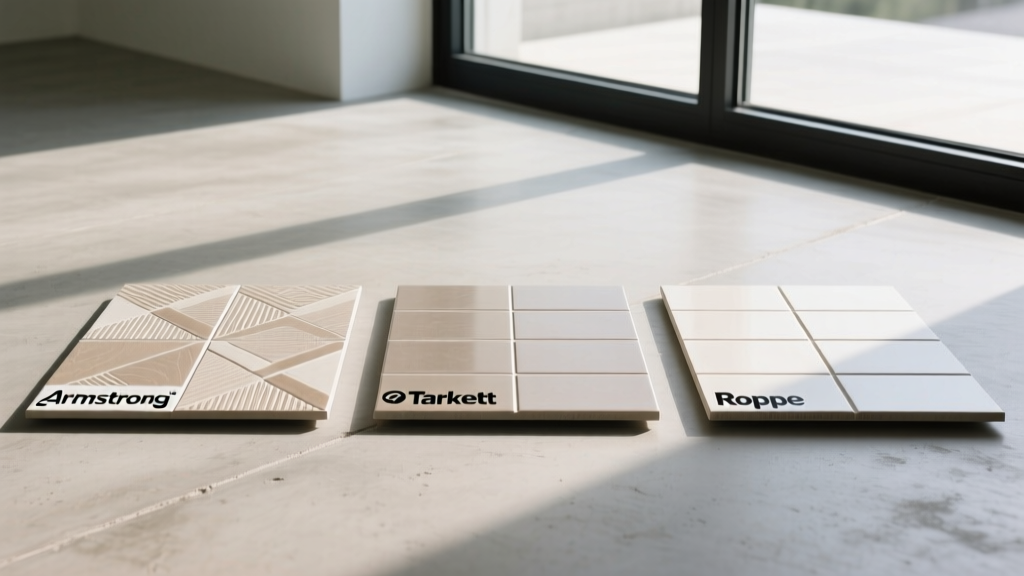
The Anatomy of Modern VCT Floor Tile
Vinyl Composition Tile (VCT) remains a dominant force in commercial flooring for healthcare, education, and retail sectors. Unlike Luxury Vinyl Tile (LVT), which relies on a printed photographic layer beneath a clear polyurethane wear layer, VCT features a through-body composition. The tile is manufactured using approximately 85% limestone filler and calcium carbonate, bound together by 15% polyvinyl chloride (PVC) resins and plasticizers. Because the color and pattern extend through the entire thickness of the tile, surface scratches and scuffs can be buffed out during routine maintenance without destroying the visual design.
However, this high mineral content makes VCT inherently porous. Without a protective acrylic floor finish (wax), the tile will rapidly absorb stains, dirt, and moisture. As of 2026, advancements in polymer science have allowed manufacturers to engineer more flexible PVC binders, reducing the brittleness that historically caused older VCT lines to crack under heavy rolling loads.
Brand Line Deep-Dive: The Big Three
When specifying VCT for commercial projects, facility managers and architects typically evaluate three legacy product lines that dictate the market standard. Below is a technical comparison of the flagship VCT lines available in 2026.
| Brand & Product Line | Thickness | Visual Technology | Material Cost (per sq. ft.) | Best Application |
|---|---|---|---|---|
| Armstrong Standard Excelon | 1/8 in. (3.2 mm) | Imperial Texture (Through-body chip) | $1.80 - $2.20 | Hospitals, K-12 Schools, Corridors |
| Tarkett Transcend | 1/8 in. (3.2 mm) | Premium chip & marbleized visuals | $2.10 - $2.60 | Higher-end retail, corporate lobbies |
| Roppe Commercial VCT | 3/32 in. (2.4 mm) & 1/8 in. | Standard chip and solid colors | $1.50 - $1.90 | Back-of-house, storage, budget builds |
Armstrong Standard Excelon is the industry benchmark. Its Imperial Texture line utilizes a randomized chip distribution that excels at hiding subfloor telegraphing and daily scuff marks. Tarkett Transcend pushes the aesthetic boundaries of VCT, utilizing tighter, more controlled chip patterns that mimic terrazzo and natural stone, though it requires a more rigorous subfloor prep to avoid telegraphing. Roppe offers highly competitive pricing and robust solid-color options, making it ideal for utility spaces where visual complexity is unnecessary.
The Hidden Killer: Alkali Silica Reaction (ASR) & pH Limits
The most common cause of catastrophic VCT failure is not moisture, but high alkalinity. When the pH of a concrete subfloor exceeds 9, it triggers a chemical breakdown of the ester bonds in standard acrylic VCT adhesives. This process, known as re-emulsification, turns the adhesive back into a liquid state, causing the tiles to shift, lift, and eventually shatter under foot traffic.
According to guidelines published by the Resilient Floor Covering Institute (RFCI), installers must perform quantitative pH testing on concrete slabs before applying any adhesive. A simple litmus test is insufficient. Contractors must use a calibrated digital pH meter on a distilled water slurry created by scoring the concrete surface. If the pH reads between 9 and 11, a two-part epoxy moisture and alkalinity mitigation system (such as Mapei Primer EP or Bostik's Moisture Defense) must be applied to encapsulate the slab before VCT installation can proceed.
Lifecycle Cost Analysis: The 20-Year Reality
While VCT boasts one of the lowest initial material and installation costs in the commercial flooring market, its Total Cost of Ownership (TCO) over a 20-year lifecycle tells a different story. Facility managers must weigh the upfront savings against rigorous, ongoing maintenance requirements.
- Initial Installation: $3.50 - $5.50 per sq. ft. (including material, adhesive, and labor).
- Annual Maintenance: $0.80 - $1.50 per sq. ft. per year.
- Stripping & Recoating: VCT requires complete chemical stripping (using high-pH strippers between 10.0 and 12.0) and the application of 4 to 6 coats of acrylic floor finish at least twice annually in high-traffic zones.
- 20-Year TCO: Approximately $22.00 - $28.00 per sq. ft.
By contrast, LVT requires only daily damp mopping and occasional auto-scrubbing, yielding a 20-year TCO of roughly $14.00 - $18.00 per sq. ft. VCT is only financially justifiable in environments where the initial capital expenditure is strictly capped, or where the abrasive scrubbing required for infection control in hospitals would quickly destroy the urethane wear layer of an LVT product.
Installation Edge Cases & Adhesive Selection
Proper adhesive selection is paramount for VCT longevity. Standard wet-set multipurpose acrylic adhesives are suitable for dry, climate-controlled environments. However, specific edge cases require specialized chemistries:
1. High Moisture Slabs
If a calcium chloride test (ASTM F1869) yields results between 5 and 8 lbs per 1,000 sq. ft. per 24 hours, or if Relative Humidity testing (ASTM F2170) reads between 80% and 90%, standard acrylics will fail. Installers must transition to a two-part polyurethane or epoxy adhesive specifically rated for high-moisture environments. These adhesives cure via chemical reaction rather than water evaporation, preventing re-emulsification.
2. Rolling Load Environments
In hospitals where heavy medical carts and steel-wheeled gurneys are prevalent, VCT must be installed using a pressure-sensitive adhesive (PSA) that cures to a hard, non-yielding film, or a hard-set wet adhesive. Soft, flexible adhesives will allow the VCT to compress and rebound under point loads, eventually causing the rigid limestone core to snap.
3. Indoor Air Quality Considerations
Modern commercial spaces demand strict VOC compliance. When specifying VCT and its companion adhesives, ensure both carry FloorScore certification from SCS Global Services. This ensures the off-gassing of plasticizers and adhesive solvents remains well below the OEHHA Standard Method v1.2 limits, protecting indoor air quality during and immediately after installation.
FAQ: VCT Floor Tile Troubleshooting
Why is my newly installed VCT turning yellow?
Yellowing in VCT is almost always caused by adhesive degradation or plasticizer migration. If a solvent-based cutback adhesive was used, or if an incompatible adhesive was applied over a residual asphaltic layer, the chemicals will migrate through the porous limestone core of the tile, causing a permanent yellow or brown stain. UV exposure from direct, unfiltered sunlight can also cause yellowing in lighter-colored VCT lines lacking UV stabilizers.
Can I install VCT directly over existing asbestos VAT (Vinyl Asbestos Tile)?
Yes, provided the existing VAT is fully adhered, flat, and free of cracks. Abatement is not strictly required if the floor is encapsulated. The VAT must be scarified (lightly sanded to remove old wax and gloss) and coated with an embossing leveler or a specialized encapsulation primer. Installing VCT directly over waxed VAT without a primer will result in immediate adhesive failure.
How do I fix localized tile cupping?
Cupping (where the edges of the tile lift while the center remains adhered) is a symptom of dimensional instability caused by uneven moisture exposure or improper acclimation. VCT must acclimate in the installation space at 65°F to 85°F for at least 48 hours prior to installation. If cupping occurs post-installation, the affected tiles must be pulled, the subfloor checked for localized moisture leaks, and the tiles replaced using a hard-set adhesive.