LVP Floor Installation Tools: 2026 Cost Estimator & Quantity Guide
Calculate exact costs and quantities for LVP floor installation tools. Includes 2026 pricing, consumable formulas, and rent-vs-buy matrices.
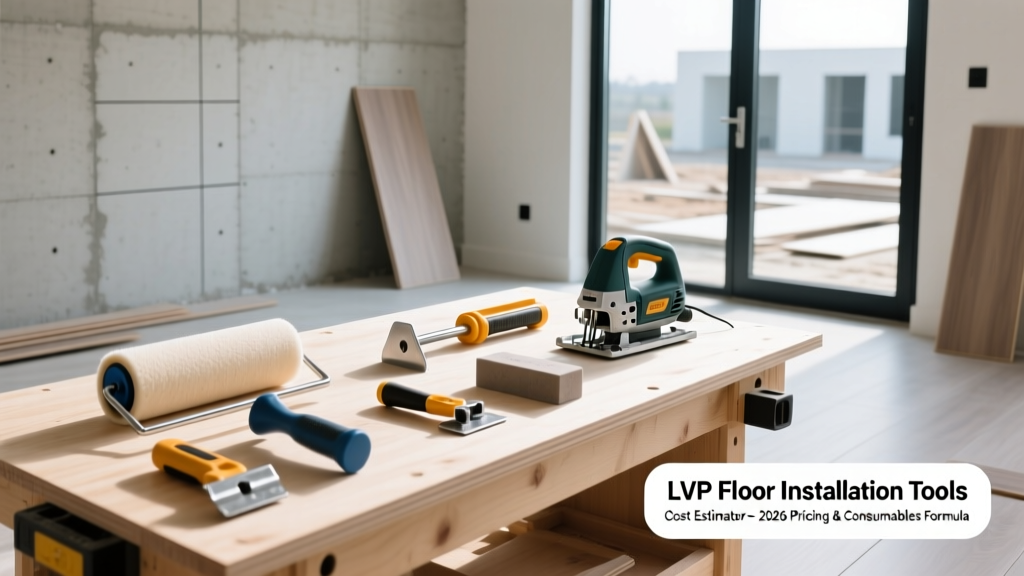
The True Cost of LVP Installation Tooling
Most contractors and DIYers meticulously calculate the square footage and waste factor for luxury vinyl plank (LVP) flooring, yet severely underestimate the tooling budget. A mid-project hardware store run for a shattered tapping block, dull multi-tool blades, or missing spacers disrupts workflow, compromises joint integrity, and inflates overall project costs. Furthermore, the rise of rigid core SPC (Stone Plastic Composite) LVP in 2026 has fundamentally changed tool wear rates compared to older, softer WPC (Wood Plastic Composite) variants.
This guide provides a precise cost estimation and quantity calculator for all essential lvp floor installation tools, translating generic tool lists into actionable, square-footage-based budgeting matrices.
2026 LVP Tool Pricing & Quantity Matrix
The following matrix breaks down the capital expenditure required for a professional-grade LVP tool kit. Prices reflect early 2026 retail averages from major industrial suppliers.
| Tool Category | Recommended Model / Spec | Est. 2026 Cost | Qty per 500 sq ft | Replacement Cycle |
|---|---|---|---|---|
| Pull Bar | Roberts 10-35-15 (Heavy Duty Steel) | $18.00 | 1 | 5,000+ sq ft |
| Tapping Block | Roberts 10-20-15 (Reinforced Polymer) | $14.00 | 2 | 250 - 400 sq ft |
| Deadblow Mallet | 1.5 lb Polyurethane (Non-marring) | $22.00 | 1 | 2,000+ sq ft |
| Oscillating Multi-Tool | DeWalt DWE315K (Corded) or equiv. | $139.00 | 1 | N/A (Capital tool) |
| Utility Knife | Stanley FatMax InterLock | $21.00 | 1 | N/A (Capital tool) |
| Knee Pads | KneeRover Pro (Foam/Gel hybrid) | $48.00 | 1 pair | 1-2 years |
| 100-lb Floor Roller | QEP / Roberts 3-Section Roller | $165.00 (Buy) | 1 | Rent or Buy |
If you are installing SPC (Stone Plastic Composite) rigid core LVP, increase your tapping block and mallet budget by 30%. SPC cores are highly brittle at the milling joints. Using a standard 3 lb steel hammer instead of a 1.5 lb deadblow mallet will shatter the polymer tapping blocks and micro-fracture the LVP click-lock mechanisms, leading to joint peaking post-installation.
Consumables Calculator: Blades, Spacers, and Adhesives
Capital tools are a one-time expense, but consumables scale linearly with your square footage. Miscalculating consumables is the primary cause of project delays. Use the following formulas to calculate exact quantities before purchasing.
The Utility Knife Blade Formula
Standard carbon-steel utility blades dull rapidly when scoring the dense limestone-infused core of modern SPC LVP. A dull blade requires excessive scoring pressure, leading to uneven snaps and ruined planks.
- Standard Carbon Blades: Yield 8-10 clean cuts per blade.
- Bi-Metal / Carbide-Tipped Blades (e.g., Lenox Gold): Yield 25-30 clean cuts per blade.
Calculation: A 500 sq ft room requires approximately 220 planks. Assuming 1.5 cuts per plank (end cuts and rip cuts), you need 330 total cuts.
Carbon Steel Requirement: 330 / 10 = 33 blades (Buy a 50-pack).
Bi-Metal Requirement: 330 / 25 = 13 blades (Buy two 10-packs).
Expansion Gap Spacers
According to the Resilient Floor Covering Institute (RFCI), maintaining a consistent 1/4-inch to 3/8-inch expansion gap is non-negotiable to prevent buckling during thermal expansion.
Quantity Rule of Thumb: Calculate the linear perimeter of the room in feet, divide by 2, and add 10% for waste. For a 20x25 ft room (90 linear feet of wall), you need roughly 50 spacers. Always purchase wedge-style spacers rather than flat blocks, as wedges allow for micro-adjustments against uneven drywall.
Rent vs. Buy: The 100-lb Floor Roller Dilemma
The 100-lb floor roller is the most debated tool in LVP installation. While click-lock LVP does not strictly require rolling for adhesion, the RFCI and major manufacturers strongly recommend rolling to ensure the mechanical click-lock joints are fully seated and flush. For glue-down LVP, it is an absolute mandate.
Buying ($165 - $200)
- Pros: Always available; can be disassembled for transport; pays for itself after 4 rentals.
- Cons: Heavy to transport (requires a truck or SUV); takes up permanent storage space.
- Best For: General contractors, flippers, or multi-room residential installs.
Renting ($45 - $65 / day)
- Pros: No storage required; easy transport in a standard sedan trunk (when disassembled by the rental shop).
- Cons: Strict 24-hour return windows; late fees; high cumulative cost for multiple projects.
- Best For: One-off DIYers, single-bedroom installs, or apartment dwellers.
'Proper rolling of resilient flooring ensures complete adhesive transfer and eliminates air pockets that can lead to localized bond failure and telegraphing of subfloor imperfections.' — RFCI Installation Guidelines
Oscillating Multi-Tool: Undercutting Door Jambs
To achieve a professional finish, door jambs and baseboards must be undercut so the LVP slides cleanly beneath them. While a manual pull-saw costs under $15, an oscillating multi-tool (like the DeWalt DWE315K) reduces undercutting time from 5 minutes per jamb to 15 seconds, while providing perfectly level cuts.
Blade Selection for Undercutting
Do not use standard wood-cutting blades if you are undercutting over a concrete subfloor. The moment the blade grazes the concrete, the teeth will strip instantly.
- Bi-Metal Blades (HCS): Ideal for cutting wood jambs over wood subfloors. Cost: ~$8 each.
- Carbide-Grit Blades: Mandatory for cutting jambs over concrete or cutting through embedded masonry nails. Cost: ~$18 each.
Calculator: Budget one carbide-grit blade per 3 door jambs if installed over concrete. For an average home with 8 doors, purchase 3 carbide-grit blades.
Scenario Breakdown: Budgeting Tools for a 500 Sq. Ft. Room
To synthesize these costs, here is a precise tool and consumable budget for a standard 500 sq. ft. living room installation over a wood subfloor, assuming the installer owns no prior tools.
| Item Category | Specific Items | Estimated Cost |
|---|---|---|
| Capital Hand Tools | Pull bar, tapping block (x2), deadblow mallet, spacers (50-pack) | $68.00 |
| Capital Power Tools | Oscillating multi-tool, utility knife | $160.00 |
| PPE & Ergonomics | KneeRover Pro knee pads, safety glasses, ear protection | $65.00 |
| Consumables | Lenox Gold utility blades (20-pack), Carbide multi-tool blade (x1) | $42.00 |
| Heavy Equipment | 100-lb Floor Roller (1-day rental) | $55.00 |
| Total Tool Budget | Complete Kit for 500 sq ft | $390.00 |
Pro-Tips for Tool Longevity and Safety
- Clean the Tapping Block Groove: LVP dust and debris accumulate in the groove of the tapping block. If not blown out with compressed air every 50 planks, the debris will prevent the block from seating flush against the plank edge, resulting in crushed locking mechanisms.
- Score and Snap Technique: Never attempt to cut LVP entirely with a utility knife. Score the wear layer deeply (at least 1/3 of the plank thickness), then snap it over your knee or a straight edge. This preserves blade life and prevents micro-chipping along the cut line.
- Subfloor Prep Tools: The installation tools listed above assume a perfectly flat subfloor. If your subfloor varies by more than 3/16-inch over a 10-foot radius (the industry standard tolerance cited by Family Handyman and most manufacturers), you must add a 6-foot magnesium straightedge ($85) and a belt sander or concrete grinder rental ($75/day) to your initial budget.
Accurate tool estimation prevents the hidden margins that erode profitability on professional jobs and cause frustrating delays on DIY projects. By calculating consumable wear rates and making strategic rent-versus-buy decisions on heavy equipment, you can lock in your LVP installation budget with precision.