Solving the Crossword Roofing Material Clue: A Climate Guide
Stuck on a crossword roofing material clue? Discover how puzzle favorites like slate, thatch, and tile actually perform across different US climate zones.
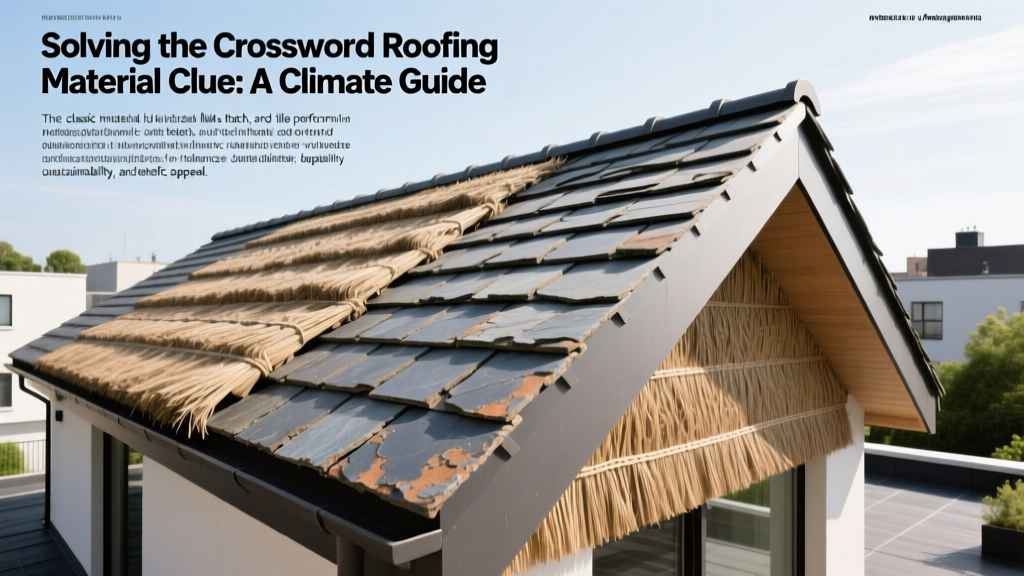
The Crossword-Roof Connection: Why Puzzle Clues Matter in Real Life
When you encounter a 'crossword roofing material' clue, the grid usually demands a specific letter count: SLATE (5), TILE (4), SHINGLE (7), THATCH (6), or TAR (3). While these terms solve your Sunday puzzle, they also represent fundamentally distinct building envelopes with wildly different climate tolerances. A material that thrives in the arid Southwest will catastrophically fail in the freeze-thaw cycles of the Northeast. This guide decodes the most common crossword roofing materials, translating puzzle answers into actionable, climate-specific architectural specifications for 2026.
5 Letters: SLATE – The Freeze-Thaw Champion
Natural slate is the gold standard for longevity, but its performance is entirely dependent on its geological origin and grading. If your crossword clue asks for a 5-letter premium roof, slate is the answer. However, specifying slate requires strict adherence to National Roofing Contractors Association (NRCA) Technical Resources and ASTM C406 standards.
Grade Specifications and Climate Matching
- S-1 Grade (Life expectancy >75 years): Mandatory for DOE Climate Zones 5 through 8 (Northern US, Mountain West). S-1 slate has a modulus of rupture that withstands severe freeze-thaw cycling without delaminating.
- S-2 Grade (40-75 years): Suitable for transitional zones (Zones 3 and 4) where hard freezes are less frequent.
- S-3 Grade (<40 years): Highly porous; strictly avoid in any climate with winter precipitation.
4 Letters: TILE – The Solar Reflectors of the Sunbelt
Whether clay or concrete, tile roofs dominate the Sunbelt. The 4-letter crossword answer 'TILE' masks a complex structural and thermal reality. Concrete tiles (ASTM C1492) and clay tiles (ASTM C1167) possess immense thermal mass, delaying heat transfer into the attic space during peak afternoon sun.
Hurricane Zones and Fastening Protocols
In Florida and the Gulf Coast, tile roofs must comply with High-Velocity Hurricane Zone (HVHZ) codes. The traditional method of mechanically fastening tiles with screws is increasingly being replaced or supplemented by two-part polyurethane foam adhesive systems. This foam creates a continuous bond that resists uplift pressures exceeding 150 mph while allowing for micro-movements during thermal expansion.
A standard concrete tile roof weighs between 900 and 1,100 lbs per square (100 sq ft). Retrofitting an existing asphalt-shingle home with tile requires a structural engineer to verify that the roof trusses can handle the dead load, often necessitating the addition of steel tension ties or reinforced load-bearing walls.
7 Letters: SHINGLE – The Transitional Climate Workhorse
SHINGLE is the most common 7-letter roofing answer. Modern architectural asphalt shingles are engineered for broad climate adaptability, but they require specific modifications depending on your regional weather patterns.
Climate-Specific Shingle Modifications
| Climate Challenge | Required Specification | Example Product Technology |
|---|---|---|
| High Humidity / Southeast | Copper-lined algicide strips to prevent Gloeocapsa magma (black streaks). | Owens Corning StainGuard Plus™ |
| Hail / Great Plains | SBS polymer-modified asphalt for flexibility; UL 2218 Class 4 impact rating. | Malarkey Vista® AR Class 4 |
| High Wind / Coastal | ASTM D3161 Class F wind resistance (110 mph) with 6-nail fastening patterns. | GAF Timberline® HDZ™ |
For optimal performance in mixed-humid climates, pairing shingles with a synthetic underlayment and a ridge vent system is critical to prevent moisture trapping, which can cause the shingles to blister and the roof deck to rot.
6 Letters: THATCH – The Niche Arid and Tropical Option
Natural thatch is a historical curiosity in the US, but synthetic thatch has carved out a highly specific niche. If your crossword grid demands a 6-letter exotic roof, THATCH is the solution. However, natural thatch is a severe fire hazard and rots quickly in temperate, rainy climates.
The Synthetic Alternative
For commercial resorts or residential accents in arid zones (like Arizona or Southern California) or controlled tropical environments, synthetic thatch made from high-density polyethylene (HDPE) or recycled plastics provides a Class A fire rating (ASTM E108). Unlike natural water reed or palm, synthetic thatch will not harbor pests, rot from humidity, or require re-ridging every 10 to 15 years. It is strictly a decorative, climate-isolated material and should never be used in regions with heavy snow loads, as the slick surface causes dangerous, uncontrolled snow avalanches.
3 Letters: TAR – The Flat Roof Heat Shield
When the clue is short and the roof is flat, TAR is the answer. In modern commercial and residential flat-roof construction, 'tar' refers to Built-Up Roofing (BUR) or modified bitumen systems.
Coal Tar Pitch vs. Asphalt
Not all tar is created equal. Coal tar pitch (ASTM D450 Type I) is chemically distinct from asphalt. Coal tar is uniquely resistant to ponding water, making it the superior choice for flat roofs in regions with heavy, slow-draining rainfalls where water sits for more than 48 hours. However, its application requires high-temperature kettles, producing intense VOCs and odors, restricting its use in densely populated urban areas with strict air quality regulations. For those zones, SBS modified bitumen torch-down systems offer a cleaner, highly reflective alternative that meets IBHS FORTIFIED Home Standards for wind uplift.

Climate-to-Material Matrix: The Master Grid
Use this decision matrix to match your crossword answer to your actual geographic reality, referencing PNNL Building America Climate Zones for regional boundaries.
| Clue Length | Material | Ideal Climate Zone | Fatal Climate Flaw | 2026 Avg Cost (per square) |
|---|---|---|---|---|
| 5 Letters | Slate | Marine / Cold (Zones 4C, 5-8) | Thermal shock in extreme desert heat | $1,500 - $3,200 |
| 4 Letters | Tile | Hot-Dry / Mixed-Dry (Zones 2, 3B) | Freeze-thaw spalling if unsealed in Zone 5+ | $800 - $1,600 |
| 7 Letters | Shingle | Transitional / Mixed-Humid (Zones 3A, 4A) | High winds without proper sealant strips | $150 - $280 |
| 6 Letters | Thatch | Arid / Tropical (Zones 1, 2B) | Rot in humid-continental zones | $900 - $1,400 (Synthetic) |
| 3 Letters | Tar (BUR) | Hot-Dry / Flat Commercial | UV degradation without reflective coating | $400 - $700 |
Final Verification: Matching Your Grid to Your Geography
Whether you are filling in the Sunday grid or drafting specifications for a new build, the intersection of language and building science requires precision. A 'crossword roofing material' is just a word until it is subjected to UV radiation, thermal cycling, and wind uplift. Always verify the ASTM ratings, local building codes, and structural load capacities before translating a 5-letter puzzle answer into a 75-year architectural commitment.
Written by
Priya KapoorPriya Kapoor is a real estate market analyst and construction economics researcher with expertise in housing affordability, development feasibility, and infrastructure investment. She holds a Master of Regional Planning from Cornell University and previously worked as a senior analyst at CBRE's Investment Properties group, where she modeled returns for $4B in mixed-use development pipelines. Priya now runs an independent research practice advising developers, municipalities, and REITs on construction cost forecasting and market timing. She publishes the quarterly "BuildMat Market Pulse" report tracking material price indices across 12 commodity categories. Based in Austin, TX, Priya serves on the board of Habitat for Humanity Austin and is a marathon runner.
More from Priya Kapoor
View all
Construction Cost
Cost to Build a 1600 Sq Ft Home in 2026: Full Breakdown
Accurate 2026 cost to build a 1600 sq ft home—material, labor, and regional pricing breakdowns included. Plan your budget with real-time estimates.
Aug 11, 2026

Wood & Lumber
Name the Types of Wood for Pressure Treatment and Preservation
Learn how to name the types of wood best suited for pressure treatment. Compare species treatability, chemical retention levels, and 2026 preservation costs.
Aug 4, 2026

Stone & Masonry
Stone Veneer Suppliers Lindenhurst: 2026 Cost Analysis
Analyze 2026 stone veneer costs in Lindenhurst, NY. Compare local supplier pricing, delivery fees, and Suffolk County installation labor rates.
Aug 4, 2026