Matching Roof Types To Premium Brand Lines For 2026
Discover how specific roof types dictate premium material choices. We compare GAF, Owens Corning, and CertainTeed lines for every roof geometry.
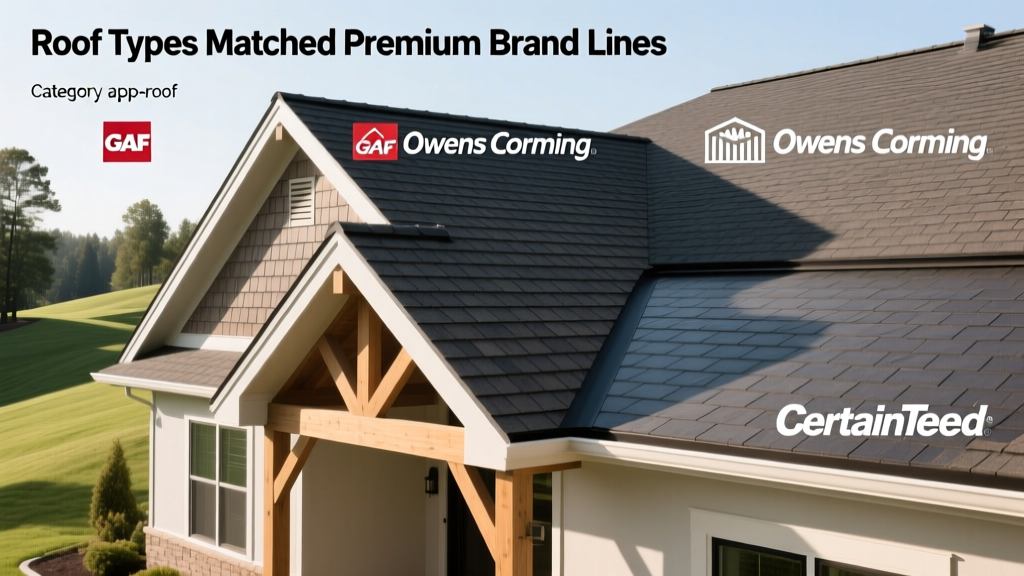
The Geometry-to-Brand Matrix: Why Roof Types Dictate Material Selection
Selecting a roofing material based solely on color or basic composition is a fundamental error in residential and light-commercial construction. The architectural geometry of your roof—whether a steep-pitch gable, a multi-faceted hip, a classic gambrel, or a low-slope transition—imposes unique mechanical, hydrostatic, and aesthetic stresses. Premium manufacturers engineer specific product lines to address these exact stressors.
In 2026, the top tier of roofing ecosystems (GAF, Owens Corning, CertainTeed, and Carlisle) offer specialized technologies that align directly with structural geometry. Below is the definitive matrix for matching your roof type to the correct premium product line.
| Roof Type | Primary Stressor | Recommended Brand Line | Key Engineered Technology |
|---|---|---|---|
| Gable / Hip | High wind uplift, rapid water shedding | GAF Timberline HDZ | 1.5-inch StrikeZone nailing area |
| Gambrel / Mansard | Extreme visual exposure, steep vertical transitions | CertainTeed Grand Manor | Triple shadow line, 450 lbs/sq weight |
| Complex Intersections | Valley water volume, ice damming | Owens Corning Duration | SureNail woven fabric strip |
| Flat / Low-Slope | Ponding water, UV degradation, seam failure | Carlisle SynTec FleeceBACK EPDM | 110-mil reinforced membrane |
Gable & Hip Roofs: Engineering for Wind Uplift and Shear
Gable and hip roofs dominate residential architecture due to their efficient water-shedding capabilities. However, their broad, unbroken planes make them highly susceptible to wind uplift, particularly at the eaves and rakes. When specifying materials for these roof types, the nailing zone and sealant activation are the most critical variables.
GAF Timberline HDZ vs. Owens Corning Duration
For standard to steep-pitch gable and hip roofs (4:12 to 12:12 pitch), the battle for wind resistance comes down to two flagship architectural shingles:
- GAF Timberline HDZ: The defining feature is the StrikeZone nailing area, which measures a massive 1.5 inches wide. This expanded target reduces installer error and ensures nails penetrate the double-layer common bond. When installed with 6 nails per shingle (rather than the standard 4) and GAF’s proprietary sealant, it qualifies for a 130 mph limited wind warranty.
- Owens Corning Duration: This line utilizes SureNail Technology, a woven fabric strip embedded in the nailing zone. This fabric prevents the shingle from tearing through the nail head during extreme sheer-force wind events, a common failure mode on exposed hip ridges.
Manufacturer wind warranties for hip and gable roofs almost universally require 6 fasteners per shingle in high-velocity hurricane zones (HVHZ) or for maximum wind ratings. Standard installation practices often default to 4 nails. Always specify 6-nail application in your contract to prevent warranty voidance.
Gambrel & Mansard Roofs: Managing Aesthetic Weight and Vertical Pitches
Gambrel (barn-style) and Mansard roofs feature distinct pitch breaks, often transitioning from a moderate upper slope to a nearly vertical lower slope. The lower slope is highly visible from the street, meaning standard 3-tab or basic architectural shingles will look flat and disproportionately cheap. Furthermore, the near-vertical sections experience different gravitational and hydrostatic loads.
The Heavyweight Solution: CertainTeed Grand Manor
For Mansard and Gambrel facades, you need a shingle that mimics the dimensional profile of natural slate. CertainTeed Grand Manor is the industry benchmark for this specific roof type. It features a triple shadow line and an exceptionally thick profile.
"When installing luxury shingles on a Mansard facade, the structural load becomes a primary engineering concern. Grand Manor weighs approximately 450 pounds per square, nearly double the weight of standard architectural shingles. We mandate a minimum of 5/8-inch CDX plywood decking; standard OSB will sag under this load over time."
— Structural Roofing Guidelines, 2026 Edition
Flashing Integration: The pitch break on a gambrel roof requires specialized step-flashing. Because luxury shingles like Grand Manor are incredibly thick, standard aluminum step flashing is insufficient. Specify 16-ounce copper or heavy-gauge color-matched steel flashing to accommodate the shingle thickness without creating visible bulges at the pitch transition.
Flat & Low-Slope Transitions: Membrane Integration for Porches and Garages
Many modern residential designs incorporate flat roofs over porches, attached garages, or dormer transitions. Applying standard asphalt shingles to any roof with a pitch below 2:12 is a catastrophic code violation and a guaranteed leak. These areas require dedicated single-ply membrane systems.
Carlisle SynTec vs. GAF EverGuard
For low-slope integrations, the choice between EPDM (rubber) and TPO (thermoplastic) depends on the specific environmental stressors of the roof section.
- Carlisle SynTec FleeceBACK EPDM (110-mil): Ideal for low-slope sections with heavy shade, overhanging trees, or complex penetrations (HVAC units, skylights). The fleece backing allows for direct adhesion to various substrates, and EPDM inherently resists ozone and UV degradation. However, seams are taped and primed, which introduces a long-term chemical failure point.
- GAF EverGuard TPO (60-mil to 80-mil): The superior choice for unshaded, south-facing low-slope porches. TPO reflects UV rays, drastically reducing cooling loads for the rooms below. More importantly, TPO seams are heat-welded at 1,000°F, creating a monolithic, watertight bond that is physically stronger than the membrane itself. According to the National Roofing Contractors Association (NRCA), heat-welded TPO consistently outperforms taped EPDM in long-term seam integrity tests.
2026 Cost Analysis: Material and Labor by Roof Type
Premium materials require specialized installation. The pricing below reflects 2026 national averages for material and certified labor, calculated per roofing square (100 sq. ft.).
| Roof Type | Selected Product Line | Material Cost / Sq | Installed Cost / Sq | Warranty Tier |
|---|---|---|---|---|
| Gable / Hip | GAF Timberline HDZ | $140 - $175 | $450 - $600 | Golden Pledge (50 Yr) |
| Complex Valleys | OC Duration (SureNail) | $135 - $165 | $425 - $575 | Platinum Protection |
| Mansard Facade | CertainTeed Grand Manor | $380 - $450 | $900 - $1,200 | 5-Star SureStart PLUS |
| Low-Slope (TPO) | GAF EverGuard (80-mil) | $180 - $220 | $550 - $750 | Diamond Pledge (NRLA) |
The System Warranty Trap: Why Mixing Brands Voids Coverage
The most common financial mistake homeowners and general contractors make when upgrading to premium roof types is mixing component brands to save marginal costs. Premium warranties—such as GAF’s Golden Pledge or CertainTeed’s 5-Star SureStart PLUS—are not just shingle warranties; they are system warranties.
To qualify for non-prorated, 50-year material and labor coverage on a complex hip or gable roof, you must use the manufacturer’s complete ecosystem:
- Underlayment: Must be the proprietary synthetic (e.g., GAF Tiger Paw or FeltBuster). Using a generic hardware-store underlayment instantly voids the system warranty.
- Ice & Water Shield: Required in all valleys, eaves, and around penetrations. Must be the brand-specific self-adhering membrane (e.g., WeatherWatch).
- Ventilation: Ridge vents must match the brand (e.g., Cobra SnowCountry). Improper attic ventilation is the number one cause of premature shingle curling and sealant failure, and manufacturers will deny claims if third-party vents are detected.
- Starter Shingles: The eave starter strip must be the brand-specific Pro-Start or WeatherBlocker, not a cut-down 3-tab shingle.
When evaluating bids for your specific roof type, scrutinize the line-item accessories. A contractor offering a GAF Timberline HDZ roof but substituting generic underlayment and off-brand ridge vents is offering you a severely compromised product that will not survive the first major thermal cycling event or wind storm.