EPDM Material Deep Dive: Carlisle vs. Firestone Roofing Lines
Compare top EPDM material product lines from Carlisle and Firestone. Explore mil thickness, reinforced options, adhesives, and 2026 pricing.
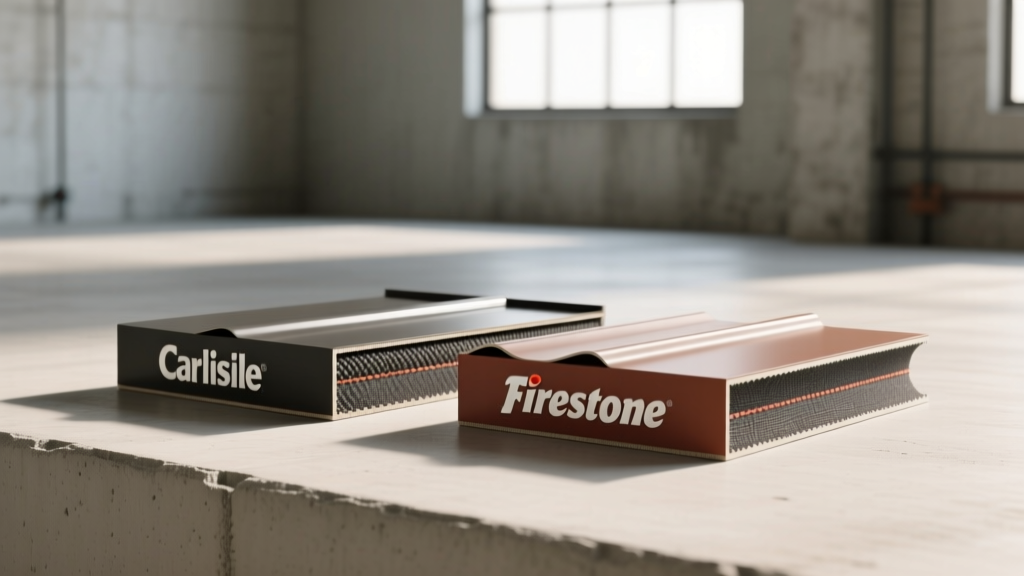
The Commercial EPDM Material Landscape
Ethylene Propylene Diene Monomer (EPDM) remains a dominant force in low-slope and flat commercial roofing due to its exceptional UV resistance, flexibility in extreme cold, and proven 30-plus-year lifespan. When procuring EPDM material for large-scale projects, facility managers and contractors typically narrow their choices to two industry giants: Carlisle SynTec and Firestone Building Products (now part of Holcim). Both manufacturers produce membranes that meet or exceed the ASTM D4637 standard for elastomeric sheet roofing, but their specific product lines, proprietary adhesive systems, and warranty structures differ in ways that directly impact project costs and long-term performance.
Carlisle SynTec: Sure-Seal and Platinum EPDM Lines
Carlisle’s flagship EPDM material is marketed under the Sure-Seal brand name. Available in 45-mil, 60-mil, and 90-mil thicknesses, Sure-Seal is an unreinforced, vulcanized black membrane. For projects requiring higher tensile strength and puncture resistance, Carlisle offers Sure-Seal FR, which integrates a tough polyester scrim reinforcement between two layers of EPDM.
Roll Dimensions and Manufacturing Tolerances
Carlisle manufactures Sure-Seal in massive roll sizes to minimize field seams—the primary failure point in any single-ply system. Standard rolls measure 10 feet by 50 feet or 20 feet by 100 feet. The 20-foot width is particularly advantageous for fully adhered systems, reducing the number of longitudinal seams by 50% compared to narrower membranes. Carlisle’s manufacturing process ensures strict thickness tolerances, maintaining the specified mil thickness across the entire sheet without thin spots at the edges.
Firestone Building Products: RubberGard EPDM
Firestone’s RubberGard line is the direct competitor to Carlisle’s Sure-Seal. Like Carlisle, Firestone offers unreinforced RubberGard and polyester-reinforced RubberGard FR in 45, 60, and 90-mil options. Firestone’s membrane is known for its high elongation properties, allowing it to stretch and recover without tearing when the roof deck experiences thermal expansion and contraction.
Firestone QuickPrime Plus and Seam Tape
Where Firestone truly differentiates its EPDM material system is in the seaming technology. The QuickPrime Plus primer combined with Firestone’s proprietary 3-inch and 6-inch seam tape creates a chemical and physical bond that is often stronger than the membrane itself. Unlike traditional liquid contact adhesives that require precise open-time management and are highly sensitive to ambient humidity, Firestone’s tape system drastically reduces human error during installation, leading to fewer seam blow-offs during high-wind events.
Always specify reinforced EPDM (FR) for mechanically attached systems. The polyester scrim provides the necessary dimensional stability to prevent the membrane from stretching and tearing around the fastener plates under wind uplift loads. Unreinforced EPDM should be strictly reserved for fully adhered or ballasted applications.
Head-to-Head Product Matrix
| Feature | Carlisle Sure-Seal / FR | Firestone RubberGard / FR |
|---|---|---|
| ASTM D4637 Tensile (Unreinforced) | 1,300 PSI minimum | 1,300 PSI minimum |
| ASTM D4637 Tensile (Reinforced) | 2,000 PSI minimum | 2,000 PSI minimum |
| Primary Seaming Method | Liquid Splice Adhesive or Tape | QuickPrime Plus + Seam Tape |
| Max Roll Width | 20 feet | 20 feet |
| Standard Warranty | Up to 30 Years (NDL) | Up to 30 Years (NDL) |
Seam Integrity: Liquid Adhesives vs. Tape Systems
The most critical vulnerability in any EPDM material installation is the field seam. Carlisle historically championed liquid contact adhesives (like their Sure-Seal Splice Adhesive), which require the installer to apply the liquid to both membrane edges, wait for the correct 'tack' time, and then roll the seam together. While effective when applied perfectly, liquid adhesives are highly susceptible to temperature and humidity fluctuations. If applied too early or too late, the seam can fail via 'fish-mouthing' or delamination.
Both Carlisle and Firestone now heavily promote tape-based seam systems for EPDM. Firestone’s QuickPrime Plus is a low-VOC primer that cleans and prepares the EPDM surface, allowing the butyl-based seam tape to form an immediate, aggressive bond. Tape systems increase material costs by approximately $0.15 to $0.25 per square foot but reduce labor time by up to 30%, resulting in a net cost savings and a vastly superior, more consistent seam.
Wind Uplift Ratings and FM Global Approvals
For commercial buildings in high-wind zones, the EPDM material must be paired with the correct fastening pattern to achieve Factory Mutual (FM) Global 1-90 or 1-120 wind uplift ratings. Reinforced EPDM (60-mil or 90-mil) is mandatory for these ratings when using a mechanically attached system. The polyester scrim prevents the fastener plates from 'cheesecutting' through the membrane during extreme negative pressure events. When specifying the system, ensure the contractor submits the exact fastener pull-out test results from the specific roof deck (e.g., 22-gauge steel vs. structural concrete) to the manufacturer for a custom wind design layout.
2026 Cost Breakdown by System Type
Pricing for EPDM material and installation has stabilized following the supply chain disruptions of the early 2020s. Below are the current 2026 market averages for commercial projects exceeding 10,000 square feet:
- Material Only (60-mil Unreinforced): $1.65 to $2.10 per sq. ft.
- Material Only (60-mil Reinforced FR): $2.25 to $2.80 per sq. ft.
- Fully Adhered System (Installed): $9.50 to $13.00 per sq. ft. (Includes membrane, insulation, adhesives, and labor).
- Mechanically Attached System (Installed): $8.00 to $11.50 per sq. ft.
- Ballasted System (Installed): $7.50 to $10.00 per sq. ft. (Excludes the cost of the ballast stone or pavers).
Thermal Performance and Cool Roof Coatings
Standard black EPDM material has a low solar reflectance index (SRI), meaning it absorbs significant heat, which can increase cooling costs in warmer climates. While black EPDM is ideal for northern climates where winter solar heat gain is beneficial, southern facilities often require a cool roof solution. According to the Environmental Protection Agency's guidelines on heat islands, applying a reflective coating can drastically reduce roof surface temperatures.
Both Carlisle and Firestone offer white EPDM material, but it carries a 20% to 30% premium over black. A more cost-effective alternative is installing standard black EPDM and applying a high-solids silicone or acrylic roof coating after the membrane has fully cured and weathered (typically 12 to 18 months post-installation). The Department of Energy notes that cool roof coatings can lower peak cooling demand by 10% to 15%, easily paying for the coating application within three to five years through energy savings.
Final Procurement Advice
When choosing between Carlisle and Firestone EPDM material lines, the decision rarely comes down to the membrane itself, as both manufacture exceptional, ASTM-compliant products. The choice should be driven by local contractor expertise and the specific adhesive/seam tape system your roofing crew is most proficient with. A flawless installation of Firestone RubberGard will always outperform a poorly seamed Carlisle Sure-Seal roof, and vice versa. Demand that your contractor holds a current, active 'Licensed Applicator' certification from the chosen manufacturer, as this is a strict prerequisite for securing a No Dollar Limit (NDL) warranty that covers both materials and workmanship.