Best Roofing Material for Flat Roof: 2026 Cost & Lifespan
Compare the best roofing material for flat roof systems in 2026. Analyze TPO, PVC, EPDM, and Mod-Bit costs, lifespans, and failure modes.

The Flat Roof Material Matrix: 2026 Cost & Performance Data
Selecting the optimal roofing material for flat roof applications requires balancing initial capital expenditure with long-term lifecycle costs, ponding water resistance, and thermal performance. The commercial and residential low-slope market in 2026 is dominated by single-ply membranes and modified bitumen. The table below synthesizes current installed costs (including polyiso insulation and cover boards), expected lifespans, and primary use cases for the top four systems.
| Membrane Type | Installed Cost (per sq. ft.) | Expected Lifespan | Puncture Resistance | Best Application Profile |
|---|---|---|---|---|
| TPO (80-mil) | $9.50 – $13.50 | 20 – 30 Years | Moderate | Energy-efficient commercial, large warehouses |
| PVC (60-mil) | $11.00 – $16.00 | 25 – 35 Years | High | Restaurants, chemical processing, high grease |
| EPDM (60-mil) | $8.00 – $12.00 | 25 – 30 Years | Moderate | Budget-conscious, cold climates, simple geometries |
| SBS Mod-Bit | $9.00 – $14.50 | 15 – 25 Years | Very High | High foot traffic, residential low-slope, balconies |
Single-Ply Membranes: TPO vs. PVC vs. EPDM
Single-ply systems account for the vast majority of new low-slope installations. However, treating them as interchangeable is a critical procurement error. Each polymer reacts differently to UV radiation, thermal shock, and chemical exposure.
TPO (Thermoplastic Polyolefin)
TPO remains the market leader for commercial flat roofs due to its balance of cost and reflectivity. Modern 2026 formulations (such as Carlisle Sure-Weld or Elevate UltraPly) have largely resolved the UV degradation and seam-splitting issues that plagued early-2000s TPOs.
- Specification Standard: ASTM D6878.
- Critical Detail: Always specify an 80-mil thickness with a minimum 32-mil top ply over the polyester scrim. The 45-mil and 60-mil options are increasingly obsolete for commercial warranties due to hail vulnerability.
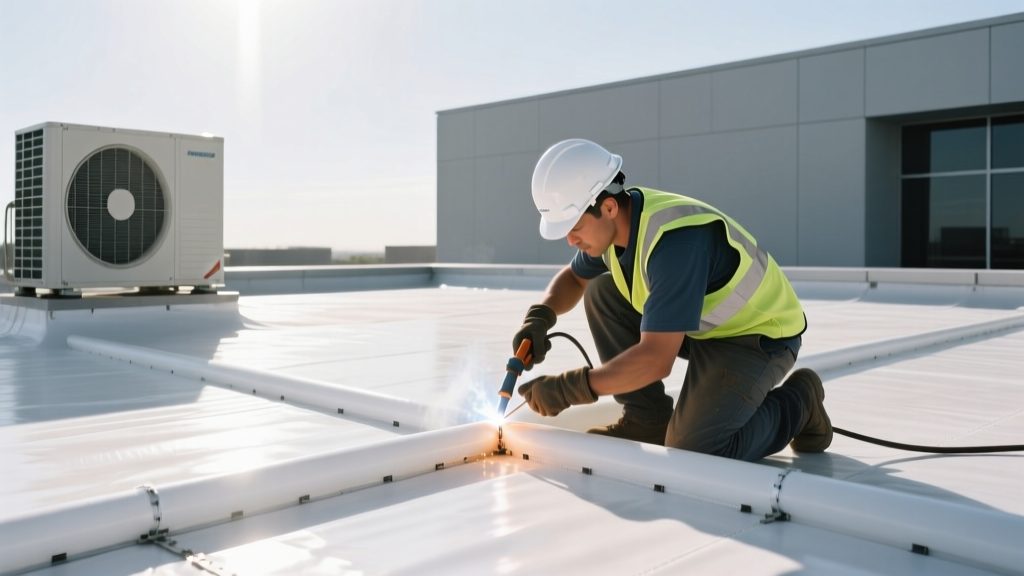
- Seam Integrity: Seams are heat-welded at 1,000°F+, creating a monolithic bond that is stronger than the membrane itself.
PVC (Polyvinyl Chloride)
PVC membranes (e.g., Sika Sarnafil, Johns Manville) are the premium choice for roofs exposed to harsh chemicals.
- Specification Standard: ASTM D4434.
- Chemical Resistance: PVC is highly resistant to animal fats, vegetable oils, and industrial hydrocarbons. If your building houses a restaurant or food processing facility, PVC is mandatory; grease will dissolve TPO and EPDM.
- Welding: Uses hot-air welding or ketone-based liquid adhesives. PVC contains plasticizers to maintain flexibility; high-quality brands use migration-resistant plasticizers to prevent the membrane from becoming brittle in its third decade.
EPDM (Ethylene Propylene Diene Monomer)
Often referred to as "rubber roofing," EPDM is a thermoset membrane. It is typically black, though white-coated versions exist. According to the EPA's Heat Island Effect guidelines, black EPDM absorbs significant solar heat, which can be advantageous in northern climates to promote snowmelt and reduce heating loads, but detrimental in southern zones where cooling costs dominate.
- Specification Standard: ASTM D4637.
- Seam Vulnerability: Unlike TPO/PVC, EPDM seams are joined using liquid adhesives or double-sided tape. Over 15-20 years, thermal cycling can cause these seams to peel, making EPDM more maintenance-intensive at the flashing details.
Asphalt-Based Systems: Modified Bitumen (Mod-Bit)
Modified Bitumen is an evolution of traditional Built-Up Roofing (BUR), consisting of asphalt reinforced with fiberglass or polyester mats. For flat roofs, SBS (Styrene-Butadiene-Styrene) modified bitumen is the superior choice over APP (Atactic Polypropylene). SBS incorporates synthetic rubber, granting it exceptional elongation properties (up to 1,500%) and cold-weather flexibility.
Failure Mode Analysis: Why Flat Roofs Actually Leak
Membrane failure rarely occurs in the field of the roof; it occurs at the transitions. Understanding these edge cases is vital for specifying the right system.
Never install EPDM or standard TPO beneath kitchen exhaust fans or HVAC units that vent oil mist. The lipids will chemically break down the polymer matrix, causing the membrane to turn to sludge and fail within 24 months. Always specify PVC or a specialized grease-guard catchment system in these zones.
Ponding Water and Insulation Compression
Flat roofs are rarely perfectly flat; they rely on a minimum 1/4-inch per foot slope (per International Building Code). When water ponds for more than 48 hours, it accelerates the degradation of asphalt-based systems and can lead to biological growth on single-plies. Furthermore, if the underlying polyiso insulation is not rated for high compressive strength, the weight of standing water can crush the foam, creating a negative slope that guarantees perpetual ponding.
The Cover Board Imperative
A common cost-cutting measure is omitting the cover board between the polyiso insulation and the single-ply membrane. In 2026, skipping the 1/2-inch high-density (HD) polyiso or gypsum fiber cover board is a critical error. The cover board provides a thermal break, protects the primary insulation from hail impact, and creates a dense substrate for mechanical fasteners to grip during high-wind events.
The 2026 Procurement Decision Framework
Use this conditional logic to select the exact material for your project:
- IF the building is a restaurant, hospital kitchen, or manufacturing plant with oil/chemical exhaust:
Select: 60-mil or 80-mil PVC. The chemical resistance outweighs the 15% cost premium over TPO. - IF the project is a large, unobstructed warehouse in a high-UV, southern climate:
Select: 80-mil TPO (white). As noted by the U.S. Department of Energy's Cool Roofs initiative, highly reflective white membranes can reduce peak cooling demand by 10-15%, paying for the material premium within five years. - IF the roof experiences heavy, daily maintenance foot traffic (e.g., solar panel arrays, telecom equipment):
Select: SBS Modified Bitumen with a heavy granule cap sheet, or a TPO system reinforced with a high-compressive gypsum cover board and designated walkway pads. - IF the building is in a severe hail zone (e.g., Texas, Colorado, Midwest):
Select: 80-mil TPO with a 5/8-inch HD cover board. The scrim in the TPO, combined with the dense cover board, will absorb the kinetic energy of 2-inch hail without fracturing the weathering surface.
Warranty and Fastening Gotchas
Manufacturer warranties (typically 20 or 30 years for NDL - No Dollar Limit warranties) are strictly contingent on installation adherence to the manufacturer's technical specifications. A frequent reason for warranty denial in 2026 is improper perimeter fastening. Wind uplift forces are highest at the corners and edges of a flat roof. Ensure your contractor utilizes a 12-inch on-center (o.c.) fastener pattern in the perimeter and corner zones, compared to the standard 24-inch o.c. in the field. Always verify that the insulation R-value meets the latest IECC (International Energy Conservation Code) mandates for your specific climate zone, as installing outdated R-20 assemblies in zones requiring R-30+ can void both the membrane warranty and building insurance compliance.
Written by
Elena RodriguezElena Rodriguez is a civil engineer and technical writer specializing in concrete technology, masonry systems, and ASTM/ACI compliance. She earned her B.S. in Civil Engineering from Texas A&M University and spent a decade at a materials testing laboratory, performing over 2,000 concrete compressive strength tests and masonry prism evaluations. Elena is an ACI-certified Field Testing Technician (Grade I) and a member of ASTM Committee C12 on Natural Building Stone. She currently consults on forensic engineering cases involving concrete failures and moisture intrusion. Based in San Antonio, TX, Elena is a proud member of the Society of Women Engineers (SWE) and coaches her daughter's FIRST Robotics team.
More from Elena Rodriguez
View all
Walls & Panels
Cost Analysis: Light Gauge Steel Framing Advantages and Disadvantages
Evaluate light gauge steel framing advantages and disadvantages through a strict cost analysis lens, comparing material, labor, and lifecycle expenses.
Aug 4, 2026

Walls & Panels
Gypsum Board Types: Exact Specifications, Thickness & Dimensions
Compare standard, Type X, and moisture-resistant gypsum board types. Get exact specifications, thicknesses, dimensions, and ASTM standards for your project.
Aug 4, 2026

Fire Resistance
Best Fire-Resistant Outdoor Decking Materials: 2026 Buyer Guide
Discover the best fire-resistant outdoor decking materials for 2026. Compare Class A PVC, aluminum, and hardwood options for WUI compliance and safety.
Aug 4, 2026