How Roofing Performance Ratings Prevent a Roof Leak: Specs Guide
Learn how specific ASTM ratings, wind uplift classes, and material specs prevent a roof leak. A technical guide to reading roofing performance data.
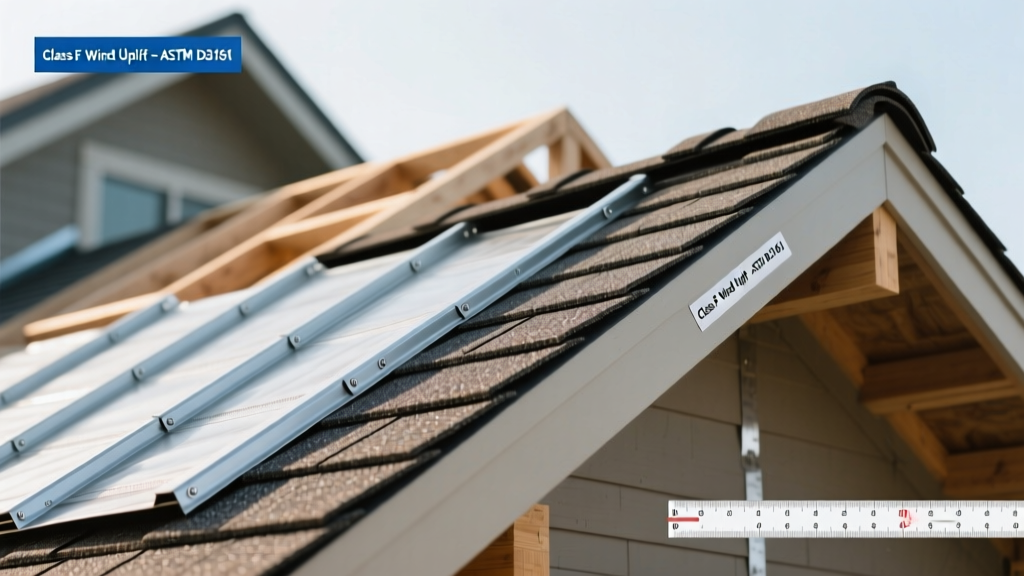
The Anatomy of a Watertight Roof: Beyond the Shingle
When homeowners experience a roof leak, the immediate assumption is often that the primary roofing material has degraded or failed. However, forensic roofing analysis reveals that the vast majority of water intrusion events are not caused by the material dissolving, but by a failure at the intersection of wind uplift, thermal cycling, and hydrostatic pressure. Preventing water intrusion requires a strict adherence to performance specifications and material ratings.
Understanding how to read and enforce ASTM International standards and Underwriters Laboratories (UL) ratings is the difference between a roof that sheds water for three decades and one that fails during its first major cyclonic event. This guide decodes the technical specifications that dictate watertight integrity across modern roofing systems.
Very few steep-slope roofing materials are technically 'waterproof'; they are 'water-shedding.' Asphalt shingles, metal panels, and clay tiles rely entirely on gravity and overlapping geometry to shed water. If wind uplift breaks the factory sealant or capillary action draws water upward past a lap joint, a roof leak is inevitable. True waterproofing is reserved for low-slope membranes and specialized underlayments.
Critical ASTM Standards for Water Penetration Resistance
To specify a roof that resists water intrusion, you must look beyond the manufacturer's warranty and examine the standardized testing protocols the product has passed. The following standards are the baseline for evaluating leak resistance.
ASTM D1970: Self-Adhering Underlayment for Ice Dams
Ice damming is a primary vector for a roof leak in northern climates. When snow melts and refreezes at the eaves, water backs up under the shingles. ASTM D1970 tests self-adhering polymer-modified bituminous sheets (commonly known as ice and water shield) for their ability to seal around nails and resist water penetration under hydrostatic head pressure. For high-risk zones, specify products that meet ASTM D1970 and mandate installation at least 24 inches past the interior warm wall line, as dictated by modern building codes.
ASTM D3161: Wind Resistance of Asphalt Shingles
Wind does not just blow shingles off; it creates localized negative pressure that breaks the factory-applied sealant strips. Once the seal is broken, driven rain is forced directly onto the underlayment and deck. ASTM D3161 classifies shingles into two primary tiers:
- Class F: Withstands 110 mph winds for 2 hours.
- Class H: Withstands 150 mph winds for 2 hours.
For coastal regions or high-altitude corridors, specifying Class H shingles is non-negotiable to prevent wind-driven roof leak events.
Material-Specific Leak Vulnerabilities & Spec Thresholds
Different roofing systems fail in fundamentally different ways. The table below maps specific materials to their primary leak vectors and the governing specifications required to mitigate those risks.
| Roofing Material | Primary Leak Vector | Governing Spec / Rating | Minimum Threshold for High-Risk Zones |
|---|---|---|---|
| Architectural Shingles | Sealant strip blow-off and capillary draw | ASTM D3161 / UL 790 | Class H (150 mph); 6-nail pattern |
| Standing Seam Metal | Thermal expansion fastener back-out | AISI S100 / FM 4474 | Clip slip-joint with min 1.5' movement |
| TPO Single-Ply | Seam peel failure and membrane puncture | ASTM F1303 / FM 4479 | 60-mil thickness; 2.5 lb/in peel strength |
| Modified Bitumen | Flashing blistering and torch voids | ASTM D6164 | Min 2-ply system; 4-inch side laps |
Decoding Wind Uplift and Fastener Pull-Out
According to the National Roofing Contractors Association, wind uplift is the leading cause of catastrophic roof envelope failure. When wind flows over a roof, it creates negative pressure (suction) at the perimeters, corners, and ridges. If the roofing assembly cannot resist this suction, the material lifts, breaking the watertight seals and allowing a massive roof leak during the storm.
UL 580 (Class 30, 60, 90): Tests the entire roof deck assembly (deck, fasteners, insulation, membrane) for uplift resistance. Class 90 is the standard requirement for commercial buildings in hurricane-prone regions, simulating 90 psf of negative pressure.
UL 1897: Specifically tests the uplift resistance of the roof *covering* (the outermost layer). A system must pass both UL 580 for the structural deck and UL 1897 for the outer membrane to ensure total watertight integrity under extreme cyclonic loads.
The Metal Roofing Thermal Expansion Factor
Standing seam metal roofs are highly susceptible to a specific type of leak caused by thermal cycling. A 100-foot run of steel roofing can expand and contract up to 1.25 inches between winter nights and summer afternoons. If the specification calls for fixed clips rather than floating/sliding clips, the thermal stress will literally pull the fasteners out of the structural purlins. Once the fastener back-outs, the neoprene washers degrade, and water infiltrates the building envelope. Always specify AISI S100 compliant floating clips that accommodate a minimum of 1.5 inches of longitudinal movement.
Underlayment Permeability and the 'False Leak' Phenomenon
Not every interior drip is a true roof leak. A significant percentage of reported leaks in modern homes are actually condensation events caused by improper underlayment permeability specifications.
Traditional #15 asphalt felt (ASTM D226 Type I) has a vapor permeance rating of roughly 5.0 to 10.0 perms, allowing moisture vapor from the attic to pass through the roof deck and escape. Conversely, many modern synthetic underlayments have a perm rating of less than 1.0, effectively acting as a Class II vapor retarder.
If a contractor installs a low-perm synthetic underlayment over a damp OSB deck, or in an unvented attic assembly without proper interior vapor control, the moisture becomes trapped. The OSB absorbs the trapped vapor, swells, and eventually rots, dripping water into the living space below. Homeowners misdiagnose this as a roof leak, but it is fundamentally a building science and vapor drive failure. Always verify the perm rating of your synthetic underlayment and ensure it aligns with your attic ventilation strategy.
Actionable Spec Checklist for Your Next Roofing Contract
Do not rely on vague contract language like 'install premium shingles.' Demand exact performance specifications to guarantee watertight integrity. Use this checklist when reviewing proposals:
- Shingle Rating: Explicitly state ASTM D3161 Class F or Class H, depending on local wind zone maps.
- Underlayment Specs: Specify ASTM D226 Type II for felt, or list the exact perm rating if using synthetic. Mandate ASTM D1970 ice and water shield at all eaves, valleys, and penetrations.
- Fastener Protocol: For high-wind zones, require a 6-nail per shingle pattern (rather than the standard 4-nail) and specify ring-shank nails for the deck sheathing to prevent uplift.
- Membrane Thickness: For flat roofs, reject 45-mil TPO. Specify a minimum 60-mil or 80-mil membrane (ASTM F1303) to resist puncture from hail and maintenance foot traffic.
- Seam Strength: For single-ply systems, require a minimum seam peel strength of 2.5 lbs/inch (ASTM D6862) verified by field test cuts during installation.
By shifting the focus from aesthetic choices to verifiable performance ratings and material specifications, you eliminate the physical mechanisms that cause water intrusion. A roof is an engineered system; treating it as such is the only reliable way to prevent a roof leak over its full lifecycle.