Cape Cod Roofing Material Repair: Cedar and Asphalt Fixes
Expert guide to Cape Cod roofing material repair. Learn specific fixes for cedar shakes, asphalt shingles, and dormer flashing on steep gabled roofs.

The Geometry Factor: Why Cape Cod Roofs Demand Specialized Care
Selecting the ideal cape cod roofing material is only the first step in protecting your home; maintaining it on a complex, steep-pitch geometry is where most property owners encounter severe challenges. The quintessential Cape Cod architectural style is defined by its steeply pitched gabled roofs (typically ranging from 12/12 to 16/12 slopes), side-gabled dormers, and deep valleys. While these features provide excellent snow shedding and classic aesthetic appeal, they create unique microclimates and structural vulnerabilities that accelerate material degradation.
Unlike standard ranch-style roofs, the intersecting planes of a Cape Cod roof concentrate water runoff into narrow valleys and place immense stress on the step flashing surrounding dormers. Furthermore, the steep pitch makes routine maintenance hazardous and often neglected until interior water damage occurs. This guide provides advanced, material-specific repair protocols for the two most common cape cod roofing materials: cedar shakes and architectural asphalt shingles.
Material-Specific Repair Protocols
Cedar Shakes: Managing Tannin Bleed, Cupping, and Splits
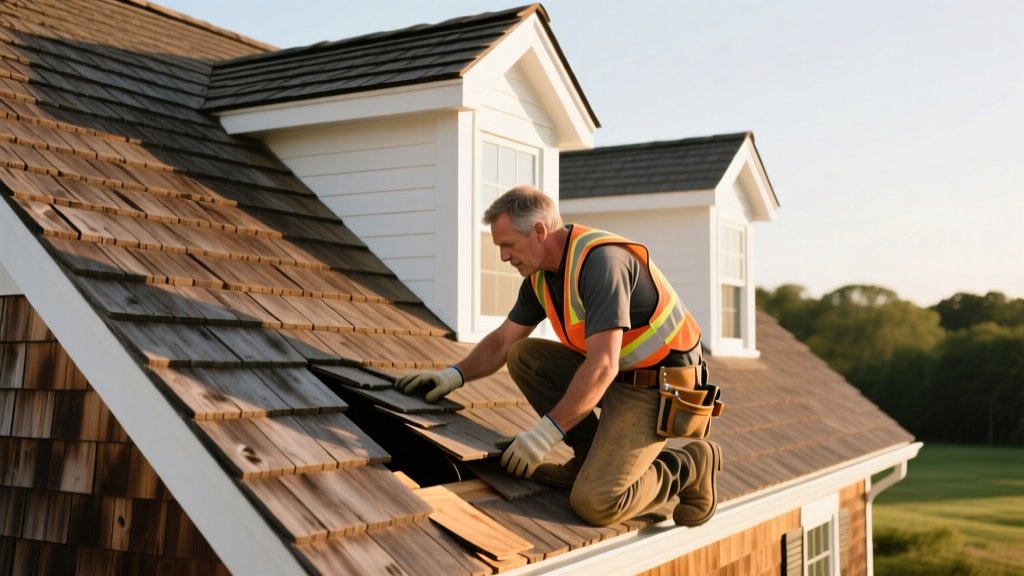
Cedar is a traditional and highly breathable cape cod roofing material, but it requires meticulous maintenance to prevent biological growth and structural splitting. The natural tannins in cedar react poorly with standard fasteners, and the steep pitch of a Cape Cod roof exposes the wood to intense UV radiation on the southern exposures while trapping moisture on the northern slopes.
- Fastener Corrosion and Tannin Bleed: If you notice black streaks radiating from nail heads, the original installer likely used galvanized nails instead of stainless steel. The tannic acid in cedar eats through zinc galvanization. Repair Fix: Remove the compromised shakes. Replace them using 100% edge-grain heartwood shakes and fasten them exclusively with Type 304 or Type 316 stainless steel ring-shank nails (minimum 1.5 inches long). The ring-shank design prevents the shakes from backing out during the extreme thermal expansion cycles common on steep south-facing pitches.
- Cupping and Curling: Cedar shakes naturally curl when the top surface dries faster than the underside. If a shake curls more than 1/4 inch, it will eventually snap under foot traffic or wind load. Repair Fix: Do not attempt to flatten and nail down a severely cupped shake; it will split. Instead, use a flat pry bar to slide the damaged shake out from under the overlapping course. Slide a new shake into place, leaving a 1/4-inch gap between adjacent shakes to allow for lateral expansion when wet.
- Biological Growth (Moss and Lichen): The steep northern slopes of Cape Cod homes rarely receive direct sunlight, making them prime targets for moss. Moss lifts the shakes, breaking the capillary break and forcing water uphill. Repair Fix: Avoid pressure washing, which destroys the wood grain. Apply a liquid zinc sulfate treatment (such as Moss-B-Ware) at a rate of 3 pounds per gallon of water. For long-term prevention, install a 3-inch wide zinc or copper ridge strip beneath the cap shingles; rainwater washing over the metal creates a natural biocide that keeps the steep slopes clear.
For comprehensive grading and installation standards, always refer to the guidelines published by the Cedar Shake and Shingle Bureau (CSSB), which dictate the exact exposure limits and fastener requirements for premium-grade cedar.
Architectural Asphalt: Fixing Wind Creasing and Granule Loss
Modern architectural asphalt shingles (meeting ASTM D3462 standards) are the most common contemporary cape cod roofing material due to their wind resistance and cost-effectiveness. However, the steep pitch and lack of overhanging eaves on traditional Cape Cods subject the shingle tabs to severe wind uplift, leading to creasing and sealant strip failure.
- Repairing Wind Creases: A crease occurs when wind lifts the shingle tab, bending it just below the sealant strip. If the fiberglass mat is not fractured, the shingle can be salvaged. Lift the creased tab gently. Apply a 1-inch diameter spot of high-grade asphalt plastic cement (such as Henry 208 Wet/Dry Roof Cement or Karnak 19 Ultra) directly under the crease. Press the tab down firmly. Drive a single 1-inch roofing nail through the tab into the deck, and immediately cover the nail head with a dab of the same cement to prevent water infiltration.
- Addressing Granule Loss in Valleys: The deep valleys of a Cape Cod roof act as water channels, accelerating granule erosion on the shingles lining the valley. If the asphalt substrate is exposed but not punctured, apply a layer of liquid rubber roof coating (like Henry 887 Tropi-Cool) specifically to the exposed valley area to restore UV and water resistance. If the mat is exposed or frayed, the entire valley run must be stripped and relined with a 36-inch wide ice and water shield membrane before weaving new shingles.
- Sealant Strip Re-activation: On steep 16/12 pitches, the factory-applied asphalt sealant strips sometimes fail to activate if installed during late autumn. If shingles are slipping, manually apply four quarter-sized dabs of roofing cement under the leading edge of the slipping shingle to bond it to the course below.
The Asphalt Roofing Manufacturers Association (ARMA) provides critical technical bulletins on proper steep-slope application and repair techniques that preserve the manufacturer's wind warranty.
The Dormer Dilemma: Flashing and Valley Maintenance
The defining feature of a Cape Cod roof is the side-gabled dormer. These structures interrupt the primary roof plane, creating complex intersections where 90% of all Cape Cod roof leaks originate. The failure is rarely the shingles themselves; it is the degradation of the step flashing.
Step Flashing Replacement Protocol:
Step flashing consists of L-shaped metal pieces interwoven with each course of shingles. On a Cape Cod dormer, you must use minimum 4x4 inch aluminum or copper step flashing pieces.
1. Carefully remove the siding courses at the base of the dormer to expose the existing flashing.
2. Pry up the shingles and extract the rusted or bent flashing pieces.
3. Install new L-shaped flashing, ensuring a minimum 2-inch headlap over the piece below it.
4. The vertical leg of the flashing must extend at least 2 inches up the dormer wall, and the horizontal leg must extend at least 2 inches over the shingle below.
5. Counter-flashing must be embedded into the dormer's mortar joints (for brick) or tucked behind the weather-resistive barrier (for wood/vinyl siding) to cover the top edge of the step flashing.
Repair Cost & Frequency Matrix for Cape Cod Materials
Budgeting for maintenance on a steep-pitch roof requires understanding the localized costs associated with complex geometry. The following table outlines average 2026 market rates for specialized repairs on Cape Cod structures.
| Repair Type | Material Focus | Average Cost Range | Expected Frequency |
|---|---|---|---|
| Individual Shake Replacement | Cedar | $18 - $28 per shake | Every 5-7 years (spot repair) |
| Zinc Strip Installation | Cedar | $600 - $900 per ridge | Once every 15-20 years |
| Wind Crease Sealing | Asphalt | $350 - $550 (min. call-out) | As needed post-gale events |
| Dormer Step Flashing Rebuild | Universal | $850 - $1,400 per dormer | Every 20-25 years |
| Valley Ice & Water Relining | Asphalt | $1,200 - $1,800 per valley | Only during full replacement |
Diagnostic Framework: When to Repair vs. Replace
Because Cape Cod roofs are labor-intensive to strip due to their steep pitch and multiple dormers, knowing when to transition from spot repairs to a full tear-off is critical for financial planning.
The 30% Rule for Steep Pitches: If more than 30% of the visible roof surface on a Cape Cod structure exhibits material failure (e.g., widespread cedar cupping, massive asphalt granule loss in valleys, or multiple failing dormer flashing points), spot repairs are no longer cost-effective. The mobilization costs for safety equipment and scaffolding on a 12/12 pitch mean that paying for multiple localized repairs will quickly exceed the premium of a full replacement.
For cedar roofs, if the underside of the shakes (visible from an unfinished attic) shows widespread dark staining or soft rot, the breathable underlayment has failed, and moisture is trapped against the roof decking. No surface repair will solve this; a complete tear-off to the decking is mandatory. For asphalt roofs, if the sealant strips have uniformly failed across the steep southern exposure, the roof is highly vulnerable to catastrophic wind uplift during nor'easters, necessitating immediate replacement with high-wind rated architectural shingles.
Written by
Marcus ChenMarcus Chen is a licensed structural engineer (PE) and building materials analyst with over 12 years of experience across residential, commercial, and industrial construction. He holds a Master of Science in Civil Engineering from UC Berkeley and spent six years at Thornton Tomasetti before transitioning to independent consulting and technical writing. Marcus specializes in material selection for seismic-prone regions, concrete reinforcement strategies, and lifecycle cost analysis. His work has been cited by the American Concrete Institute (ACI) and the Structural Engineers Association of California (SEAOC). When he is not on a job site or at his desk, you will find him hiking the Sierra Nevada or restoring a 1920s craftsman bungalow in Oakland, CA.
More from Marcus Chen
View all
Construction Cost
How Much Did the Eiffel Tower Cost to Build?
How much did the Eiffel Tower cost to build in 1889? We adjust for inflation and compare its budget to modern skyscraper construction.
Aug 4, 2026

Fire Resistance
What Is a Fire Resistant Material? Testing & Certification Guide
Discover what is a fire resistant material through ASTM and UL testing. Learn how fire ratings, certifications, and assemblies work in construction.
Aug 4, 2026

Construction Cost
How Much Did the Burj Khalifa Cost to Build?
How much did the Burj Khalifa cost to build? We break down the $1.5B project and extract 5 money-saving strategies for your next build.
Jul 30, 2026