Bamboo in Building Construction: Complete Material Guide
Discover how to use bamboo in building construction. This complete guide covers structural systems, engineered products, costs, and building codes.
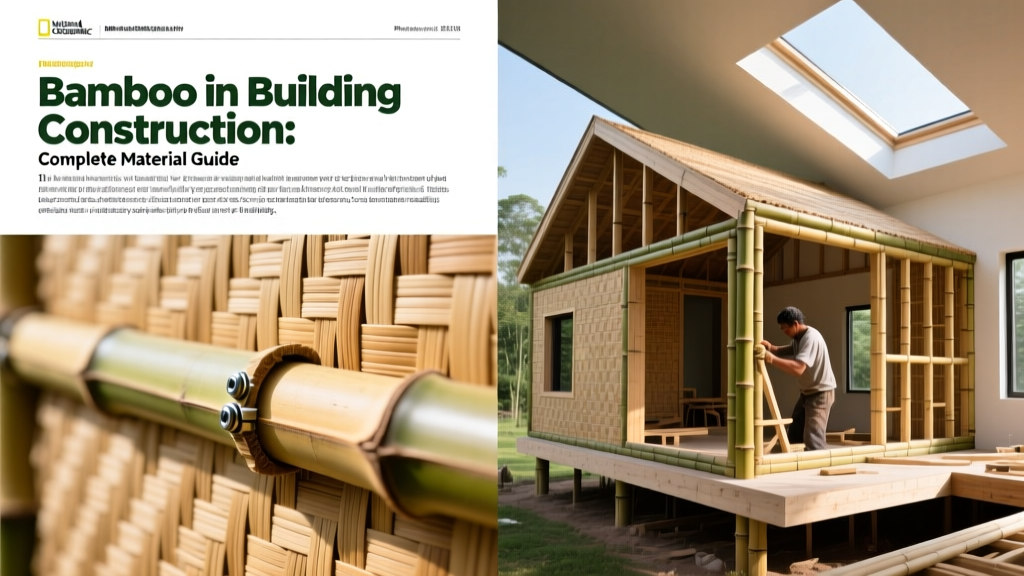
The Material Science of Bamboo in Building Construction
Specifying bamboo in building construction requires moving past its reputation as a simple vernacular material and treating it as a high-performance structural composite. Botanically a grass, bamboo's vascular bundle structure provides exceptional mechanical properties. The outer wall of a bamboo culm contains the highest density of vascular bundles, granting it a tensile strength that rivals mild steel (up to 400 MPa in premium species) and a compressive strength parallel to the grain of 40 to 80 MPa, which is comparable to standard concrete.
However, bamboo is highly anisotropic. Its strength drops significantly under radial tension and shear forces perpendicular to the grain. Understanding this directional strength profile is the foundational step for any structural engineer or architect integrating bamboo into modern load-bearing systems.
Species Selection: Guadua vs. Moso
Not all bamboo is structurally viable. The construction industry primarily relies on two species, each serving distinct architectural applications:
- Guadua angustifolia: Native to South and Central America, this is the premier species for round-pole structural framing. It features thick walls, short internodes, and a natural taper that makes it ideal for columns, trusses, and space frames.
- Phyllostachys edulis (Moso): Native to China, Moso is rarely used in its round form for heavy structural loads. Instead, it is the primary feedstock for engineered bamboo products like Laminated Bamboo Lumber (LBL) and Cross-Laminated Bamboo (CLB) panels due to its straight grain and rapid growth cycle.
System Selection: Round Pole vs. Engineered Bamboo
When integrating bamboo in building construction, you must choose between traditional round culm framing and modern engineered mass bamboo. The decision dictates your connection details, architectural finish, and supply chain logistics.
| System Type | Typical Dimensions | Primary Structural Use | 2026 Est. Material Cost | Architectural Finish |
|---|---|---|---|---|
| Round Pole (Guadua) | 100-150mm dia. @ base | Columns, roof trusses, space frames | $4.50 - $8.00 / linear ft | Exposed, rustic, organic |
| Laminated Bamboo Lumber (LBL) | 2x4 up to 6x12 beams | Beams, headers, floor joists | $6.50 - $11.00 / board ft | Uniform, modern timber-look |
| Cross-Laminated Bamboo (CLB) | 4-inch to 12-inch thick panels | Shear walls, floor/roof diaphragms | $28.00 - $45.00 / sq ft | Mass timber aesthetic, CNC-milled |

Critical Treatment and Harvesting Protocols
Untreated bamboo contains high levels of starch and sugars, making it highly susceptible to powderpost beetles (Dinoderus minutus) and fungal decay. Proper specification requires strict adherence to harvesting and treatment protocols.
Harvesting Age and Timing
Bamboo must be harvested at the exact moment of peak structural maturity. For Guadua, this is between 4 and 5 years of age. Harvesting before 3 years results in culms with high moisture content and low lignin, leading to severe shrinkage and collapse. Harvesting after 6 years increases the risk of internal fungal rot. Furthermore, harvesting should occur during the dry season (typically winter months) when the plant's starch reserves are at their lowest, naturally reducing pest attractiveness.
Chemical Treatment Standards
According to guidelines published by the International Bamboo and Rattan Organization (INBAR), the industry standard for preservation is a Borax and Boric Acid solution.
- Ratio: Mix Borax (Sodium Tetraborate Decahydrate) and Boric Acid in a strict 1:1 ratio by weight.
- Concentration: Achieve a 5% to 8% concentration in water, depending on the intended use (5% for interior, 8% for exterior or ground-adjacent elements).
- Application: For round poles, use the Boucherie method (displacement of sap via transpiration) or pressure-vessel impregnation. For engineered LBL/CLB, treatment is applied to the individual strips before lamination.
Never enclose bamboo structural elements behind drywall or vapor barriers until the core moisture content drops below 15%. Entrapped moisture in thick culms or dense LBL beams will trigger rapid internal fungal degradation. Use a pin-type moisture meter driven into the inner wall of the culm to verify.
Structural Connections: Preventing Axial Splitting
The most common point of failure when using bamboo in building construction is the connection joint. Bamboo's hollow cylindrical geometry and brittle nodes make it highly prone to axial splitting when subjected to dowel forces or bolt tension.
The Node Problem
The diaphragm at each node acts as a stress concentrator. Driving a standard nail or untreated bolt directly through a node will almost guarantee a longitudinal split as the wood dries and shrinks. To prevent this, structural connections must bypass the node or reinforce it.
Engineered Connection Solutions
- Epoxy-Grouted Nodes: Inject a structural epoxy or non-shrink cementitious grout into the hollow internode cavity directly behind the connection point. This converts the hollow tube into a solid composite block, allowing standard steel bolts to be used without splitting the culm.
- External Steel Gussets: Use external steel hose clamps or custom-fabricated U-bolt saddles that grip the outside of the culm, transferring shear forces through friction rather than relying on internal dowel bearing.
- Fish-Mouth Joints with Threaded Rods: For truss connections, carve a precise 'fish-mouth' profile into the intersecting culm to maximize surface contact, then secure with a single threaded rod passing through a grouted node, capped with oversized steel washers to distribute the clamping force.
Navigating Building Codes and ISO Standards
Historically, the lack of standardized building codes hindered the commercial adoption of bamboo. Today, structural engineers have a robust framework for permitting bamboo structures.
The primary global reference for structural bamboo design is ISO 22156:2004 (Bamboo Structural Design), paired with ISO 22157 for testing methods. These standards provide the allowable stress design (ASD) parameters and load-duration factors specific to bamboo's unique viscoelastic properties.
In the United States, bamboo is not yet explicitly detailed in the prescriptive chapters of the International Building Code (IBC). Instead, it must be permitted under IBC Section 104.11 (Alternative Materials, Design and Methods of Construction). To secure approval, the design team must submit a comprehensive engineering package to the local International Code Council (ICC) certified plan reviewer, including:
- Species identification and mechanical test reports from an accredited laboratory.
- Proof of treatment and moisture content at the time of installation.
- Calculated connection capacities based on ISO 22156 or peer-reviewed equivalent research.
- A specialized inspection plan detailing how the building official will verify hidden grouted nodes and treatment penetration.
Project Cost Matrix: 2026 Estimates
When evaluating bamboo in building construction, material costs are only a fraction of the total budget. Labor and specialized hardware significantly impact the final price. Below is a comparative cost breakdown for a standard 2,000 sq. ft. single-story structural frame.
| Cost Category | Round Pole (Guadua) | Engineered LBL Beams | Conventional Douglas Fir |
|---|---|---|---|
| Primary Material | $12,000 - $16,000 | $18,000 - $24,000 | $14,000 - $19,000 |
| Connection Hardware | $4,500 (Custom steel/epoxy) | $2,000 (Standard joist hangers) | $1,800 (Standard joist hangers) |
| Specialized Labor | $18,000 (Master craftsmen) | $10,000 (Standard framing crew) | $9,500 (Standard framing crew) |
| Treatment & Sealing | $3,000 (Borax + UV sealant) | $1,500 (Factory pre-treated) | $1,200 (Standard termite spray) |
| Total Framing Cost | $37,500 - $41,500 | $31,500 - $37,500 | $26,500 - $31,500 |
While round pole bamboo can be more expensive overall due to the highly specialized labor required for carving and grouting complex joints, it offers unmatched architectural value as an exposed interior finish, eliminating the need for drywall and painting on ceilings and accent walls.
Common Specification Mistakes to Avoid
Never specify bamboo, even heavily treated bamboo, for direct earth contact or embedded concrete footings. Bamboo will wick moisture via capillary action through its vascular bundles, leading to rot at the base. Always use a steel or concrete pier that elevates the bamboo base plate at least 12 inches above finished grade, utilizing a slotted steel saddle to allow for ventilation and water runoff.
Written by
James ThorntonJames Thornton is a construction industry veteran with 25 years of hands-on experience in wood framing, lumber grading, and residential building codes. He started as a framing carpenter in rural Oregon, earned his ICC Residential Building Inspector certification, and eventually became a senior plan reviewer for the City of Portland Bureau of Development Services. James holds a B.S. in Wood Science & Technology from Oregon State University and is a certified lumber grader through the West Coast Lumber Inspection Bureau (WCLIB). He has inspected over 3,000 residential construction sites and authored the city's internal guide on advanced framing techniques (2x6 at 24" O.C.). James lives in Bend, OR, where he builds custom timber-frame cabins and competes in lumberjack sports.
More from James Thornton
View all
Insulation
Best Home Insulation Materials: Complete 2026 Guide
Compare top home insulation materials for 2026. Find R-values, installed costs per square foot, and best uses for fiberglass, spray foam, and mineral wool.
Aug 4, 2026

Sustainable Building
Certify Your Green Building Material for LEED and WELL
Step-by-step guide to certifying a green building material for LEED v5 and WELL v2. Master EPDs, HPDs, and VOC limits for 2026 project specifications.
Aug 4, 2026

Stone & Masonry
Veneer Stacked Stone Panels: Interior Design & Style Showcase
Discover how veneer stacked stone panels transform interiors. Explore modern design profiles, material pairings, and technical installation specs.
Aug 4, 2026