Bamboo Building Sustainability: LCA and Embodied Carbon Analysis
Analyze the true sustainability of bamboo building materials. Explore LCA data, embodied carbon, sequestration rates, and structural certifications.

The "Green Steel" Paradox: Raw Culm vs. Engineered Products
The architectural narrative surrounding bamboo often conflates the rapid growth of the raw plant with the final installed building material. To conduct an accurate sustainability analysis of any bamboo building project, we must immediately bifurcate the material into two distinct categories: raw structural culm and engineered bamboo products (EBP). The environmental profiles of these two forms are drastically different, and treating them as interchangeable leads to severe miscalculations in Life Cycle Assessments (LCA).
Raw bamboo culm, primarily Guadua angustifolia in the Americas or Phyllostachys edulis (Moso) in Asia, requires minimal processing. Harvested at 3-5 years of maturity, the culms are treated with borate solutions and air-dried. The embodied carbon of this raw material is exceptionally low, often registering below 0.5 kg CO2e/kg, driven almost entirely by transportation logistics rather than manufacturing.
Conversely, engineered bamboo—such as strand-woven bamboo flooring, cross-laminated bamboo (CLB), and bamboo scrimber—undergoes intensive mechanical and thermal processing. The culm is crushed into fibers, coated in synthetic resins, and subjected to extreme heat and pressure. This manufacturing bottleneck fundamentally alters the material's carbon profile, a reality that modern 2026 building codes and Buy Clean procurement policies now require architects to quantify via Environmental Product Declarations (EPDs).
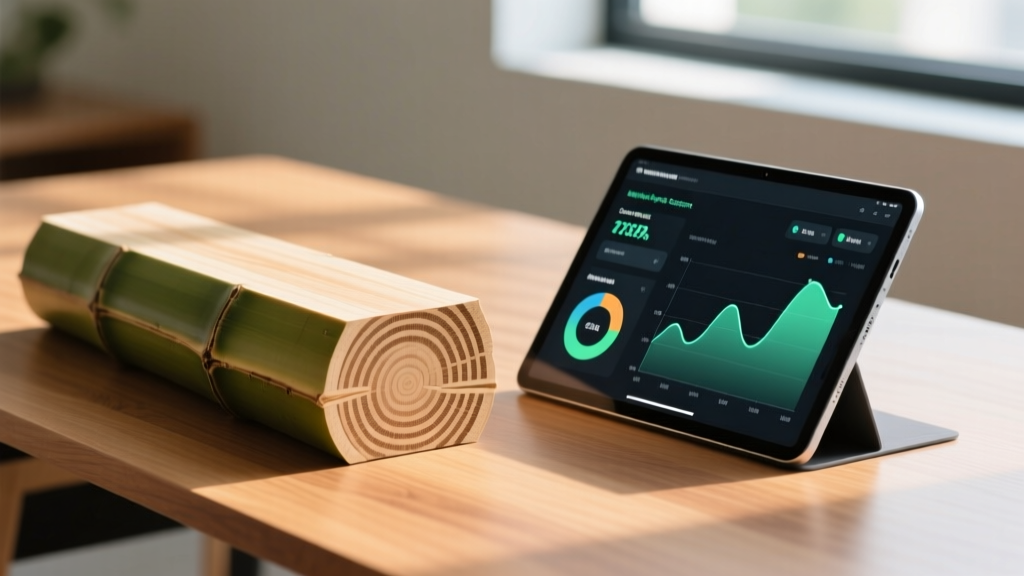
Life Cycle Assessment (LCA): Embodied Carbon Matrix
When specifying materials for low-carbon construction, relying on generalized "green" labels is insufficient. The following matrix compares the cradle-to-gate embodied carbon (A1-A3) of bamboo building materials against traditional structural alternatives, utilizing data aligned with the Building Transparency EC3 database and recent ICE (Inventory of Carbon and Energy) benchmarks.
| Material Type | Embodied Carbon (kg CO2e/kg) | Biogenic Carbon Storage | Primary Carbon Drivers |
|---|---|---|---|
| Raw Bamboo Culm (Borate Treated) | 0.35 - 0.55 | High (approx. 1.8 kg CO2/kg stored) | Harvesting, transport, borate salts |
| Strand-Woven Bamboo (PF Resin) | 3.80 - 4.50 | Negated by processing emissions | Phenol-formaldehyde resin, kiln drying, hot pressing |
| Cross-Laminated Bamboo (CLB / PUR) | 2.10 - 2.80 | Partial (resin offsets some storage) | Polyurethane adhesives, planing, lamination |
| Virgin Structural Steel | 2.20 - 2.60 | None | Iron ore reduction, electric arc furnaces |
| Cross-Laminated Timber (CLT) | 1.10 - 1.60 | High (approx. 1.4 kg CO2/kg stored) | Adhesives, milling, transport |
The Processing Bottleneck: Adhesives and Thermal Modification
To understand why engineered bamboo carries a heavy carbon penalty, we must examine the chemical and thermal requirements of the manufacturing process. Bamboo fibers possess high cellulose content but lack the natural lignin cross-linking found in wood. To achieve structural integrity, manufacturers rely on synthetic adhesives and thermal modification.
Adhesive Selection and VOC Off-Gassing
Traditional bamboo scrimber and strand-woven products utilize PF (phenol-formaldehyde) or UF (urea-formaldehyde) resins. PF resins require high-temperature curing (140°C to 160°C), demanding massive thermal energy inputs, typically sourced from coal or natural gas in primary manufacturing regions. Furthermore, while PF is highly water-resistant, its production is heavily reliant on petrochemical phenol.
For projects targeting LEED v5 or Living Building Challenge certification, specifiers must mandate Polyurethane (PUR) or Methylene Diphenyl Diisocyanate (MDI) binders. MDI reacts with the moisture in the bamboo fibers to create a rigid polymer, requiring lower pressing temperatures and eliminating formaldehyde emissions entirely, though it comes at a 15-20% cost premium.
Thermal Modification (Caramelization)
Raw bamboo contains high levels of starch and sugars, making it highly susceptible to fungal decay and insect infestation (specifically powderpost beetles). To mitigate this without heavy chemical preservatives, manufacturers use thermal modification, heating the bamboo to 180°C-220°C in a low-oxygen environment. This process caramelizes the sugars and alters the hemicellulose structure. While it improves durability and dimensional stability, the sustained energy requirement for industrial kilns significantly inflates the A3 embodied carbon module.
Carbon Sequestration and Land Use Efficiency
Where bamboo building materials truly outperform traditional timber is in the A0 (biogenic carbon sequestration) phase of the life cycle. According to data from the International Bamboo and Rattan Organization (INBAR), a well-managed Moso bamboo plantation can sequester between 12 and 15 tonnes of CO2 per hectare annually. This is roughly 2 to 3 times the sequestration rate of a fast-growing pine plantation.
"Bamboo's rhizome root system remains intact after harvesting, meaning the soil carbon sink is never disrupted. Unlike clear-cut timber forestry, which releases soil-bound carbon and halts sequestration for years, bamboo harvesting operates on a continuous selective-yield model, maintaining an unbroken carbon drawdown cycle."
Furthermore, the yield per hectare is staggering. A mature bamboo plantation can produce 20 to 30 tonnes of usable culm per hectare annually, compared to 4 to 8 tonnes for fast-growing timber species. This land-use efficiency is a critical metric for sustainable procurement, particularly when evaluating the ecological footprint of the supply chain.
Procurement Framework: Specifying Low-Carbon Bamboo
Architects and structural engineers must move beyond generic "bamboo" specifications. To ensure structural safety and verifiable sustainability, use the following procurement framework for your next bamboo building project:
- Mandate Structural Standards: Raw bamboo structures must be engineered in strict accordance with ISO 22156:2021 (Bamboo — Structural design). For engineered bamboo products used in load-bearing applications, require testing data compliant with ASTM D5457 for structural composite lumber.
- Demand EPDs, Not Just Certificates: FSC (Forest Stewardship Council) certification verifies sustainable forestry, but it does not track manufacturing emissions. Require a Type III Environmental Product Declaration (EPD) that explicitly breaks down A1-A3 modules to verify the resin and energy sources used.
- Specify Resin Chemistry: Explicitly ban UF (urea-formaldehyde) resins in interior applications. For exterior or high-moisture applications, specify MDI/PUR binders over traditional PF resins to reduce thermal curing energy and eliminate toxic off-gassing.
- Verify Preservation Methods: Reject raw bamboo treated with CCA (Chromated Copper Arsenate) or creosote. Specify borate-based treatments (e.g., borax/boric acid solutions) for interior use, or thermal modification for exterior cladding, ensuring the treatment facility utilizes closed-loop water systems to prevent aquatic toxicity.
End-of-Life Scenarios and Biodegradability
The sustainability of a bamboo building material is ultimately capped by its end-of-life (Module C4) disposition. Raw, borate-treated bamboo culm is fully biodegradable and can be composted or safely incinerated for biomass energy recovery, releasing only the biogenic carbon it stored during growth.
However, engineered bamboo products present a complex disposal challenge. Strand-woven bamboo bonded with PF or MDI resins cannot be safely composted, as the synthetic polymers do not break down and can leach microplastics or chemical residues into the soil. Furthermore, the high resin content makes mechanical recycling (chipping and re-pressing) impossible. Currently, the only viable end-of-life pathway for heavily resinated bamboo products is controlled incineration with advanced flue-gas cleaning to capture volatile organic compounds, or landfilling, where the synthetic resins will persist for decades. Specifying mechanical fastening over chemical adhesives in the assembly phase (Design for Disassembly) remains the most effective strategy to extend the lifecycle of engineered bamboo components.
Written by
Sarah WhitfieldSarah Whitfield is a chartered quantity surveyor (MRICS) and construction cost analyst with 15 years of experience in material pricing, procurement strategy, and project budgeting. She earned her degree in Construction Management from the University of Reading (UK) and has worked on projects ranging from $2M custom homes to $180M mixed-use developments across North America and Europe. Sarah currently leads cost estimating for BuildMat Insight, maintaining a proprietary database of 4,000+ material price points updated quarterly. She is a frequent contributor to RSMeans cost data panels and has presented at the International Cost Engineering Council (ICEC) congress. Based in Denver, CO, Sarah is an avid trail runner and volunteer mentor for Women in Construction.
More from Sarah Whitfield
View all
Wood & Lumber
What Are the Different Types of Wood? A Builder's Guide
Compare structural softwoods, finish hardwoods, and engineered lumber. Analyze Janka ratings, MOE values, and 2026 pricing for construction.
Aug 4, 2026

Walls & Panels
Steel Framing vs Wood Framing: Corrosion and Moisture Defense
Compare steel framing vs wood framing for moisture resistance. Learn about galvanized coatings, condensation risks, and corrosion protection strategies.
Jul 21, 2026

Stone & Masonry
How to Cut Stone Veneer: Wet Saw vs Grinder Comparison
Compare the best tools for cutting stone veneer. We review wet saws, angle grinders, and chop saws to help you achieve clean, chip-free cuts.
Jul 21, 2026