Evaluating Fiberglass for Pool Shells: Key Performance Specs
Review critical performance ratings and ASTM specs for fiberglass for pool shells, covering tensile strength, gel coat thickness, and osmosis resistance.
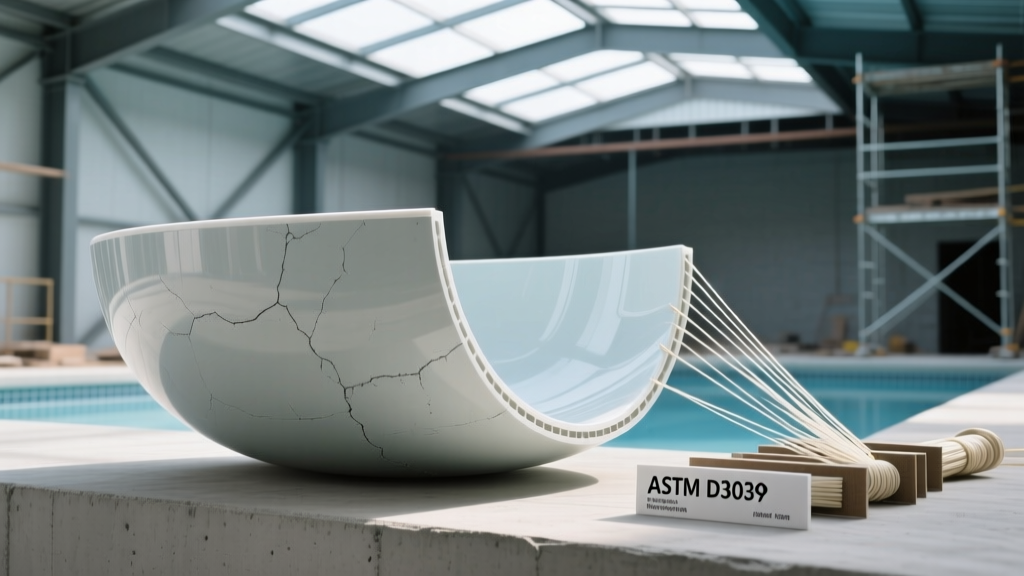
Anatomy of High-Performance Fiberglass Pool Shells
When specifying fiberglass for pool construction, architects and builders are evaluating a Fiber-Reinforced Polymer (FRP) composite system, not a single homogenous material. The structural integrity, longevity, and hydraulic performance of a fiberglass pool shell depend entirely on the precise lamination schedule, resin chemistry, and catalytic cure rates achieved during manufacturing. Unlike concrete, which relies on compressive strength and steel rebar for tensile reinforcement, FRP pool shells utilize a matrix of E-glass fibers and thermoset resins to achieve high strength-to-weight ratios and exceptional flexural modulus.
According to guidelines published by the Pool & Hot Tub Alliance (PHTA), modern fiberglass pools must withstand immense hydrostatic pressure, thermal cycling, and chemical degradation from sanitizers. Understanding the exact performance ratings and material specifications is critical for procurement, ensuring the shell will not suffer from osmotic blistering, structural deflection, or surface crazing over its 30-plus year lifespan.
Quick Reference: Premium FRP Pool Shell Specifications
- Optimal Gel Coat Thickness: 18 to 22 mils (0.018" - 0.022")
- Barcol Hardness (Cure Indicator): Minimum 40 (ASTM D2583)
- Tensile Strength: 15,000 to 25,000 psi (ASTM D638)
- Flexural Strength: 25,000 to 35,000 psi (ASTM D790)
- Primary Resin System: Isophthalic or Vinyl Ester (for osmosis resistance)
Core Material Standards: ASTM and ISO Benchmarks
The ASTM International provides the definitive testing frameworks for FRP composites. When reviewing manufacturer spec sheets for fiberglass for pool applications, three primary ASTM standards dictate the structural viability of the shell:
Tensile and Flexural Modulus
ASTM D638 measures the tensile properties of plastics, while ASTM D790 evaluates flexural properties. A high-quality pool shell requires a flexural modulus of at least 1.2 x 10^6 psi. This stiffness prevents the pool walls from bowing outward when the pool is filled with 30,000+ gallons of water (approximately 250,000 lbs of hydrostatic force) while simultaneously resisting inward compression from expansive clay soils during freeze-thaw cycles.
Barcol Hardness and Catalytic Cure
ASTM D2583 measures the indentation hardness of rigid plastics using a Barcol impressor. This is arguably the most critical quality control metric in fiberglass pool manufacturing. A reading below 40 indicates an under-cured resin matrix. Under-cured resin leaves unreacted styrene monomers trapped in the laminate, which inevitably leads to severe osmotic blistering and a distinct chemical odor in the pool water post-installation. Premium manufacturers mandate a minimum Barcol reading of 45 across all structural ribs and floor pans before the shell leaves the factory.
Lamination Schedule and Structural Integrity
The structural laminate of a fiberglass pool is built in distinct layers, each serving a specific mechanical purpose. A standard high-performance lamination schedule includes:
- Vinyl Ester Skin Coat (15-20 mils): Applied directly behind the gel coat, this layer acts as the primary chemical barrier against water intrusion and osmotic blistering.
- Chopped Strand Mat (CSM) (1.5 oz/sq ft): Provides isotropic strength and builds thickness rapidly. CSM is crucial for conforming to the complex radii of pool coves and steps.
- Woven Roving (24 oz/sq ft): The primary structural backbone. Alternating layers of CSM and woven roving create a cross-linked matrix that maximizes tensile strength and prevents crack propagation.
- Structural Core (Polyurethane Foam or Honeycomb): Used in the floor pan and vertical walls to increase the moment of inertia without adding excessive weight. A 1-inch foam core can increase the flexural stiffness of the panel by up to 400%.
Gel Coat and Osmosis Resistance Ratings
The gel coat is the pigmented, non-structural outer layer that provides the pool's color and waterproof seal. Specifying the correct thickness is a balancing act. If the gel coat is too thin (under 15 mils), it will lack durability and become susceptible to UV fading and micro-cracking. If it is too thick (over 25 mils), it becomes brittle and prone to 'star crazing'—spider-web fractures caused by point impacts or thermal shock.
The most catastrophic failure mode in fiberglass pools is osmotic blistering. This occurs when water molecules permeate the gel coat and react with hydrophilic impurities (like unreacted glycols or trapped air voids) in the underlying laminate. This reaction creates a concentrated solution that draws more water through the semi-permeable gel coat via osmosis, building pressure up to 600 psi and forming blisters on the pool floor.
Resin System Comparison Matrix
The choice of resin dictates the shell's resistance to osmosis and its overall cost. According to data from the American Composites Manufacturers Association (ACMA), vinyl ester resins provide superior hydrolytic stability compared to standard polyesters.
| Resin Type | Osmosis Resistance | Flexural Modulus | Cost Premium (Wholesale) |
|---|---|---|---|
| Orthophthalic Polyester | Low (High Blister Risk) | ~1.0 x 10^6 psi | Baseline |
| Isophthalic Polyester | Moderate | ~1.1 x 10^6 psi | +$400 - $600 |
| Vinyl Ester | Exceptional (Industry Standard) | ~1.3 x 10^6 psi | +$800 - $1,200 |
Thermal Expansion and Hydrostatic Deflection Limits
Fiberglass composites exhibit a Coefficient of Thermal Expansion (CTE) of approximately 1.5 x 10^-5 in/in/°F, which is remarkably close to that of concrete (approx. 5.5 x 10^-6 in/in/°F). This compatibility allows fiberglass pools to be installed within concrete bond beams and cantilever decks without inducing severe shear stresses at the coping interface during seasonal temperature swings.
Critical Edge Case: In regions with high water tables, hydrostatic uplift pressure can exceed the weight of an empty fiberglass shell. Procurement specifications must mandate integrated hydrostatic relief valves in the floor pan and a minimum floor laminate thickness of 3/8 inch to prevent catastrophic 'floating' or floor pan fracture during winterization or maintenance draining.
UV Degradation and Color Retention Metrics
Standard pigmented gel coats are susceptible to photo-oxidation, leading to chalking and color fading over time. To mitigate this, premium manufacturers utilize aliphatic urethane clear coats or incorporate advanced UV absorbers (such as benzotriazoles) directly into the gel coat matrix. When evaluating UV performance, request the manufacturer's QUV accelerated weathering test results (ASTM G154). A high-performance gel coat should exhibit a Delta E (color change) of less than 2.0 after 2,000 hours of continuous UV exposure, ensuring the pool retains its original hue for decades.
Procurement Checklist for Specifiers
To ensure the fiberglass for pool shells meets rigorous construction standards, require the following documentation from the manufacturer prior to purchase:
- Barcol Hardness Log: Batch-specific readings confirming a minimum cure hardness of 40+ across the shell and structural ribs.
- Resin Certification: Proof of Vinyl Ester or high-grade Isophthalic resin usage in the skin coat and structural laminate.
- Gel Coat Mil-Thickness Report: Ultrasonic testing logs verifying the 18-22 mil specification across the floor, walls, and coves.
- Hydrostatic Relief Valve Specs: Verification of dual-valve integration with clear flow-rate ratings for high-water-table installations.
- Warranty Exclusions Review: Careful analysis of warranty terms regarding soil settlement, improper backfill (mandating clean, angular 3/8" gravel), and groundwater management.