Fiberglass vs Black Foam Pipe Insulation: Material Comparison Guide
Specifying HVAC piping? Compare fiberglass vs black foam pipe insulation for R-value, vapor barriers, fire ratings, and total installed cost.

Thermal Boundaries: Glass Wool vs. Nitrile Rubber
When specifying mechanical pipe insulation for commercial and industrial HVAC systems, the fiberglass vs black foam pipe insulation materials comparison represents the fundamental divide between inorganic glass-based minerals and organic closed-cell elastomers. Fiberglass pipe insulation (manufactured under ASTM C547 standards by brands like Johns Manville Micro-Lok II and Owens Corning) consists of resin-bonded glass fibers formed into rigid or semi-rigid half-sections. Black foam insulation (manufactured under ASTM C534, notably Armacell’s Armaflex or Aeroflex) is a flexible, closed-cell nitrile rubber (NBR) or EPDM elastomer.
The primary differentiator is thermal tolerance. Fiberglass is inherently non-combustible and can withstand continuous operating temperatures up to 850°F (454°C), making it the mandatory choice for high-temperature steam, boiler feedwater, and high-heat hot water systems. Conversely, black elastomeric foam degrades rapidly above 220°F (105°C). Specifiers must never use black foam on high-temp steam lines; the material will melt, off-gas toxic smoke, and leave the pipe entirely exposed.
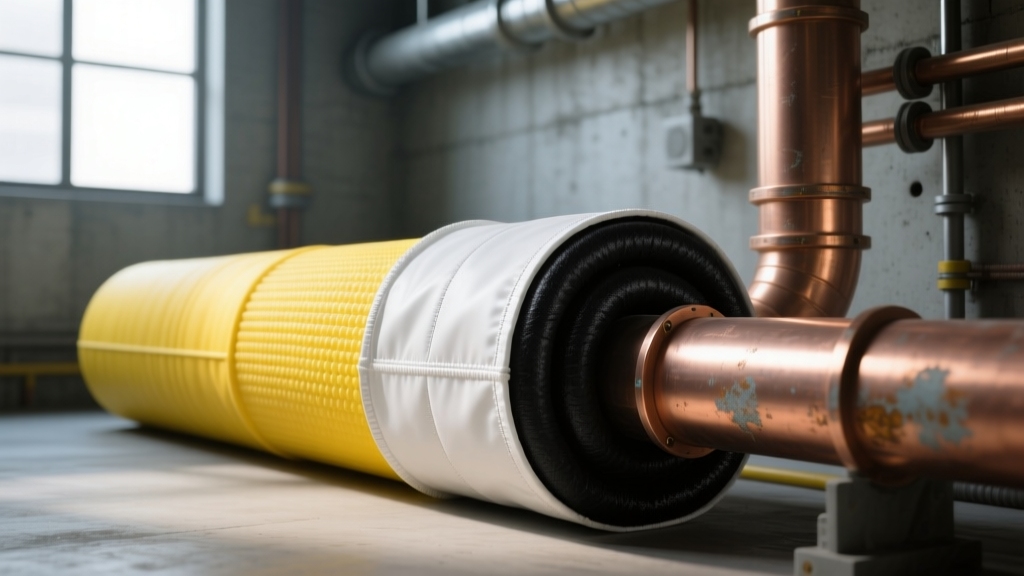
Head-to-Head Specification Matrix
Below is a technical comparison of standard 1-inch thick preformed pipe insulation for both materials, evaluated at a mean temperature of 75°F (24°C).
| Property | Fiberglass (ASJ Jacketed) | Black Foam (Elastomeric/NBR) |
|---|---|---|
| ASTM Standard | C547 (Type I) | C534 (Type I) |
| Max Operating Temp | 850°F (454°C) | 220°F (105°C) |
| R-Value (1" at 75°F) | R-3.3 to R-3.7 | R-4.6 to R-5.2 |
| Cell Structure | Open-cell (Fibrous) | Closed-cell (95%+) |
| Water Vapor Permeance | Requires ASJ/FSK Jacket (<0.02 perms) | Inherent (<0.03 perms per ASTM E96) |
| Surface Burning (ASTM E84) | 25 Flame / 50 Smoke (with jacket) | 25 Flame / 50 Smoke (with fire retardants) |
| Material Cost (per lin. ft.) | $1.20 - $1.80 | $2.50 - $3.80 |
The Vapor Drive & CUI Vulnerability
The most critical failure mode in chilled water and refrigeration piping (operating between 35°F and 55°F) is Corrosion Under Insulation (CUI). This is where the fiberglass vs black foam pipe insulation materials comparison shifts heavily in favor of elastomeric foam.
Open-Cell vs. Closed-Cell Dynamics
Fiberglass is an open-cell material. While the factory-applied All-Service Jacket (ASJ) acts as a vapor retarder, the jacket is highly susceptible to mechanical damage. If a technician kicks the pipe, or if a seam tape fails, ambient moisture migrates through the vapor drive into the fiberglass matrix. Once the glass fibers absorb water, the R-value collapses to near zero, and the trapped moisture sits directly against the carbon steel or copper pipe, accelerating CUI. According to the U.S. Department of Energy, maintaining an unbroken vapor barrier on cold pipes is essential to prevent catastrophic system degradation.
Black foam, by contrast, features a closed-cell structure that acts as its own built-in vapor barrier. Even if the outer skin of an Armaflex tube is punctured, moisture cannot travel laterally through the cellular matrix. For chilled water systems, black foam dramatically reduces the long-term risk of CUI, provided all longitudinal and butt seams are sealed with a specialized contact adhesive (such as Armaflex 520) rather than mechanical tape.
Fire, Smoke, and Toxicity (ASTM E84)
Both materials can achieve the standard 25/50 Flame Spread Index (FSI) and Smoke Developed Index (SDI) required by the International Building Code (IBC) for plenum spaces, but they achieve this through entirely different chemistries.
- Fiberglass: The glass fibers themselves are completely non-combustible. The 25/50 rating is derived from the kraft paper, fiberglass scrim, and aluminum foil layers in the ASJ jacket. In a severe fire, the jacket burns away, but the glass wool remains intact and does not produce toxic black smoke.
- Black Foam: Nitrile rubber is inherently combustible. Manufacturers must load the elastomer with halogenated fire retardants to force it to self-extinguish and meet the 25/50 ASTM E84 threshold. When exposed to direct, sustained flame, black foam will eventually burn, releasing dense, highly toxic black smoke containing hydrogen cyanide and carbon monoxide. Specifiers must verify that the specific black foam brand carries a current UL listing for plenum use if routing through air-handling spaces.
Total Installed Cost: Material vs. Labor
A common mistake in procurement is evaluating insulation based solely on material cost. Fiberglass is significantly cheaper at the supply house, but the total installed cost often equalizes due to labor intensity.
Labor Reality: Installing fiberglass requires cutting rigid half-sections, aligning them, stapling the ASJ lap, and then troweling or brushing a vapor-sealing mastic over every single longitudinal and circumferential seam. Installing black foam requires cutting the flexible tube, applying contact adhesive to both mating surfaces, waiting 60 seconds for the flash-off, and pressing the seam together. Black foam installation is typically 40% to 50% faster, offsetting its higher upfront material cost on complex piping networks with numerous valves and flanges.
Specifier Decision Flowchart
Specify Fiberglass (ASJ Jacketed) When:
- Operating temperatures exceed 220°F (Hot water heating, steam, boiler condensate).
- The project budget prioritizes lower upfront material costs and labor rates are low.
- High acoustic dampening is required (fiberglass absorbs pipe-borne water hammer noise better than dense foam).
Specify Black Foam (Elastomeric) When:
- Piping operates below ambient dew point (Chilled water, VRF refrigerant lines, condensation drains).
- The environment is high-humidity or subject to wash-downs (food processing, marine, coastal facilities).
- The piping network is highly complex with tight mechanical room clearances where rigid half-sections are difficult to maneuver.
Code Compliance & Sizing Tools
To ensure compliance with the 2026 IECC (International Energy Conservation Code) minimum insulation thickness requirements, specifiers should not rely on rule-of-thumb sizing. The North American Insulation Manufacturers Association (NAIMA) provides the industry-standard 3E Plus software. This thermodynamic modeling tool allows engineers to input specific pipe diameters, fluid temperatures, ambient conditions, and local energy costs to calculate the exact economic thickness required to prevent condensation and minimize heat loss, regardless of whether you ultimately select fiberglass or black foam.
Frequently Asked Questions
Can I use black foam insulation on outdoor rooftop piping?
Not without secondary protection. Black elastomeric foam degrades rapidly when exposed to ultraviolet (UV) radiation from direct sunlight. If used outdoors, black foam must be painted with a UV-resistant elastomeric coating (like Armacell’s WB Finish) or wrapped in an aluminum or PVC outdoor jacketing. Fiberglass with an ASJ jacket also requires an outdoor PVC or metal jacket to protect the paper facing from weather.
Does fiberglass insulation lose its R-value over time?
Only if it becomes compressed or wet. Fiberglass relies on trapped, still air within its glass matrix for thermal resistance. If pipes are subjected to heavy vibration that causes the rigid fiberglass to fracture and settle, or if moisture breaches the vapor barrier, the R-value will drop. Black foam’s rigid closed-cell structure is highly resistant to vibration settling and moisture ingress.
Which material is safer for indoor air quality (IAQ)?
Both materials are certified by GREENGUARD Gold for low VOC emissions, making them safe for occupied spaces. However, during installation, bare fiberglass releases microscopic glass shards that require installers to wear PPE (respirators, gloves). Black foam does not shed fibers, making it the preferred choice for retrofits in occupied buildings like hospitals or schools where containment of airborne particulates is critical.
Written by
David NakamuraDavid Nakamura is a licensed architect (AIA) and construction technology writer focused on sustainable building methods, mass timber engineering, and high-performance building envelopes. He holds a Master of Architecture from the University of Washington and is a certified Passive House Consultant (CPHC). David spent eight years at the Seattle firm Mithun, where he led the design of three LEED Platinum projects, before founding his own practice specializing in net-zero residential design. He serves on the editorial advisory board of GreenBuilder Magazine and has authored peer-reviewed papers on cross-laminated timber (CLT) connections for the Journal of Structural Engineering. In his spare time, David teaches woodworking at Pratt Fine Arts Center and kayaks the Puget Sound.
More from David Nakamura
View all
Construction Cost
Labor Cost to Build a Deck Per Sq Ft: 2026 Installation Guide
Discover the exact labor cost to build a deck per sq ft in 2026. This installation guide breaks down contractor rates, complexity factors, and hidden fees.
Aug 4, 2026

Construction Cost
How Much Does It Cost to Build a 3 Bedroom House? Financing Guide
Learn exactly how much it costs to build a 3 bedroom house and explore 2026 financing options, construction loan types, and budget frameworks for your build.
Aug 4, 2026

Construction Cost
Cost to Build a Tennis Court: 2026 Guide
How much does it cost to build a tennis court in 2026? Breakdowns for asphalt, concrete, and synthetic surfaces plus fencing and lighting.
Jul 30, 2026