Laminated Glass Performance Ratings and Safety Specifications
Explore laminated glass performance ratings, including PVB and SGP interlayer specs, impact safety standards, acoustic STC ratings, and structural loads.
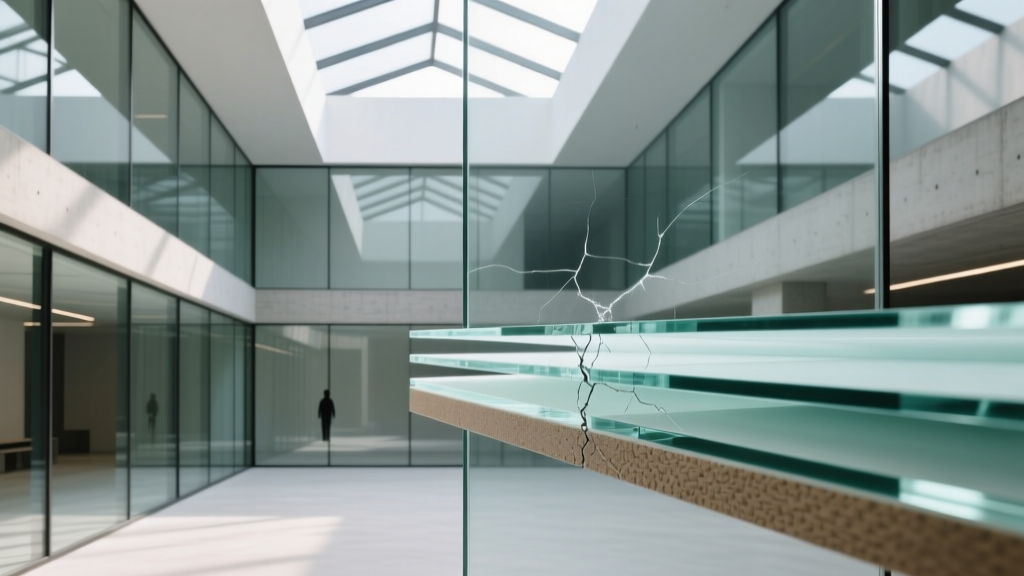
Core Anatomy and Interlayer Specifications
Laminated glass is a composite material formed by bonding two or more glass plies under heat and pressure using a polymer interlayer. The performance profile of the assembly is dictated not just by the glass thickness, but fundamentally by the interlayer chemistry. As of 2026, architectural specifications predominantly rely on three interlayer families, each with distinct mechanical and optical properties.
- Polyvinyl Butyral (PVB): The industry baseline. Standard thicknesses range from 0.38mm to 2.28mm. Offers excellent UV filtration (blocking 99% of UV rays up to 380nm) and basic impact resistance. Tear strength is approximately 10 N/mm.
- Ionoplast (e.g., SentryGlas® Plus / SGP): Engineered for structural and hurricane applications. SGP exhibits a tear strength of roughly 50 N/mm (5x PVB) and a shear modulus 100 times stiffer than PVB at room temperature. It maintains post-breakage structural integrity even when both glass plies fracture.
- Ethylene Vinyl Acetate (EVA): Highly moisture-resistant, making it ideal for exterior frameless applications or glass with embedded elements (LEDs, fabrics). However, its post-breakage structural stiffness is lower than SGP, and it is generally not specified for overhead structural glazing.
Standard metric configurations are defined by the sum of the glass and interlayer thicknesses. A 6.38mm laminate consists of two 3mm glass plies and one 0.38mm PVB interlayer. For safety-critical applications, specifications typically mandate a minimum of 8.38mm (4mm glass / 0.38mm PVB / 4mm glass) or 10.76mm (5mm glass / 0.76mm PVB / 5mm glass).
Impact Resistance and Safety Certifications
Architectural laminated glass must comply with stringent impact standards to qualify as safety glazing. The required certification depends on the application height, location, and local building codes. According to the Whole Building Design Guide (WBDG), specifying the correct impact category is critical for avoiding liability in commercial and multi-family residential projects.
| Standard | Test Methodology | Application Scope |
|---|---|---|
| CPSC 16 CFR 1201 | 100 lb bag drop. Cat I: 18-inch drop. Cat II: 48-inch drop. | Mandatory for architectural glazing in the US. Cat II required for full-height doors and sidelites. |
| ANSI Z97.1 | 100 lb bag drop (48-inch). Evaluates fragmentation and impact resilience. | Often used for interior glazing, shower enclosures, and non-hazardous locations where CPSC is not strictly enforced. |
| EN 12600 | Twin-tire impactor at varying drop heights (Class 1 to 3). | European standard. Class 1(B)1 represents the highest safety level (equivalent to 1200mm drop). |
| ASTM E1886 / E1996 | Large missile (2x4 timber) and cyclic pressure testing. | Hurricane-prone regions (HVHZ). Requires heavy-duty SGP or multi-ply PVB laminates. |
For overhead and sloped glazing (skylights, canopies), specifications must explicitly require heat-strengthened or fully tempered glass plies laminated with PVB or SGP to ensure the shattered glass adheres to the interlayer and does not fall through the opening upon impact.
Acoustic Performance and STC Ratings
Standard monolithic glass suffers from the "coincidence dip," a phenomenon where sound waves at specific critical frequencies (typically between 1000 Hz and 4000 Hz) cause the glass to resonate, drastically reducing its acoustic insulation. Laminated glass mitigates this through the viscoelastic damping properties of the interlayer.
Frequency-Specific Damping Metrics
When specifying laminated glass for acoustic control—such as in airport perimeters, urban high-rises, or recording studios—architects must differentiate between standard PVB and purpose-engineered acoustic PVB (e.g., Trosifol® SC or Saflex® Acoustic).
- Standard 6.38mm PVB Laminate: Yields a Sound Transmission Class (STC) of approximately 35 to 37. Provides marginal improvement over 6mm monolithic glass.
- 10.76mm Acoustic PVB Laminate: Achieves an STC of 40 to 43. The acoustic interlayer is formulated to have a lower shear modulus at high frequencies, effectively eliminating the coincidence dip in the human speech range.
- Insulating Glass Units (IGUs) with Laminated Lites: A high-performance IGU featuring a 10.76mm acoustic laminate on the exterior, a 16mm argon-filled cavity, and a 6mm interior monolithic lite can achieve an STC of 45+ and an Outdoor-Indoor Transmission Class (OITC) of 38+, effectively dampening low-frequency traffic noise.
Structural Load and Wind Resistance Specifications
Designing laminated glass for wind load requires adherence to FEMA and ASTM E1300 guidelines, which dictate load resistance based on glass thickness, aspect ratio, and support conditions. The critical advantage of laminated glass in structural engineering is its post-breakage behavior.
Engineering Directive: In structural glass fins, balustrades, and overhead canopies, never rely on standard annealed PVB laminates for post-breakage load bearing. Specify SGP interlayers combined with heat-strengthened glass. SGP's high shear modulus allows the fractured assembly to act as a monolithic structural beam, preventing catastrophic collapse until the unit can be safely replaced.
When calculating deflection under sustained wind loads, engineers must apply the appropriate load duration factor. PVB exhibits viscoelastic creep under long-term static loads (such as snow on a skylight or continuous wind pressure), meaning its effective shear modulus decreases over time. SGP interlayers show virtually no creep, allowing engineers to use the short-term shear modulus for long-term load calculations, resulting in thinner, lighter glass assemblies.
Common Failure Modes and Edge Delamination
Despite its robust performance ratings, laminated glass is highly susceptible to edge degradation if detailing and sealant compatibility are ignored during installation. The most frequent field failure is edge delamination, where moisture penetrates the interlayer perimeter, causing it to turn opaque and lose adhesion.
Never use acidic silicone sealants, putty, or linseed oil-based glazing compounds in contact with exposed laminated glass edges. These chemicals plasticize the PVB, breaking down its molecular bond with the glass. Always specify neutral-cure silicones or structural polyurethanes, and ensure a minimum 1/2-inch edge delete (clean glass perimeter) when integrating laminated lites into an IGU to allow proper secondary sealant bite.
Troubleshooting Edge Stability in Frameless Systems
For exterior frameless glass balustrades or point-fixed canopies where the glass edge is permanently exposed to weather:
- Specify EVA or High-Adhesion PVB: EVA interlayers are inherently hydrophobic and resist moisture ingress far better than standard PVB.
- Polished Edges: Mandate seamed and polished edges rather than arrised edges. Micro-fissures from poor edge fabrication act as capillaries, drawing moisture deep into the interlayer.
- Drainage Detailing: Ensure the bottom edge of the glass is elevated at least 1/4 inch above the finished floor or drainage channel using structural setting blocks, preventing the interlayer from sitting in standing water.
By strictly aligning interlayer chemistry with the specific mechanical, acoustic, and environmental demands of the project, architects and engineers can leverage laminated glass to achieve highly specialized performance targets without compromising structural safety or longevity.