How Long Do Lime Wash Walls Last? Durability & Lifespan Analysis
Discover the true lifespan of lime wash walls. We analyze carbonation, weathering, failure modes, and maintenance cycles for lasting durability.
The Carbonation Mechanism: Why Lime Wash Walls Outlast Paint
Unlike acrylic or latex paints that form a superficial plastic film on a surface, limewash undergoes a chemical transformation. When applied to a wall, calcium hydroxide (slaked lime) reacts with atmospheric carbon dioxide in a process called carbonation. This converts the lime back into calcium carbonate—the same crystalline structure as natural limestone. Because the finish petrifies into the pores of the substrate rather than sitting on top of it, the durability profile of lime wash walls is fundamentally different from conventional coatings.
The carbonation process is not instantaneous. It penetrates the substrate at a rate of approximately 1 to 2 millimeters per month, depending on ambient humidity, temperature, and the porosity of the wall. A fully carbonated limewash finish is highly alkaline (pH 10-12), naturally biocidal, and entirely vapor-permeable. According to technical guidelines from the National Park Service Technical Preservation Services, this vapor permeability is the primary reason lime-based finishes prevent the moisture-trapping that leads to structural spalling in historic and modern masonry alike.
Carbonation requires moisture. If limewash dries too quickly (common in low-humidity or high-wind environments), the water evaporates before the CO2 reaction completes, resulting in a weak, powdery surface that fails within months. Professional applicators must mist the wall before application and lightly fog the surface for 24-48 hours post-application to ensure complete crystallization.
Substrate Compatibility and Lifespan Matrix
The lifespan of lime wash walls is entirely dictated by the substrate's porosity and alkalinity. Limewash requires a highly porous, mineral-based surface to achieve a mechanical key. Applying it to sealed, painted, or non-porous surfaces guarantees premature delamination.
| Substrate Type | Porosity & Breathability | Expected Lifespan (Exterior) | Expected Lifespan (Interior) | Failure Risk Profile |
|---|---|---|---|---|
| Unsealed Brick & Stone | High / Excellent | 15 - 25+ Years | 50+ Years | Very Low (if properly carbonated) |
| Lime Plaster / Stucco | High / Excellent | 15 - 20 Years | 50+ Years | Low (chemical compatibility is perfect) |
| Portland Cement Render | Low-Medium / Poor | 3 - 7 Years | 15 - 20 Years | Medium (trapped moisture causes flaking) |
| Previously Painted Drywall | Very Low / None | N/A (Not recommended) | 1 - 3 Years | High (will chip and peel rapidly) |
| Raw, Unsealed Wood | High / Good | 5 - 10 Years | 20+ Years | Medium (wood expansion breaks the crystalline bond) |
Modern Formulations vs. Traditional Slaking
Historically, limewash was made by slaking quicklime (calcium oxide) in water for months or years to create lime putty. Today, the market offers two primary routes for lime wash walls, each with distinct durability characteristics and labor requirements.
1. Traditional Type S Hydrated Lime
Mixed on-site with water (and occasionally natural binders like casein or tallow). Type S (Special) hydrated lime is preferred over Type N due to its higher plasticity and water-retention capacity. Cost: $0.15 - $0.30 per square foot for materials. Durability Note: Requires immense skill to mix to the correct consistency (the "skim milk" test). Inconsistent mixing leads to varying carbonation depths and patchy weathering.
2. Pre-Mixed Commercial Limewash (e.g., Romabio Classico, Color Atelier)
These modern formulations include mineral stabilizers and precise pigment dispersions. Products like Romabio Classico Limewash utilize a proprietary slaking process that guarantees consistent particle size and adhesion without requiring on-site binders. Cost: $0.60 - $1.10 per square foot for materials. Durability Note: Highly consistent carbonation. These products are engineered to withstand high-UV and high-rain environments better than raw site-mixed putty, often extending exterior maintenance cycles by 3 to 5 years.
Diagnosing and Preventing Premature Failure
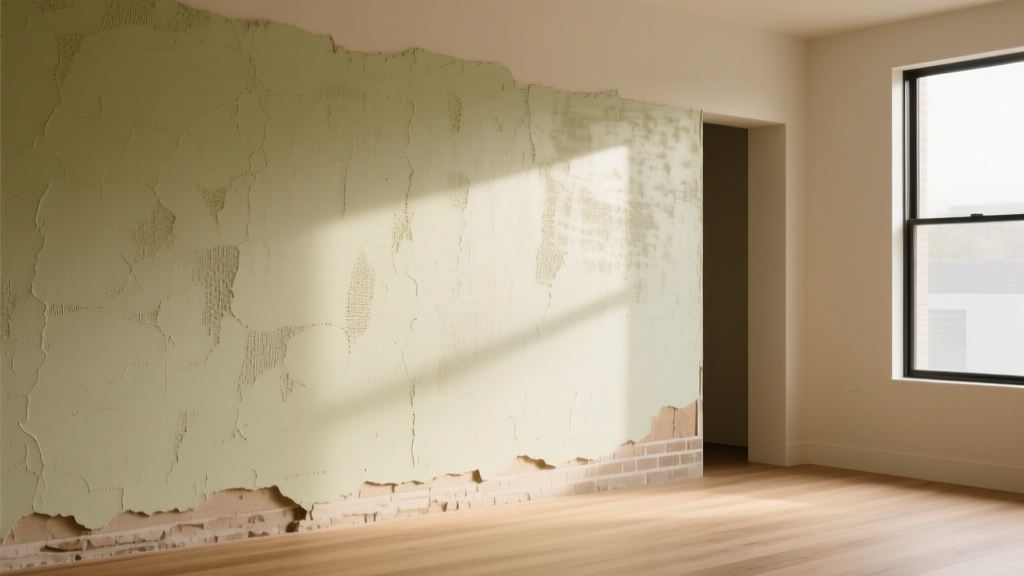
When lime wash walls fail before their expected lifecycle, it is almost always due to substrate incompatibility or application errors, not material degradation. Below are the most common failure modes and their structural remedies.
A common mistake in modern renovations is applying a clear acrylic or siloxane water-repellent sealer over limewash to "protect" it. This destroys the vapor permeability of the system. Moisture migrating from inside the wall becomes trapped behind the acrylic film, freezing and expanding in winter, which blows the limewash and the masonry face right off the wall. Never seal limewash with film-forming polymers.
- Powdering / Chalking: Cause: Rapid drying during application prevented carbonation. Fix: Brush off loose material, mist the wall heavily, and reapply a thinner coat, maintaining surface dampness for 48 hours.
- Flaking / Peeling: Cause: Applied over a painted surface, a primer, or a highly dense cementitious render. Fix: Strip the wall entirely via chemical strippers or low-pressure walnut shell blasting. Limewash must contact raw masonry.
- Efflorescence Staining: Cause: Soluble salts within the masonry are drawn to the surface by moisture. While limewash is breathable and handles this better than paint, heavy salt loads will stain the finish white/yellow. Fix: Identify and eliminate the moisture source driving the salts. Dry-brush the efflorescence; do not wash it with water, which re-dissolves the salts.
The Patina Effect: Weathering vs. Degradation
Understanding the lifespan of lime wash walls requires distinguishing between degradation (structural failure of the coating) and weathering (the aesthetic evolution of the finish). Limewash is designed to weather. Over 5 to 10 years on an exterior wall, rain will gently erode the microscopic peaks of the crystalline structure, particularly on south- and west-facing elevations exposed to UV and driving rain.
This erosion creates the highly sought-after "patina" or mottled, antique look. According to conservation guidelines published by Historic England, this gradual thinning is a feature, not a bug. As the surface micro-layer erodes, fresh lime beneath continues to carbonate, maintaining the protective alkalinity of the wall. True degradation only occurs when the wash wears completely down to the bare substrate, which typically takes 15 to 25 years on exposed exteriors.
Lifecycle Economics and Maintenance Cycles
While the initial application of limewash is more labor-intensive than rolling on acrylic paint, the long-term lifecycle economics heavily favor lime, particularly on masonry structures where moisture management is critical.
Exterior Maintenance Schedule
- Years 1-5: No maintenance required. The finish is actively hardening as deep carbonation completes.
- Years 5-10: Aesthetic weathering becomes pronounced. North-facing walls will look largely unchanged; south-facing walls will show patina.
- Years 10-15: High-exposure areas (eaves, parapets, south elevations) may require a single "refresher" coat. This refresher coat costs approximately 40% less than the initial application because no substrate prep or priming is needed—the new wash chemically bonds to the old calcium carbonate.
- Years 15-25: Full reapplication cycle for heavily exposed commercial or coastal exteriors.
Cost Comparison: 25-Year Lifecycle (per 1,000 sq. ft. Exterior Brick)
| Coating Type | Initial Application Cost | Reapplication Frequency | 25-Year Total Cost | Substrate Health Impact |
|---|---|---|---|---|
| High-End Acrylic Masonry Paint | $3,500 - $5,000 | Every 5-7 Years | $17,500 - $25,000 | Negative (traps moisture, requires scraping) |
| Pre-Mixed Commercial Limewash | $4,000 - $5,500 | Every 12-15 Years | $8,000 - $11,000 | Positive (allows breathing, prevents spalling) |
| Traditional Site-Mixed Limewash | $2,500 - $3,500 (High Labor) | Every 10-12 Years | $7,500 - $10,500 | Positive (highly breathable) |
When evaluating lime wash walls for a project, prioritize substrate testing. Perform a simple water-absorption test: spray a 12-inch square area of the wall with water. If the water beads up or runs off immediately, the substrate is sealed and will not accept limewash without aggressive mechanical abrasion. If the water is absorbed rapidly, leaving a dark, damp patch, the substrate is an ideal candidate for a highly durable, multi-decade limewash finish.