Slaked Lime Deep Dive: Limeworks Putty vs Saint-Astier Hydrated
Compare top slaked lime brands for masonry and plastering. We deep-dive into Limeworks, Saint-Astier, and Carmeuse product lines, specs, and pricing.
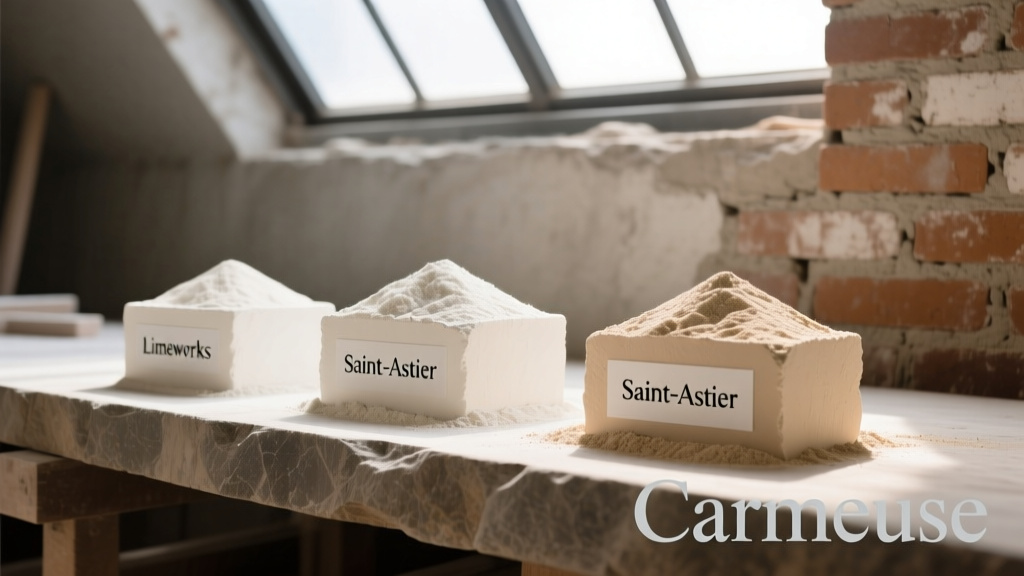
Decoding Slaked Lime: Putty vs. Hydrated Form Factors
Slaked lime (calcium hydroxide, Ca(OH)2) remains the undisputed backbone of breathable masonry, historic conservation, and traditional plastering. Unlike Portland cement, slaked lime cures through carbonation—absorbing atmospheric CO2 to revert to calcium carbonate. In 2026, the building materials market splits slaked lime into two distinct form factors: lime putty (wet, matured calcium hydroxide) and hydrated lime (dry powder). Selecting the correct brand and product line dictates the workability, vapor permeability, and structural longevity of your mortar or plaster.
| Form Factor | Chemical State | Preparation Required | Primary Use Case | Governing Standard |
|---|---|---|---|---|
| Lime Putty (CL/QL) | Wet Ca(OH)2 | None (if pre-matured) | Heritage repointing, fine finish plasters | EN 459-1 (CL90) |
| Type S Hydrated | Dry Ca(OH)2 | 24-hour soak or direct gauging | Masonry mortar gauging, base coat plaster | ASTM C206 |
| Type N Hydrated | Dry Ca(OH)2 (unhydrated oxides present) | Mandatory 16+ hour soak | Rarely used in modern finish plasters | ASTM C207 |
Limeworks.us: Heritage Putty and Specialist Hydrates
Operating under the Ecological Building Systems umbrella, Limeworks.us caters primarily to historic preservationists and specialized plasterers. Their product line is engineered for maximum vapor permeability and chemical compatibility with pre-1900 soft masonry.
Specs: Aged minimum 24 months. Crystal structure undergoes colloidal breakdown during aging, resulting in sub-micron platelets that provide unmatched workability and water retention.
2026 Pricing: ~$85.00 per 5-gallon pail (approx. 60 lbs).
Best Application: 1:2.5 ratio with well-graded sharp sand for repointing historic brick and rubble stone. Do not use in high-exposure exterior environments without a mild pozzolan addition (e.g., 5% metakaolin by volume).
Limeworks also supplies a Type S Hydrated Lime sourced from the Mississippi Lime Company. While it meets ASTM C206, it is marketed specifically for gauging into gypsum plasters to improve trowelability and for creating quick-mix mortars where the 2-year aging timeline of putty is unfeasible.
Saint-Astier: European EN 459-1 Pure Calcium Lines
Saint-Astier, sourced from the Brittany region of France, represents the gold standard for European pure calcium limes. Their geology yields a limestone with >98% calcium carbonate purity before calcination, resulting in a brilliantly white, highly reactive slaked lime.
Product Spotlight: Saint-Astier CL90 (Dry Hydrate & Putty)
The CL90 line is available both as a dry hydrate powder (25kg bags) and as a wet putty in tubs. The dry hydrate is exceptionally fine, passing through a 600-micron sieve with minimal residue. When slaked on-site, it yields a highly thixotropic putty that resists slumping on vertical plaster applications.
- Dry Hydrate Pricing: ~$42.00 per 25kg (55 lb) bag.
- Putty Pricing: ~$60.00 per 15kg tub.
- Mixing Protocol: For on-site slaking of the dry powder, mix at a 1:2 (lime to water) volume ratio. Agitate vigorously, then allow to cool and mature for a minimum of 72 hours before use in finish coats to prevent blistering.
Carmeuse: Commercial-Grade Type S for Modern Masonry
While Limeworks and Saint-Astier dominate the heritage and fine plastering sectors, Carmeuse supplies the high-volume commercial masonry market. Their Franconia Type S Hydrated Lime is the workhorse of modern bricklaying and blockwork.
Product: Franconia Type S Hydrated Lime.
Standard: ASTM C206 (Finishing Hydrated Lime) and ASTM C207 (Building Lime).
2026 Pricing: ~$14.00 per 50lb bag (pallet pricing drops to ~$11.50/bag).
Key Trait: Fully autoclaved during manufacturing. This ensures all magnesium oxides are fully hydrated, eliminating the risk of 'unsoundness' (expansive popping) when gauged directly into Portland cement mortars without a pre-soak.
Carmeuse’s slaked lime is designed to be mixed directly into cementitious mortars (e.g., 1 part Portland cement, 1 part Carmeuse Type S, 6 parts sand) to improve the mortar's elastic modulus, autogenous healing capabilities, and water retention without requiring the extended soaking times demanded by heritage plasters.
Brand Selection Framework: Which Slaked Line Fits Your Project?
Choosing the wrong slaked lime product line leads to catastrophic failure modes, from efflorescence and spalling to plaster delamination. Use this decision matrix to select the correct brand and form factor:
- Pre-1920 Historic Repointing: Choose Limeworks.us Mature Lime Putty. The sub-micron crystal structure ensures maximum capillary action and vapor transmission, protecting soft historic bricks from spalling during freeze-thaw cycles.
- Traditional 3-Coat Plaster (Finish Coat): Choose Saint-Astier CL90 Putty. The high purity and brilliant white base eliminate the need for synthetic pigments and provide a tight, burnished trowel finish.
- Modern Brick/CMU Mortar Gauging: Choose Carmeuse Franconia Type S. The autoclaved dry hydrate allows for immediate silo or bag mixing with OPC (Ordinary Portland Cement) to meet modern compressive strength requirements (ASTM C270 Type N or S mortars).
Critical Mixing and Curing Protocols
Even the highest-grade slaked lime will fail if mixed or cured incorrectly. Adhere to these strict on-site protocols:
1. The Dry Hydrate Pitting Failure (And How to Avoid It)
If you use dry Type S or Type N hydrated lime for a pure lime plaster (without Portland cement), you must soak the powder in excess water for a minimum of 24 hours. Mixing dry hydrated lime powder directly with sand and applying it to a wall will result in unhydrated particles absorbing moisture from the air weeks later, expanding, and 'popping' out of the plaster surface, leaving 1/4-inch craters.
2. Mixer RPM Limits
When mixing slaked lime putty with aggregate, use a low-RPM mortar mixer (ideally < 300 RPM). High-speed drill attachments entrain microscopic air bubbles into the putty. While this increases workability, it severely reduces the compressive strength and abrasion resistance of the cured mortar.
3. Carbonation Curing Environments
Slaked lime does not 'dry'; it carbonates. It requires both CO2 and moisture to complete the chemical reversion to calcium carbonate.
- Too Dry: If the wall surface is exposed to direct sun or high wind, the surface will crust over, sealing off CO2 and halting the carbonation of the inner mortar joint.
- Too Wet: Submerging or constantly misting the lime mortar displaces atmospheric CO2, stalling the cure.
- Protocol: Mist the substrate before application, protect from direct wind/sun with burlap, and lightly mist the curing mortar once daily for the first 7 days if ambient humidity drops below 50%.
References and Industry Standards
For further technical specifications regarding slaked lime applications and historic preservation standards, consult the following authoritative resources:
- National Park Service (NPS) Preservation Brief 2: Repointing Mortar Joints in Historic Masonry Buildings - Details the necessity of high-vapor-permeability slaked lime putties in pre-1930 masonry conservation.
- ASTM C206 / C206M - Standard Specification for Finishing Hydrated Lime - The governing standard for Type S hydrated lime purity, residue limits, and plasticity emulsion requirements.
- Society for the Protection of Ancient Buildings (SPAB) Technical Advice on Mortars - Comprehensive guidelines on mixing ratios, aggregate selection, and curing protocols for non-hydraulic slaked lime mortars.